
Muriatic acid lowers pool pH and total alkalinity. When pH climbs too high, chlorine loses its power, water turns cloudy, and scale builds on surfaces. Adding muriatic acid to your pool brings chemistry back into balance so your sanitizer works and your water stays clear.
Quick Answer: Muriatic acid lowers pool pH and total alkalinity, prevents calcium scale, and helps chlorine work more effectively. It does not sanitize water or remove calcium hardness.
What Does Muriatic Acid Do for a Pool
That is the short answer. The full picture is a bit more useful.
What Is Muriatic Acid and What Does It Do in a Pool?
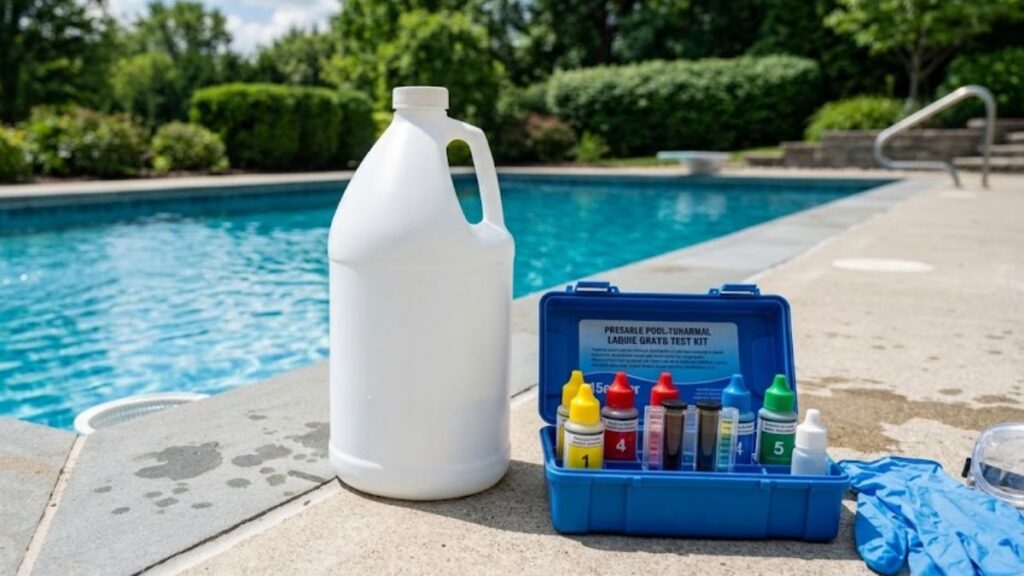
Muriatic acid is a diluted form of hydrochloric acid, typically sold at 31.45% concentration for pool use. It is a clear to pale yellow liquid with a sharp smell. When you add it to pool water, it releases hydrogen ions that immediately lower pH.
Pool water needs to stay between pH 7.2 and 7.6. When pH drifts above 7.8, two things happen fast. Your chlorine becomes far less effective at killing bacteria, and calcium starts dropping out of solution and sticking to your tile, plaster, and equipment.
What Does Muriatic Acid Do for a Pool
Muriatic acid in pools fixes both problems by pulling pH back into range.
According to the Pool and Hot Tub Alliance, pH and total alkalinity are the two most critical measurements in residential pool water chemistry. Getting them wrong affects every other chemical you add.
What Does Muriatic Acid Do to Pool Water Specifically?
Here is the thing: most guides list the benefits but skip the chemistry that actually explains why it works. Let me be more specific.
It Lowers Pool pH
This is the primary job. At pH 7.8, chlorine is only about 33% active as a sanitizer. At pH 7.2, that number jumps to around 63%. That is not a minor difference. You could be spending double the money on chlorine and getting half the results, purely because pH is too high.
Muriatic acid drops pH by introducing hydrogen ions that neutralize the alkaline carbonates in pool water. It acts fast. You will usually see a measurable drop within 30 minutes of adding a correctly diluted dose.
It Lowers Total Alkalinity
Total alkalinity acts like a pH buffer. When it is too high, above 120 ppm, pH becomes almost impossible to hold in range. You add acid, pH drops, then it climbs back up within a day or two. Pool owners often blame the acid for not working. The real problem is high alkalinity fighting every correction.
Muriatic acid lowers alkalinity too, but the technique is different. To target alkalinity, you use what pool professionals call slug dosing: pour the acid into one concentrated spot with the pump off, let it sit for 10 minutes, then circulate. That concentrated dose hits the alkalinity buffer much harder than a dispersed dose does.
It Prevents Calcium Scale
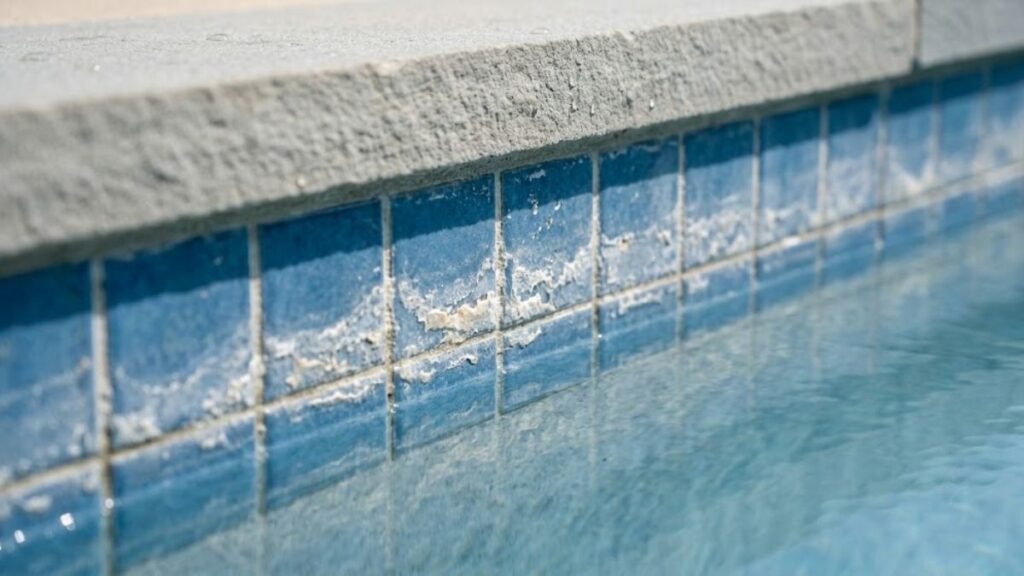
When pH stays high, calcium carbonate comes out of solution and sticks to every surface it touches. Tile lines, grout, plaster, salt cell plates, heater cores. Muriatic acid use prevents this by keeping water chemistry in the range where calcium stays dissolved.
It Improves Chlorine Efficiency
Muriatic acid does not add chlorine or act as a sanitizer. What it does is restore the conditions where chlorine can do its actual job. Many pool owners with persistent algae or cloudy water are actually dealing with a pH problem, not a chlorine shortage.
Quick note: if you find yourself adding shock every week with little improvement, test pH before reaching for more chlorine. High pH is responsible for chlorine loss more often than people expect.
What Muriatic Acid Does NOT Do
This part is missing from most guides, and it causes real confusion.
Muriatic acid does not kill algae directly. It does not sanitize pool water. It does not raise free chlorine. It does not fix cloudy water caused by poor filtration. And it does not lower calcium hardness.
That last one surprises people. Will muriatic acid lower hardness in a pool? No. Calcium hardness is a separate measurement from alkalinity. High calcium hardness requires partial draining and refilling, not acid. Muriatic acid affects how calcium behaves in water, but it does not remove calcium from the water.
If your pool is cloudy and calcium hardness is high, acid alone will not solve it.
⚠️ Warning: Never mix muriatic acid with chlorine or pool shock. Dangerous fumes can form. Add only one chemical at a time and allow the pool to circulate before adding another.
Signs Your Pool Needs Muriatic Acid
You should test before assuming, but these are the reliable signals:
✓ pH reading is above 7.6 on a drop-test kit
✓ Total alkalinity is above 120 ppm
✓ Chlorine seems to disappear faster than it should
✓ White or gray scale is forming on tile or at the waterline
✓ Water looks slightly hazy even after shocking
✓ Swimmers complain of eye irritation despite normal chlorine levels
The Taylor Technologies K 2006 drop test kit is the standard for accurate pH and alkalinity readings. Test strips work in a pinch, but they carry enough margin of error to push you toward the wrong decision.
How Much Muriatic Acid Should You Add?
Dose depends on three things: current pH, target pH, and pool volume. There is no universal answer.
As a rough guide using 31.45% strength muriatic acid:
| Pool Size | Lower pH by 0.2 | Lower pH by 0.4 |
|---|---|---|
| 10,000 gallons | 13 fl oz | 26 fl oz |
| 15,000 gallons | 20 fl oz | 40 fl oz |
| 20,000 gallons | 26 fl oz | 52 fl oz |
| 25,000 gallons | 32 fl oz | 64 fl oz |
Never try to fix a large pH swing in one dose. Split corrections over two sessions with a retest in between.
For an exact calculation based on your current readings, the free muriatic acid pool calculator does the math for your specific pool size and target pH in seconds.
Muriatic Acid vs Dry Acid: Which Is Better for Pools?
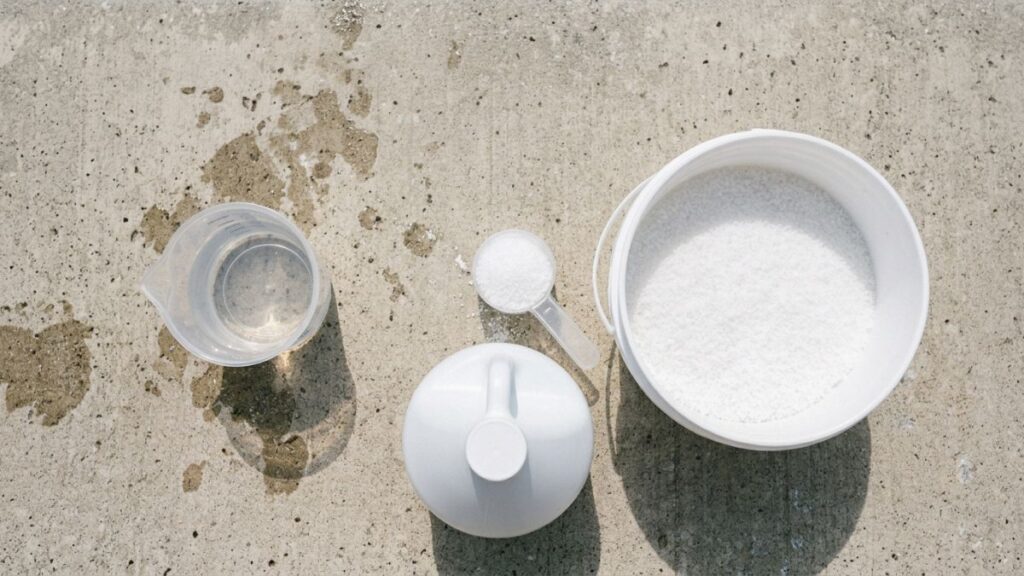
Some pool owners prefer dry acid (sodium bisulfate) because it is easier to handle. Both lower pH. The question is which fits your situation.
Quick Comparison
| Option | Best For | Key Benefit | Limitation |
|---|---|---|---|
| Muriatic acid (liquid) | Large pools, high pH correction, alkalinity reduction | Fast-acting, low cost, works on alkalinity | Fumes, requires dilution, more handling care |
| Dry acid (sodium bisulfate) | Smaller pools, beginners, enclosed spaces | Easier to handle, no strong fumes | Slower acting, costs more per dose, less effective on alkalinity |
Or maybe I should say it this way: dry acid is safer to handle but costs roughly 2 to 3 times more per pH point corrected. For a large pool with persistent high pH, muriatic acid is the practical choice. For a small above-ground pool where you are adding tiny doses occasionally, dry acid is more forgiving.
Some experts argue dry acid is always preferable due to safety. That is valid for situations where ventilation is limited or handling acid safely is a genuine concern. But for most outdoor residential pools, muriatic acid used correctly is the more cost-effective and equally reliable option.
Why Does Pool pH Keep Rising After Adding Muriatic Acid?
This is one of the most common frustrations pool owners search for, and almost no guide addresses it clearly.
pH rebounds after acid treatment for four main reasons:
High total alkalinity. This is the most common cause. Alkalinity is a pH buffer. If TA is still above 120 ppm, the water has enough buffering capacity to push pH back up within 24 to 48 hours. The acid lowered pH temporarily, but the underlying pressure was not removed. Lowering alkalinity using slug dosing is the actual fix.
Aeration. Running waterfalls, fountains, jets, or aerating features drives off carbon dioxide, which raises pH naturally. This is why pools with water features need more frequent acid additions.
Saltwater chlorinator systems. Salt chlorinators produce hypochlorous acid and sodium hydroxide. The hydroxide raises pH continuously as a byproduct of chlorine generation. Saltwater pool owners typically need muriatic acid more regularly than traditional chlorine pool owners.
New plaster or fresh pool surfaces. Fresh plaster leaches calcium hydroxide into water for weeks after installation. This drives pH up persistently regardless of how much acid you add. It normalizes over time.
If your pH keeps climbing after treatment, test alkalinity before adding more acid. The problem is usually there. Never add muriatic acid based on guesswork. Always test your pool water first and use a reliable dosage calculator to avoid overcorrecting the pH.
Never add muriatic acid based on guesswork. Always test your pool water first and use a reliable dosage calculator to avoid overcorrecting the pH.
Is Muriatic Acid Safe for Swimming Pools?
Used correctly, yes. Muriatic acid is one of the most widely used pool chemicals worldwide precisely because it works reliably when handled properly.
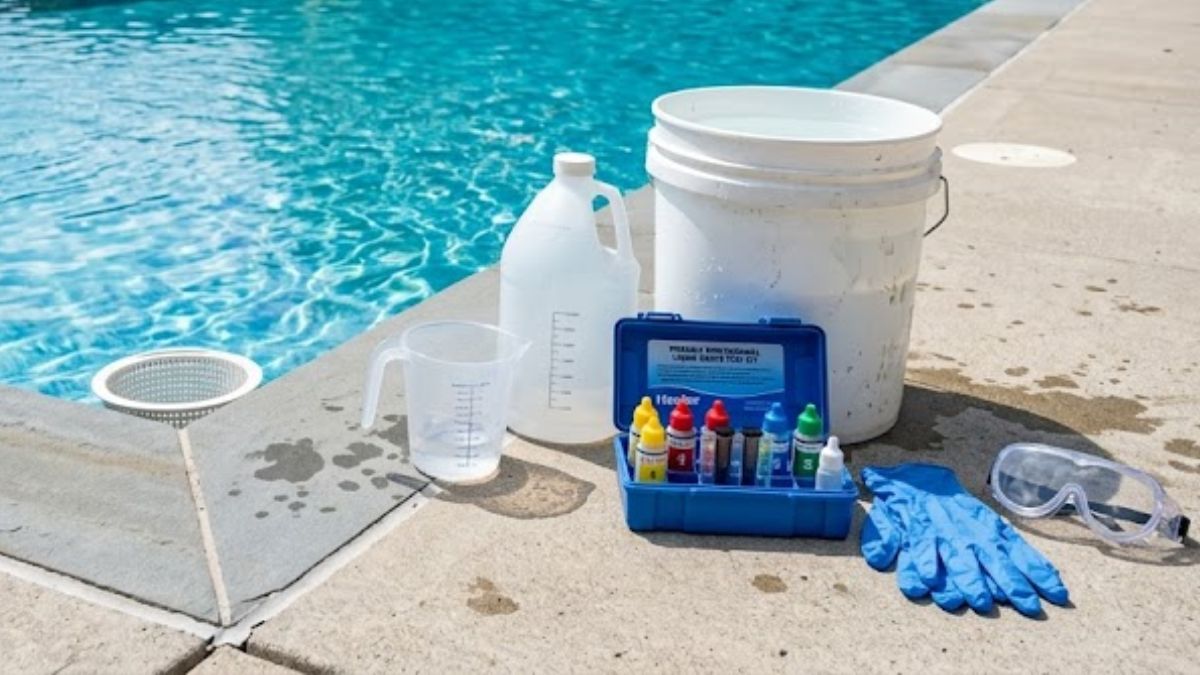
The safety requirements are straightforward: gloves, goggles, old clothing, acid into water never water into acid, dilute before adding, pour near return jets with the pump running, wait 30 minutes minimum before swimming and retest pH first.
For full safety steps and the correct pouring technique, read the complete guide on how to add muriatic acid to your pool.
This guide covers outdoor residential pools. It does not address muriatic acid use in commercial pools, spas, or indoor facilities, where ventilation and regulatory requirements differ significantly.
Common Questions About Muriatic Acid in Pools
Q: What does muriatic acid do in a pool? It lowers pH and total alkalinity. When pH is too high, chlorine loses effectiveness and calcium scale forms on surfaces. Muriatic acid corrects both conditions and restores water balance so sanitizers can work properly.
Q: Does muriatic acid lower pool pH? Yes. It is one of the fastest and most effective ways to lower pool pH. A correctly dosed treatment typically shows a measurable pH drop within 30 minutes.
Q: Does muriatic acid lower alkalinity in a pool? Yes, but the technique matters. For alkalinity reduction, turn the pump off after pouring the acid and let it concentrate in one area for 10 minutes before circulating. This slug dose method is far more effective on alkalinity than a dispersed pour.
Q: Does muriatic acid lower chlorine levels? No. Muriatic acid does not affect free chlorine directly. It lowers pH, which actually makes existing chlorine more effective. Many pool owners see improved chlorine performance after correcting pH with acid.
Q: Will muriatic acid lower hardness in a pool? No. Calcium hardness requires partial draining and refilling to reduce. Muriatic acid affects pH and alkalinity but does not remove calcium from pool water.
Q: Can I swim after adding muriatic acid to my pool? Wait at least 30 minutes for a small dose with the pump running, and retest pH before anyone swims. For larger doses, wait 4 hours. pH should be between 7.2 and 7.6 before swimming.
The Bottom Line
Muriatic acid does three things in a pool: lowers pH, reduces total alkalinity, and prevents calcium scale. It makes chlorine more effective by restoring the water chemistry conditions where sanitization actually works.
It does not kill algae, sanitize water, or lower calcium hardness. Using it correctly means testing first, calculating the right dose, diluting before adding, and retesting before swimming.
If your pool pH keeps rising after treatment, the answer is almost always high total alkalinity, not a problem with the acid itself.