
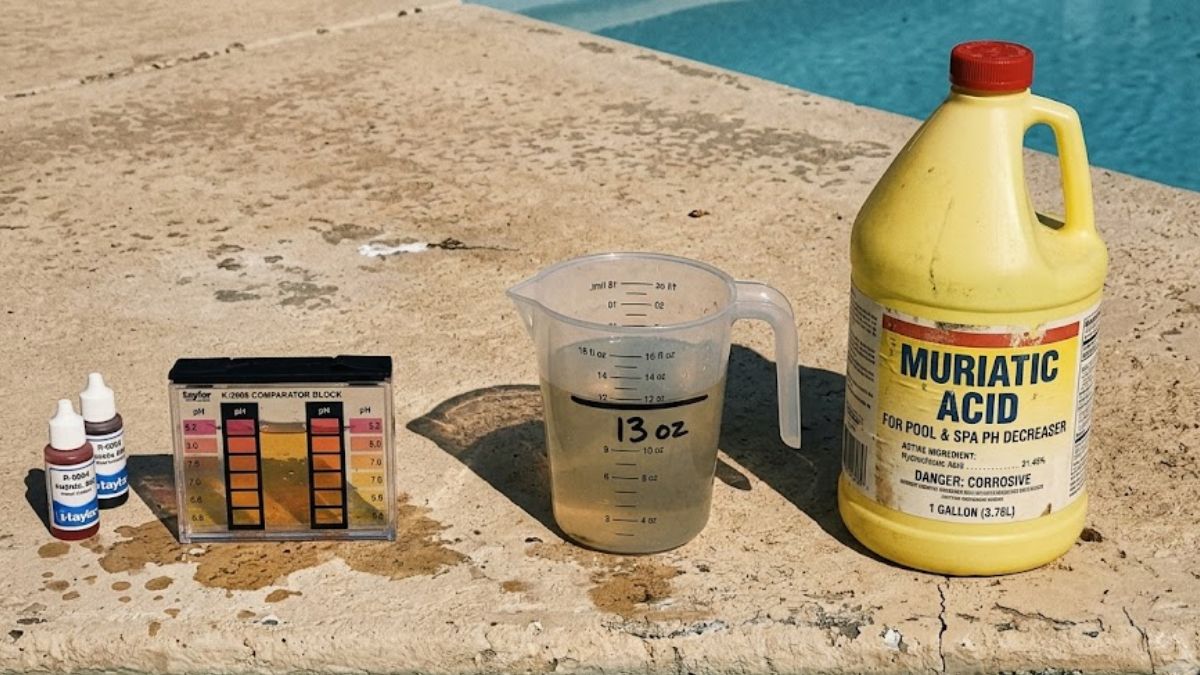

The amount of muriatic acid you need depends on three things: your current pH, your pool volume, and the acid strength you are using. For a 10,000-gallon pool at pH 7.8, you need about 13 fl oz of 31.45% muriatic acid to drop pH to 7.4. Use more for larger pools, less for smaller ones.
Quick Answer:
How Much Muriatic Acid to Lower Pool pH: Exact Doses
The amount of muriatic acid needed to lower your pool’s pH depends on your pool size, current pH level, total alkalinity (TA), and the strength of the acid you’re using. As a general rule, a 10,000-gallon pool with a pH of 7.8 needs about 13 fluid ounces of 31.45% muriatic acid to reach a safer pH of 7.4. Always test your water before adding acid, measure carefully, and retest after 4 hours to avoid overcorrecting the pH.
If pH keeps climbing back after treatment, the problem is almost always high total alkalinity, not the acid dose. That is covered below.
Why Getting the Dose Right Matters
How Much Muriatic Acid to Lower Pool pH: Exact Doses
Too little acid and pH barely moves. Too much and pH drops below 7.0, which corrodes metal fittings, irritates swimmers, and etches plaster surfaces.
Most pool owners underdose on the first attempt, then overdose trying to compensate. Both mistakes cost time and money.
The right dose comes from your actual test results, not a guess. Always test before adding anything.
What You Need Before Calculating Dose
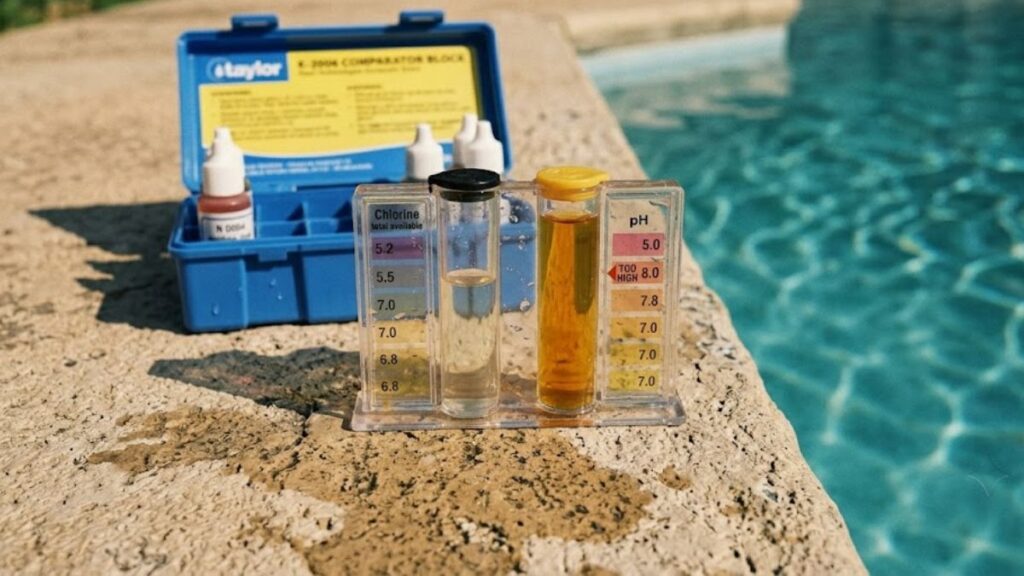
Three numbers. That is all.
✓ Current pH from a drop-test kit (not strips, which have too much margin of error)
✓ Pool volume in gallons
✓ Acid strength printed on the jug: 31.45%, 20%, or 14.5%
If you do not know your pool volume, multiply length x width x average depth x 7.48 for a rectangular pool. For oval or kidney shapes, most pool manufacturers include volume in the documentation.
Test with the Taylor Technologies K-2006 or equivalent drop-test kit. Accurate readings mean accurate dosing.
Muriatic Acid Dosage Chart by Pool Size
These doses use 31.45% strength muriatic acid, which is the standard concentration sold at most hardware and pool supply stores.
Lower pH from 7.8 to 7.4
| Pool Size | Dose Needed |
|---|---|
| 10,000 gallons | 13 fl oz |
| 15,000 gallons | 20 fl oz |
| 20,000 gallons | 26 fl oz |
| 25,000 gallons | 32 fl oz |
| 30,000 gallons | 38 fl oz |
Lower pH from 8.0 to 7.4
| Pool Size | Dose Needed |
|---|---|
| 10,000 gallons | 26 fl oz |
| 15,000 gallons | 39 fl oz |
| 20,000 gallons | 52 fl oz |
| 25,000 gallons | 65 fl oz |
| 30,000 gallons | 78 fl oz |
For doses above 32 fl oz, split into two sessions. Add the first dose, run the pump for 4 hours, retest, then add the second dose if needed.
Using a Different Acid Strength? Here Is the Conversion
Many stores sell muriatic acid at different concentrations. The label will say 31.45%, 20%, or 14.5%. Using the wrong strength without adjusting your dose causes either undercorrection or overdose.
| Acid Strength | Multiply Chart Dose By |
|---|---|
| 31.45% (standard) | 1.0 (no change) |
| 20% | 1.57 |
| 14.5% | 2.17 |
So if the chart says 13 fl oz for your pool and you have 20% acid, you actually need 13 x 1.57 = about 20 fl oz.
For an exact calculation based on your specific readings, the free muriatic acid pool calculator handles all the math including acid strength adjustment.
How to Add Muriatic Acid to Lower Pool pH
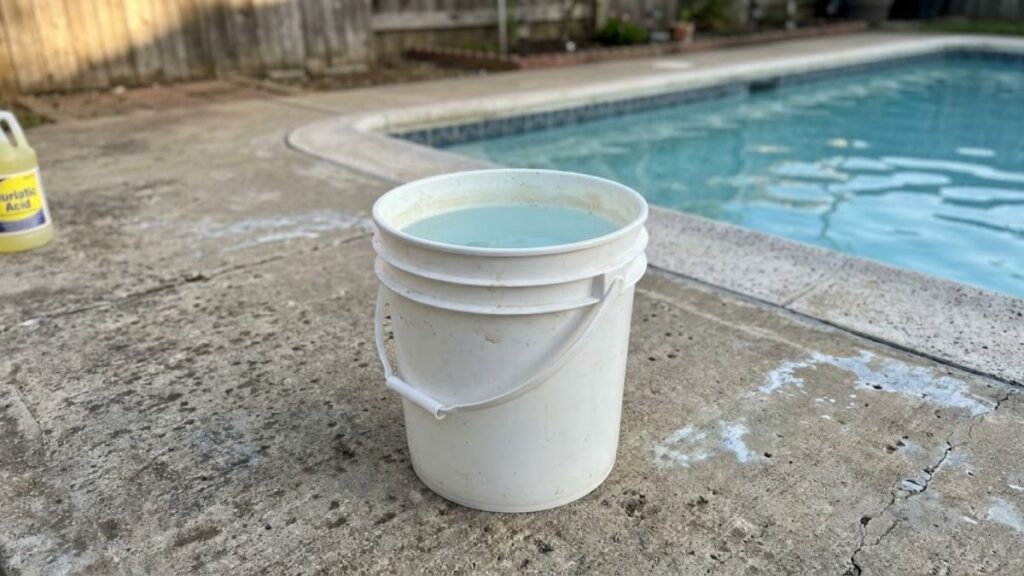
To lower pool pH with muriatic acid correctly, follow these steps:
- Test pH and confirm it is above 7.6
- Calculate your dose using the chart or calculator above
- Put on gloves and goggles
- Fill a plastic bucket three-quarters full with pool water
- Pour the measured acid slowly into the bucket, acid into water, never reverse
- With the pump running, pour slowly near the deep end return jets
- Brush the pool floor for 2 minutes after pouring
- Run the pump for 4 hours, then retest before swimming
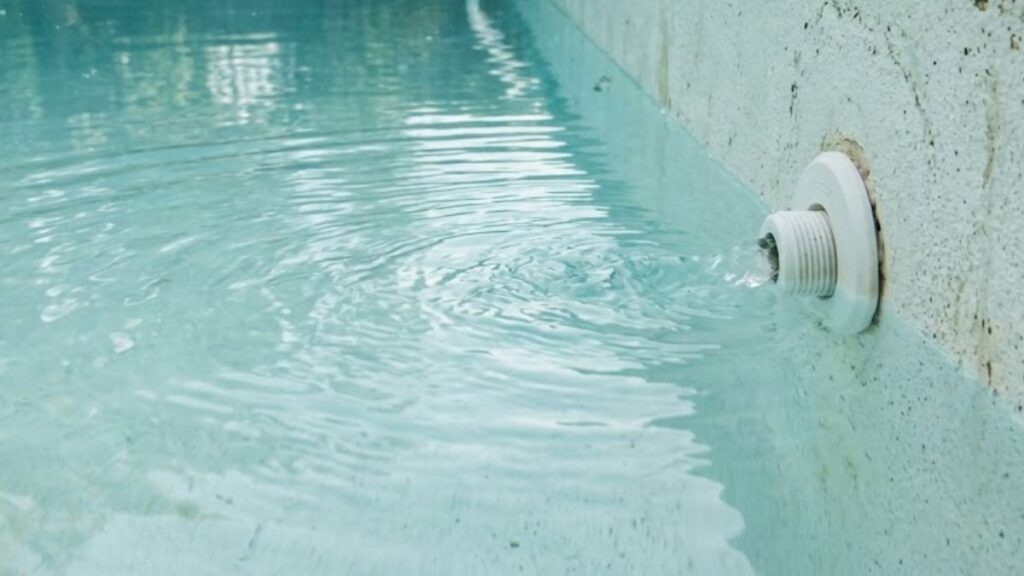
Never dump acid directly from the jug into one spot. It concentrates and sits on the pool floor, etching surfaces. Always dilute first.
The full step-by-step safety guide is in the how to add muriatic acid to pool article.
We’ve found that many pool owners assume they need more acid when the pH doesn’t change immediately. In most cases, the real issue is high total alkalinity, not the acid dose. We always recommend testing both pH and TA before adding a second dose—it saves chemicals, protects pool surfaces, and delivers more consistent results.
Why High Alkalinity Changes Your Dose
This is the part most guides skip, and it causes real frustration.
Total alkalinity acts as a pH buffer. When TA is above 120 ppm, it absorbs acid before that acid can drop pH. You add the correct dose, pH barely moves, and you wonder if the acid even worked.
It did. The alkalinity consumed it.
If your TA is between 100 and 120 ppm, the chart doses above work reliably. If TA is above 120 ppm, you will need to lower alkalinity first before pH corrections hold. That means a different technique called slug dosing, which concentrates acid in one area with the pump off.
According to the Pool and Hot Tub Alliance, ideal total alkalinity for residential pools is 80 to 120 ppm. Keeping TA in this range makes pH far easier to manage.
pH Not Dropping After Adding Muriatic Acid? Here Is Why
You added the right dose. pH barely moved. Sound familiar?
Four common reasons this happens:
Total alkalinity is too high. Already covered above. Test TA first if pH seems unresponsive.
You used the wrong acid strength. 20% acid looks the same as 31.45% acid in the jug. If you used the lower concentration without adjusting the dose, you may have added half what you actually needed.
The pump was off. Acid that sits undiluted in one spot has a very local effect. It does not treat the whole pool. Always add with the pump running and circulate for at least 4 hours before retesting.
Saltwater chlorinator is fighting back. Salt chlorinators continuously produce a byproduct that raises pH. Saltwater pool owners often see pH climb back to 7.8 or higher within 24 hours even after a correct acid treatment. This is normal. It means you need to lower TA to the lower end of the range, around 70 to 80 ppm, so pH rises more slowly and stays manageable between treatments.
Dosage for Saltwater Pools
Saltwater pools need muriatic acid more frequently than traditional chlorine pools. The salt chlorinator produces hydroxide ions that raise pH continuously as a byproduct of chlorine generation.
Use the same dosage chart, but target a slightly lower pH of 7.2 to 7.4 rather than 7.4 to 7.6. That buffer gives you more time before pH climbs back out of range.
Many saltwater pool owners find that keeping TA at the lower end of normal, around 70 to 80 ppm instead of 100 to 120 ppm, significantly reduces how often muriatic acid is needed. Less alkalinity means less resistance to the continuous pH rise from the chlorinator.
What Happens If You Add Too Much Muriatic Acid
pH drops below 7.0. Here is what that means in practice:
✓ Swimmers get red eyes and skin irritation
✓ Metal fittings, ladders, and heater components begin corroding
✓ Plaster and vinyl surfaces can etch or discolor
✓ Chlorine becomes hyperactive and burns off faster than normal
The fix is aeration. Point your return jets upward, run any water features or fountains, and let carbon dioxide exchange naturally raise pH. Do not add more chemicals until pH stabilizes.
If pH dropped very low, below 6.8, add soda ash (sodium carbonate) in small amounts, a quarter pound at a time, and retest after each addition. Avoid adding large amounts at once or pH will overshoot in the other direction.
Frequently Asked Questions
Q: How much muriatic acid do I add to lower pool pH from 8.0 to 7.4?
For a 10,000-gallon pool using 31.45% acid, you need about 26 fl oz. Split this into two doses, retest after the first, and adjust before adding the second. Never try to fix a 0.6 pH drop in one shot.
Q: How long does muriatic acid take to lower pool pH?
You will see a measurable pH drop within 30 minutes of adding a correctly diluted dose with the pump running. Wait 4 hours and retest before making any additional adjustments or allowing swimming.
Q: Why is my pool pH not going down after adding muriatic acid?
The most common reason is high total alkalinity above 120 ppm. Alkalinity buffers pH and absorbs acid before it can lower pH. Test TA first. If it is high, lower alkalinity with slug dosing before trying to correct pH.
Q: How much muriatic acid for a 20,000-gallon pool?
To drop pH by 0.4 points in a 20,000-gallon pool, you need about 52 fl oz of 31.45% muriatic acid. If using 20% strength acid, multiply by 1.57, which gives you about 82 fl oz.
Q: Can I add muriatic acid twice in one day?
Yes, but wait at least 4 hours between doses and retest pH each time. Never add a second dose without testing first. Two correct doses are always safer than one large dose.
The Bottom Line
For a 10,000-gallon pool at pH 7.8, use 13 fl oz of 31.45% muriatic acid. Scale up for larger pools using the chart above. Adjust for acid strength if your jug is not 31.45%.
If pH does not respond, test total alkalinity before adding more acid. High TA is the real problem in most cases where pH refuses to drop.
Use the muriatic acid pool calculator for a precise dose based on your exact readings.