
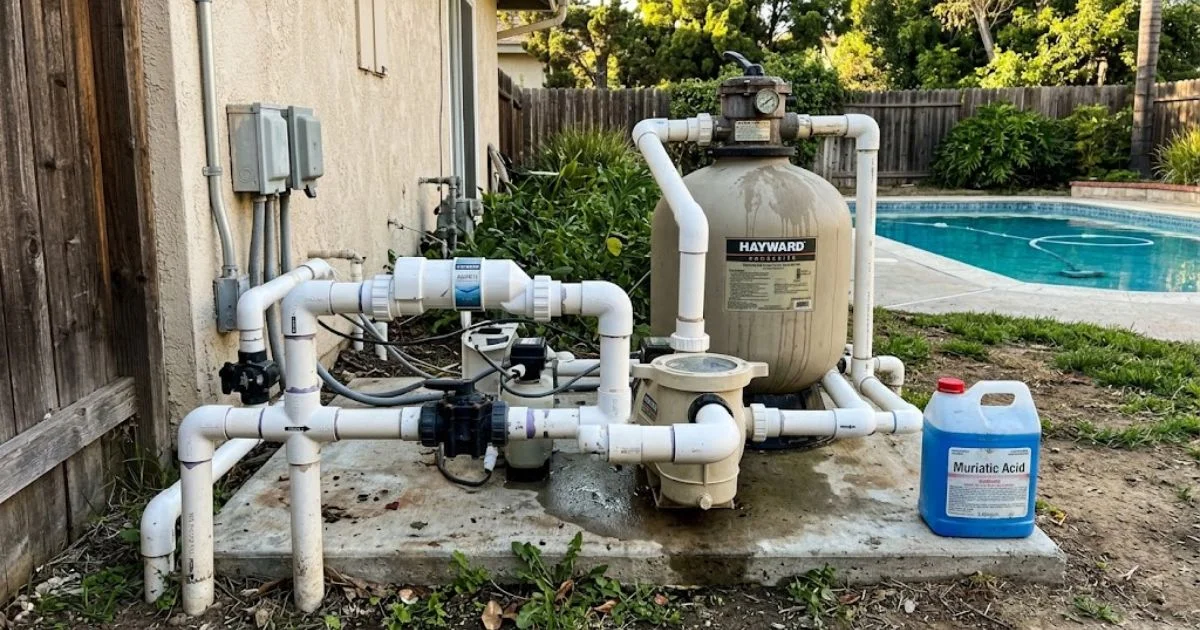

Saltwater pools need muriatic acid more often than traditional chlorine pools. The salt chlorinator continuously produces a byproduct that raises pH, so even a perfectly balanced saltwater pool will need acid every few days to a week during swimming season. The key difference: saltwater pools work better with total alkalinity kept lower, around 60 to 80 ppm instead of the standard 80 to 120 ppm. That lower TA makes pH rise more slowly and keeps your acid doses manageable.
Muriatic Acid for Salt Water Pool
If your saltwater pool pH climbs back to 8.0 three days after you treated it, nothing is wrong with your pool. That is how saltwater systems work. The fix is not more acid every few days forever. The fix is understanding why pH rises and adjusting your strategy once.
Why Saltwater Pools Need More Muriatic Acid Than Chlorine Pools
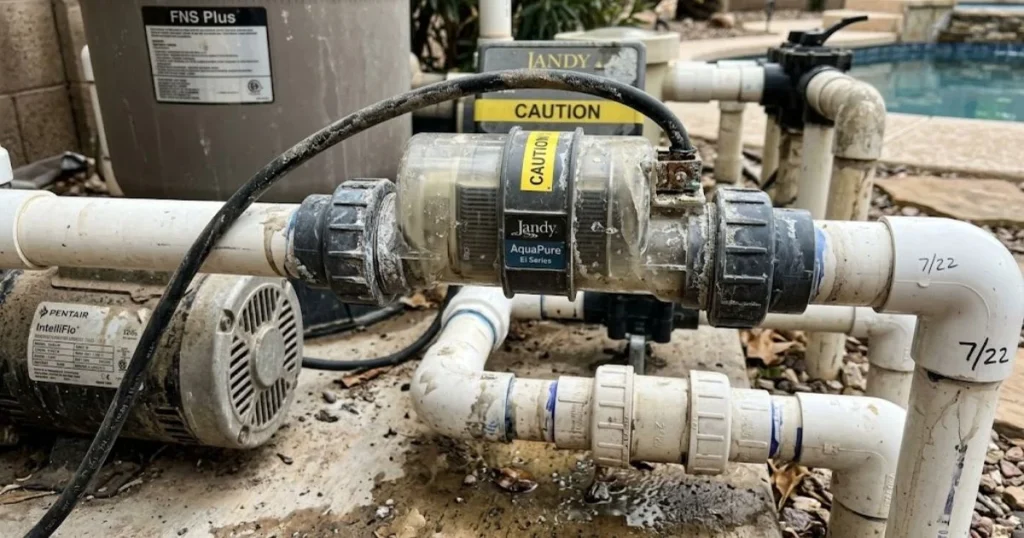
The salt chlorinator is the reason.
When a salt cell converts dissolved salt into chlorine through electrolysis, it produces sodium hydroxide as a byproduct. Sodium hydroxide is a strong base. It raises pH continuously as long as the chlorinator is running.
This is not a malfunction. Every salt chlorinator does this. As pool chemistry experts on Trouble Free Pool explain, the complete chlorination cycle through a salt water generator is pH-neutral in theory, but the extended pump runtimes needed to produce enough chlorine create more aeration than most chlorine pools experience, and that aeration is what actually drives pH upward.
The practical result: your saltwater pool pH will rise even when water chemistry is otherwise perfect. Planning for weekly acid additions is not a problem to solve. It is normal saltwater pool maintenance.
Muriatic Acid for Salt Water Pool
The Saltwater Pool Alkalinity Rule Most Guides Get Wrong
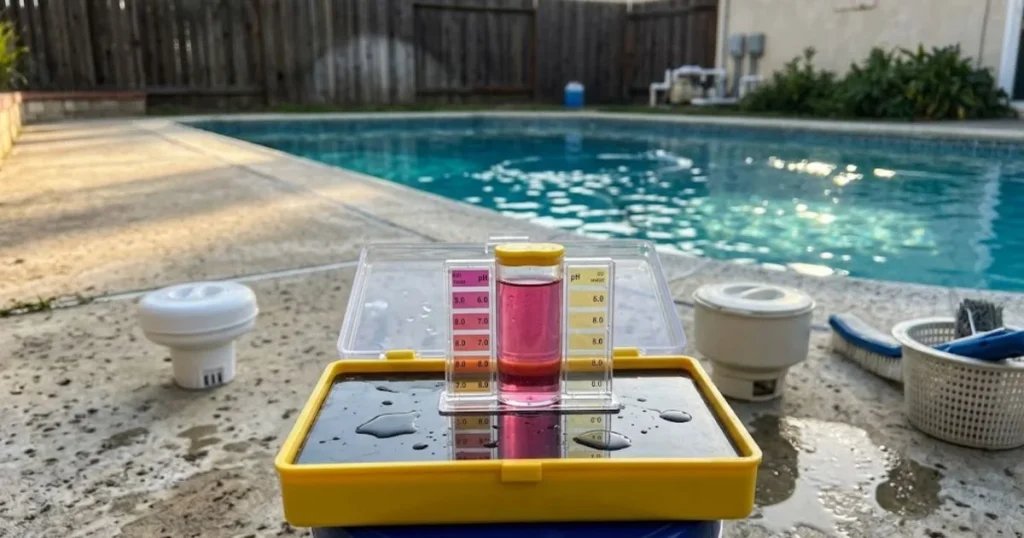
Standard pool guides tell you to keep total alkalinity between 80 and 120 ppm. That is correct for traditional chlorine pools.
For saltwater pools, that range is too high.
According to Beatbot’s pool chemistry team, saltwater pools where pH rises frequently are often easier to manage with total alkalinity kept at the lower end, around 60 to 70 ppm, rather than the standard 80 to 120 ppm range.
Here is why this matters. High alkalinity buffers pH strongly. In a chlorine pool, that is helpful. In a saltwater pool where pH is already rising continuously from the chlorinator, that same buffering works against you. The alkalinity holds pH up when you want it to come down.
When you lower TA to 60 to 80 ppm in a saltwater pool:
✓ pH still rises from the chlorinator, but more slowly
✓ Each acid dose brings pH down further and it stays down longer
✓ You need fewer acid treatments per week
✓ Your water chemistry stabilizes into a manageable weekly routine
This is the single biggest change saltwater pool owners can make to reduce how often they add muriatic acid.
How Much Muriatic Acid to Add to a Saltwater Pool
The dosage calculation is the same as any pool. It depends on your pool volume, current pH, and acid strength.
For 31.45% strength muriatic acid in a saltwater pool, use these as your starting reference:
| Pool Size | Drop pH from 8.0 to 7.4 | Drop pH from 7.8 to 7.4 |
|---|---|---|
| 10,000 gallons | 26 fl oz | 13 fl oz |
| 15,000 gallons | 39 fl oz | 20 fl oz |
| 20,000 gallons | 52 fl oz | 26 fl oz |
| 25,000 gallons | 65 fl oz | 32 fl oz |
Saltwater pool targeting tip: Aim for a lower target pH of 7.2 to 7.4 rather than 7.4 to 7.6. The chlorinator will push pH up within days. Starting lower gives you more time before the next treatment is needed.
For your exact dose every time, the free muriatic acid pool calculator calculates by pool size, current pH, target pH, and acid strength in one step.
Step by Step: How to Add Muriatic Acid to a Saltwater Pool
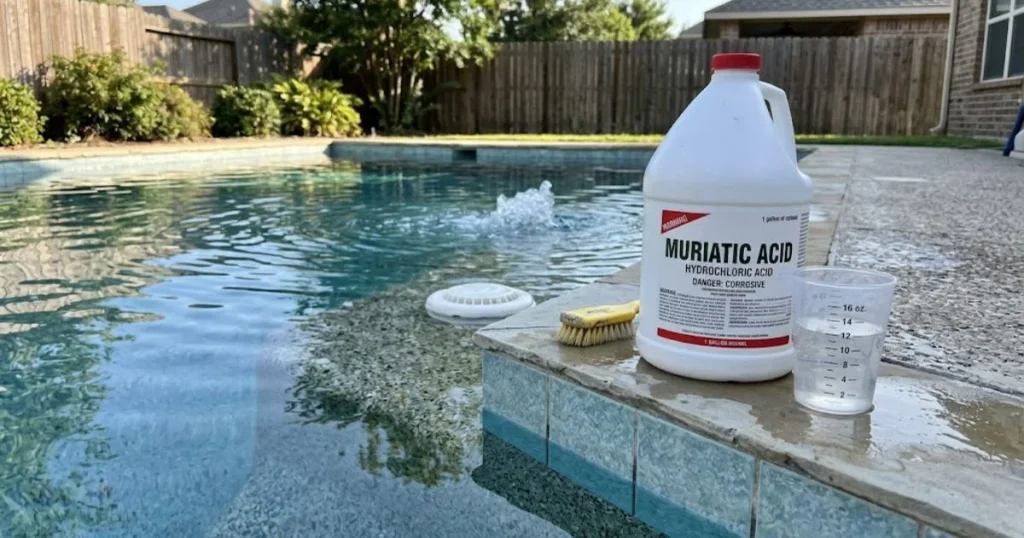
The method is the same as a regular pool with one key addition: test both pH and total alkalinity every time, not just pH.
- Test pH and TA with a drop-test kit
- Calculate dose from the table above or the calculator
- Gloves and goggles on
- Dilute acid in a bucket three-quarters full of pool water
- Pour near return jets in the deep end with the pump running
- Brush pool floor for 2 minutes after pouring
- Run pump 4 hours then retest both pH and TA
Full safety guide: how to add muriatic acid to pool.
How to Lower Total Alkalinity in a Saltwater Pool
If your TA is above 100 ppm, lowering it is the most effective long-term fix for persistent pH rise in a saltwater pool.
Use the slug dosing method:
- Confirm TA is above 100 ppm
- Turn the pump OFF
- Dilute acid in bucket and pour into one concentrated spot in the deep end
- Wait 10 to 15 minutes, then turn pump on
- Point return jets upward to aerate for 24 to 48 hours
- Retest TA before repeating
- Continue until TA reaches 60 to 80 ppm
Do not panic when pH drops low after slug dosing. Aeration brings it back naturally without chemicals.
Does Your Salt Cell Output Level Affect How Much Acid You Need?
Yes. Almost no guide mentions this.
Salt chlorinators let you set the output percentage from 0% to 100%. Higher output produces more chlorine but also creates more aeration inside the cell, which raises pH faster.
Test your free chlorine before assuming you need high cell output. The target is 2 to 4 ppm. If you are testing at 6 or 7 ppm, you are overproducing chlorine and driving up pH unnecessarily. Reducing cell output to match actual chlorine demand cuts your muriatic acid usage noticeably.
Salt Water Pool pH Schedule: What Normal Looks Like
| Testing Frequency | Action |
|---|---|
| Every 2 to 3 days | Test pH. Add muriatic acid if above 7.6 |
| Weekly | Test TA, free chlorine, and salt level |
| Monthly | Inspect and clean salt cell |
| Every season | Test calcium hardness and cyanuric acid |
pH rising every 3 to 5 days is normal. If it rises faster than every 2 days despite correct TA levels, your cell output may be set too high.
One of the most common mistakes we see is saltwater pool owners adding muriatic acid down to pH 7.4, then immediately running water features or jets that aerate heavily and push pH back to 7.8 the same day. If you have waterfalls, fountains, or a spa spillover, run them after testing pH, not right after adding acid. Give the acid treatment 4 to 6 hours to stabilize before aerating heavily.
Muriatic Acid vs Dry Acid for Saltwater Pools
Both lower pH. For saltwater pools specifically, the choice matters more than for traditional pools because you are adding acid frequently.
| Option | Best For | Cost Per Treatment | Key Limitation |
|---|---|---|---|
| Muriatic acid 31.45% | Saltwater pools with regular treatment | Lowest | Fumes, requires dilution |
| Dry acid (sodium bisulfate) | Occasional small corrections | 2-3x higher | Introduces sulfate ions over time |
| Low-fume muriatic acid 20% | Same use, easier handling | Low | Need larger dose than 31.45% |
For saltwater pools where acid additions happen weekly, muriatic acid is the practical and cost-effective choice.Sensorex notes that sodium bisulfate can damage surfaces and coatings in pools over time, which makes muriatic acid the preferred option for regular saltwater pool maintenance.
Dry acid has its place for occasional fine-tuning or when fumes are a concern. Using it as the primary acid in a saltwater pool that needs weekly treatment gets expensive quickly.
Frequently Asked Questions
Q: How often do you add muriatic acid to a saltwater pool?
Most saltwater pools need muriatic acid every 4 to 7 days during swimming season. This is normal and expected. The salt chlorinator produces byproducts that continuously raise pH. Keeping total alkalinity at 60 to 80 ppm instead of the standard 80 to 120 ppm reduces how often acid is needed.
Q: Why does my saltwater pool pH keep rising after I add muriatic acid?
Two reasons. First, the salt chlorinator continuously produces sodium hydroxide, which raises pH as a normal byproduct of chlorine generation. Second, if total alkalinity is above 100 ppm, it buffers pH upward. Lower your TA to 60 to 80 ppm using slug dosing. Once TA is in the correct range for a saltwater pool, pH rises more slowly and each acid dose lasts longer.
Q: Can you use muriatic acid in a saltwater pool?
Yes. Muriatic acid is the standard and most cost-effective way to lower pH in a saltwater pool. It works the same way as in a traditional chlorine pool. The difference is that saltwater pools need it more frequently and work better with TA kept in the lower 60 to 80 ppm range.
Q: How much muriatic acid do I add to a saltwater pool?
The dose depends on your pool volume and how far pH needs to drop. For a 15,000-gallon saltwater pool at pH 7.8, you need about 20 fl oz of 31.45% muriatic acid to reach 7.4. Target pH 7.2 to 7.4 rather than 7.4 to 7.6 so you have more buffer time before the next treatment. Use the free muriatic acid pool calculator for your exact dose.
Conclusion
Saltwater pools need muriatic acid more often than chlorine pools because the salt chlorinator raises pH continuously. This is normal, not a problem.
The strategy that actually works: lower total alkalinity to 60 to 80 ppm using slug dosing, target pH 7.2 to 7.4 instead of 7.6, check your cell output setting, and test pH every 2 to 3 days.
Once TA is in the correct range for a saltwater pool, your weekly acid routine becomes predictable and manageable instead of a constant battle.
The Pool and Hot Tub Alliance recommends testing pool water chemistry at least twice per week during swimming season. For saltwater pools, that frequency is not optional.