
Pool calcium hardness refers to the total amount of dissolved calcium in your pool water, measured in parts per million (ppm). It directly affects whether water corrodes pool surfaces or deposits mineral scale. According to PHTA/ANSI standards, the ideal range for most pools is 200–400 ppm. Getting outside that window causes real, visible damage over time.
This article is for home pool owners who’ve tested their water and gotten a calcium reading they’re unsure how to interpret. If you’re seeing cloudy water, rough plaster, or crusty white buildup and aren’t sure what’s causing it, this is the right place to start.
What Is Calcium Hardness in a Pool
Calcium hardness measures how much dissolved calcium exists in your pool water. Think of it as your water’s mineral content.
Here’s why it matters: water is naturally aggressive. If it doesn’t contain enough dissolved calcium, it’ll pull calcium from wherever it can find it: your plaster walls, grout lines, metal fittings. Too much calcium, and it has nowhere to go. It precipitates out of solution and deposits on surfaces as hard white scale.
Both extremes damage your pool. The goal is keeping calcium in a balanced range where the water is chemically satisfied and leaves everything alone.
According to the Pool & Hot Tub Alliance (PHTA), the recommended pool calcium hardness range is 200–400 ppm for most residential pools, with plaster surfaces needing the higher end due to their porous structure. This is the same standard referenced in ANSI/APSP-11 water quality guidelines.
Ideal Calcium Hardness Levels (Chart)
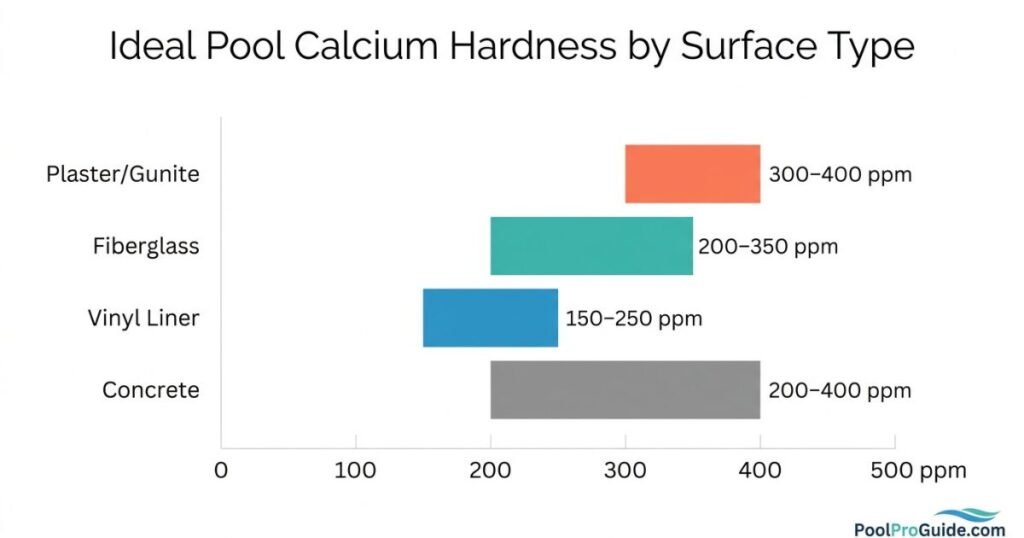
The right target depends on your pool surface. This is the detail competitors consistently leave out. It changes what “ideal” actually means for your pool.
| Pool Surface | Ideal Calcium Range | Why It Matters |
|---|---|---|
| Plaster / Gunite | 300–400 ppm | Porous surface needs higher mineral saturation to prevent etching |
| Fiberglass | 200–350 ppm | Less porous; mid-range protects the gel coat from scale |
| Vinyl Liner | 150–250 ppm | High calcium can stiffen and crack vinyl over time |
| Concrete | 200–400 ppm | Similar to plaster; higher end preferred for longevity |
Quick note: Spa water follows the same ranges but needs testing every 1–2 weeks. Heat accelerates evaporation, which concentrates calcium faster than in a standard pool.
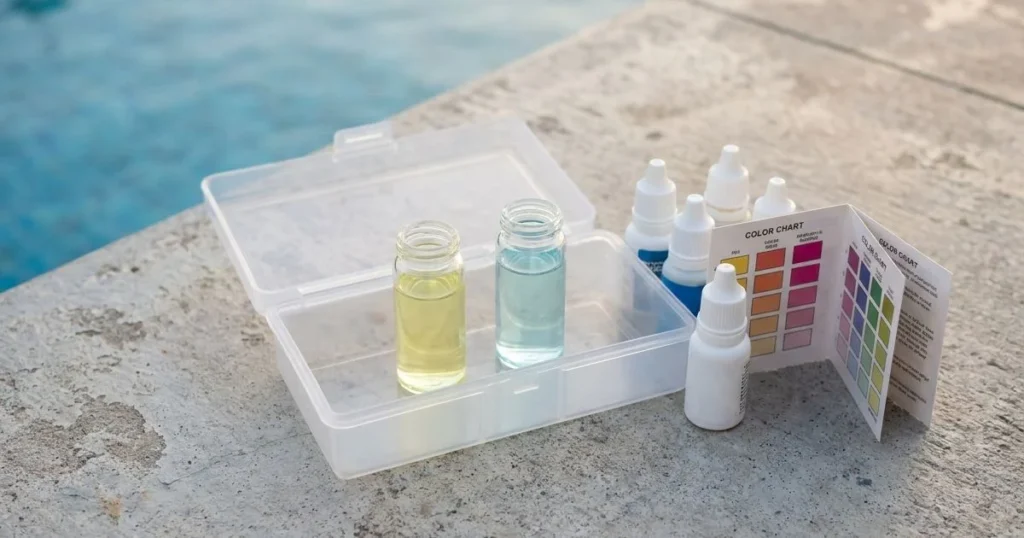
To test pool calcium hardness levels, use a drop-based reagent kit. The Taylor Technologies K-2006 is the standard for home use. It’s accurate to ±10 ppm and covers all the parameters you need. Dip-and-read strips give rough estimates but aren’t reliable enough for making adjustment decisions, especially before adding chemicals.
Signs Your Calcium Hardness Is Too High
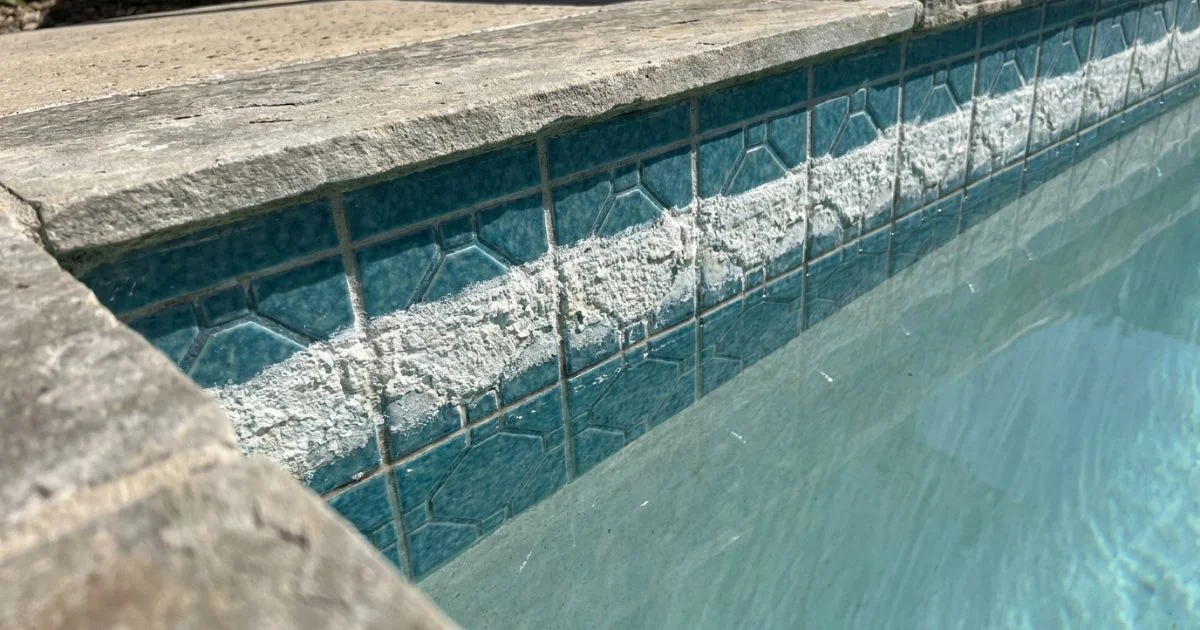
White. Crusty. Rough.
Those three words describe high calcium in a pool. Scale deposits appear on tile lines first. The waterline is especially vulnerable because evaporation concentrates minerals right at the surface, where water meets air.
Other signs to watch for:
✓ Cloudy or hazy water that doesn’t clear despite correct chlorine and pH levels
✓ Rough plaster texture that scratches feet on the pool floor
✓ Clogged filter from calcium flakes accumulating in the media or cartridge
✓ Scale on equipment: heater elements and salt cell plates are the most common casualties
Calcium scaling on pool tile gets worse fast in summer when evaporation peaks. If you’re brushing white deposits off your waterline every week, test your calcium hardness before assuming it’s a pH problem.
Read Our Article On : Calcium Scale on Pool Tile: How to Remove It
Signs Your Calcium Hardness Is Too Low
Low calcium hardness is quieter. You don’t always see it until the damage is done.
The water might look crystal clear. But underneath, it’s slowly etching your plaster, dissolving grout, and corroding metal fittings. Many homeowners run into this after refilling pools with very soft tap water, which is common in parts of the Pacific Northwest, Southeast, and areas on well water, without realizing they need to add calcium separately.
Warning signs:
✓ Pitting or etching on plaster: rough, cratered patches on walls or floor
✓ Metal staining from dissolved copper or iron the water pulled from fixtures
✓ Foamy water in some cases, from the water’s aggressive chemistry
✓ Fast pH swings: soft water has less buffering capacity and is harder to stabilize
Or maybe I should say it this way: low calcium hardness doesn’t announce itself with visible buildup. It announces itself on your next replastering bill.
Read our on : Pool Water Chemistry Guide
Can You Swim With Wrong Calcium Hardness
Short answer: probably, for a day or two. Don’t panic.
High calcium water causes mild skin and eye irritation. The same mineral precipitation that deposits on your tile can irritate mucous membranes at high levels. Low calcium water is less of a direct irritant to swimmers but is actively corroding your surfaces and equipment.
Look: if you’re opening your pool for the season and calcium is slightly off, don’t cancel the swim. Test it, order what you need, and correct it within a week. The real damage from out-of-range calcium is cumulative, not immediate.
The one exception: if calcium is above 600 ppm, the water will likely be visibly cloudy and uncomfortable. At that level, hold off swimming until you’ve diluted the pool.
How to Lower Calcium Hardness
Here’s the thing: calcium is one of the harder parameters to lower, because it doesn’t evaporate or get consumed the way chlorine does. It just accumulates.
To lower pool calcium hardness:
- Test current levels precisely with a reagent kit (Taylor K-2006 or equivalent)
- Drain 25–50% of your pool water
- Refill with fresh water, but check your tap water hardness first
- Retest and repeat if the level is still high
Partial draining is the most reliable method for home pools. Specialty products like calcium sequestrants (available from Leslie’s Pool Supplies and similar retailers) can bind calcium temporarily and help prevent it from precipitating, but they don’t actually remove it. They’re useful for controlling scale during high-calcium periods, not for long-term reduction.
I’ve seen conflicting data on whether sequestrants lower calcium long-term or just delay scaling. My read is: they work well as a holding strategy while you plan a partial drain, but they’re not a replacement for dilution if you’re sitting at 500+ ppm.
One thing worth checking before you refill: if your tap water tests above 300 ppm, you’re adding more calcium with every top-off. In that case, consider mixing with distilled or reverse-osmosis water, or look into a water softener bypass for pool fills. proves ANSI recommended ranges
Read our latest Article on : Pool Muriatic Acid Complete Guide
How to Raise Calcium Hardness Safely
Raising calcium is much more straightforward.
Calcium chloride is the standard product. Clorox Pool&Spa Calcium Hardness Increaser is widely available at hardware and big-box stores. Generic calcium chloride (the same compound used for de-icing) also works at lower cost. Just confirm it’s food-grade or pool-grade, not mixed with other materials.
To raise calcium hardness in a pool:
1.Test current levels and calculate your ppm deficit
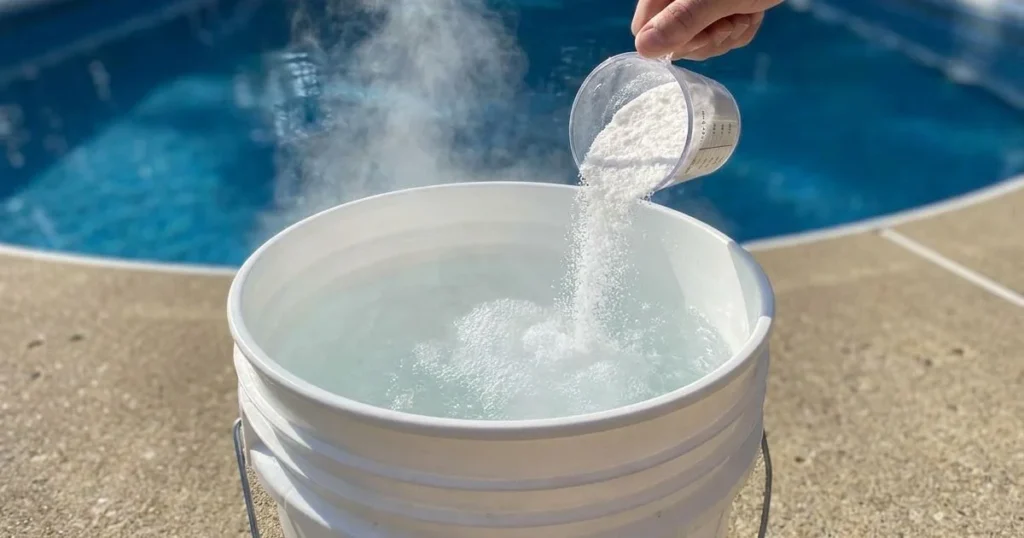
2. Pre-dissolve calcium chloride in a bucket of pool water before adding, since it releases significant heat when it hits water
3. Pour the solution slowly around the pool perimeter with the pump running
4. Wait 4–6 hours before retesting and adding more
As a general estimate: 1.25 lbs of calcium chloride per 10,000 gallons raises hardness by approximately 10 ppm. Run the math before you add. Overshooting is harder to fix than undershooting, and adding too much at once can cause temporary cloudiness.
How Calcium Hardness Affects pH and Scale
Calcium hardness doesn’t work alone. It’s one of four variables in the Langelier Saturation Index (LSI), a calculation that tells you whether your water is corrosive, balanced, or scaling.
The LSI accounts for:
✓ pH: the most influential factor in water balance
✓ Total alkalinity: buffers pH from swinging
✓ Calcium hardness: mineral saturation level
✓ Water temperature: warmer water accelerates scaling
An LSI of 0 is perfectly balanced. Negative values indicate corrosive water. Positive values above +0.3 signal visible scale formation. High calcium pushes LSI positive, which sounds safe, but it creates the crusty buildup that damages tile grout and clogs equipment.
What most guides skip is this: you can have calcium hardness sitting perfectly at 300 ppm and still have a scaling problem if pH is running high. Or have calcium at 400 ppm and no scaling because alkalinity and pH are aligned. Calcium hardness adjustments should always be paired with a full water balance check, not treated in isolation.
Some experts argue that keeping calcium hardness at the low end of the range (200 ppm) is safer because it prevents scale. That’s valid for fiberglass and vinyl pools. But for plaster pools, water that’s too soft is just as damaging. It eats the surface from below. The PHTA recommendation of 300–400 ppm for plaster exists for a reason.
If you regularly top off your pool due to evaporation, test your fill water for calcium hardness at least once. In areas with hard water, every refill adds more calcium to the pool, which can gradually lead to scale buildup even if your chemistry was balanced at the start of the season.
FAQ
What is the ideal calcium hardness for a pool?
For most pools, the target is 200–400 ppm. Plaster pools should aim for 300–400 ppm. Vinyl liner pools do better at 150–250 ppm. Use the pool surface table above to find your specific target.
How do I raise calcium hardness in my pool fast?
Add calcium chloride, available as Clorox Pool&Spa Calcium Hardness Increaser or pool-grade calcium chloride. Pre-dissolve in a bucket, add slowly with the pump running, and retest after 4–6 hours. Add 1.25 lbs per 10,000 gallons to raise levels by roughly 10 ppm.
Why is my pool calcium hardness so high?
Usually hard fill water, summer evaporation concentrating the minerals, or topping off with hard tap water. Every time water evaporates, the calcium stays behind, so levels creep up over a long swim season.
Should I worry about calcium hardness in a fiberglass pool?
Yes, though the risks are different than plaster. Fiberglass resists etching better, but high calcium still scales the gel coat, clogs equipment, and builds up in the heater. Keep it 200–350 ppm.
When should I test pool calcium hardness?
Test at opening, at closing, and every 4–6 weeks during swim season. Test more often if you’re topping off frequently or after heavy rain that dilutes your water.
Conclusion
Keeping your pool’s calcium hardness within the recommended range is essential for protecting your pool surface, equipment, and water quality. Test your water regularly, adjust calcium levels gradually, and always balance calcium hardness alongside pH and total alkalinity for the best results. With routine monitoring and proper maintenance, you can prevent costly damage, avoid scale or corrosion, and enjoy clean, comfortable swimming water all season long.