
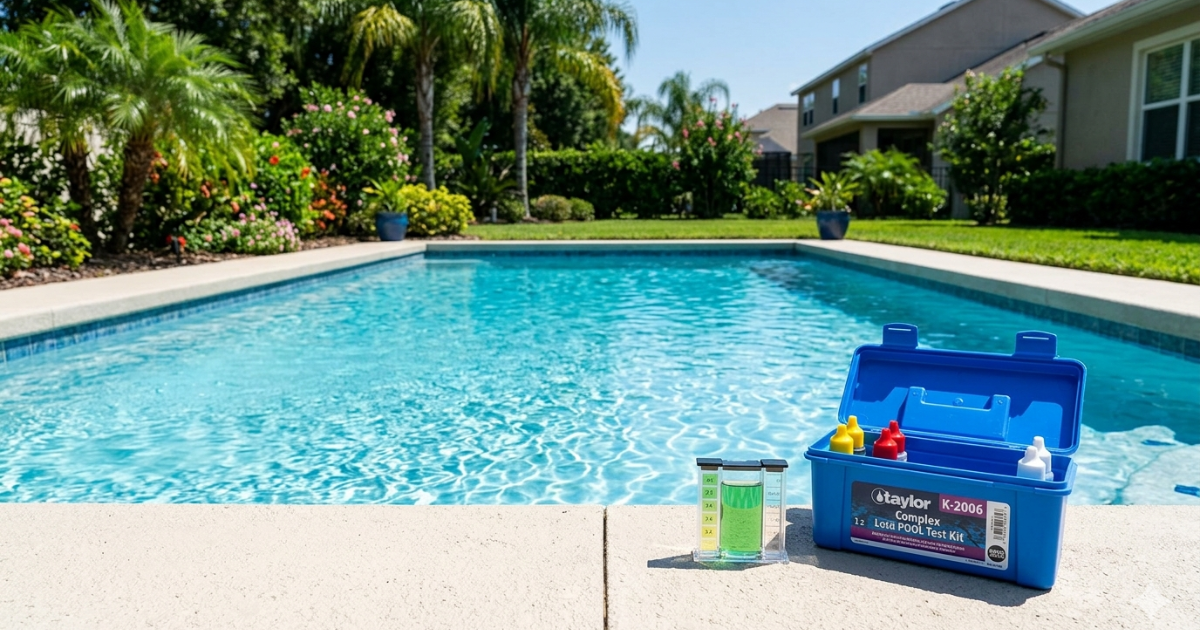

How to lower pool pH naturally is one of those questions that sounds simple, until you’ve added pH Down for the fifth time this month and watched the number climb straight back to 8.1.
Your pH spikes. You treat it. Three days later, 8.1 again.
If that loop sounds familiar, you’re not fixing the right problem. Most guides (and most pool stores) sell you a short-term acid hit without explaining why the pH keeps rising. Once you understand the root cause, the fix is straightforward, low-chemical, and actually lasts.
This guide covers residential pools, plaster, vinyl, and fiberglass, in the 10,000–20,000 gallon range. It does NOT address commercial pools, saltwater chlorine generator systems in full detail, or situations where pH is crashing below 7.0.
Quick Note on Scope: The methods below work best when total alkalinity is above 100 ppm and pH is consistently reading above 7.8. If your alkalinity is already in the 80–120 ppm range, skip to Method 2.
What Does “Lower Pool pH Naturally” Actually Mean?
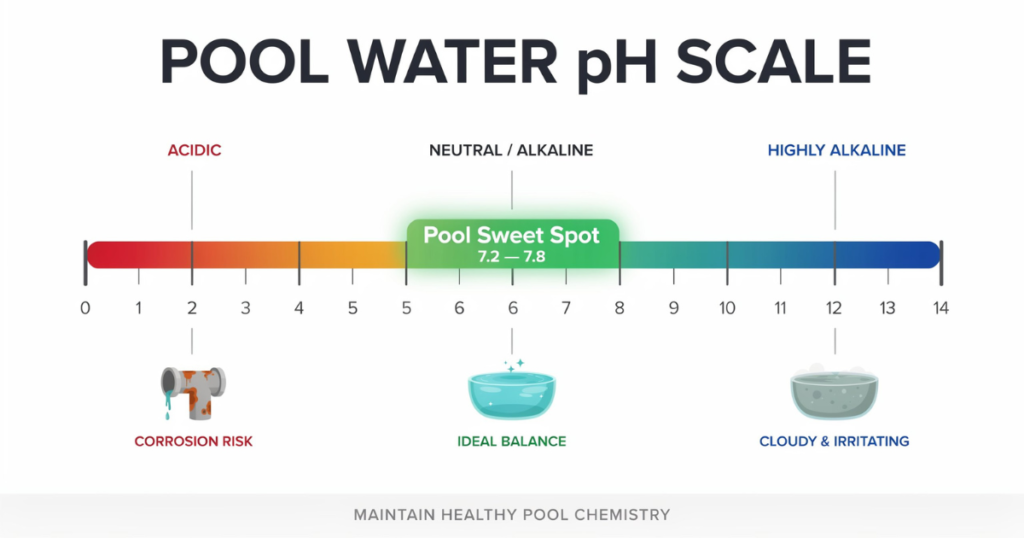
Lowering pool pH naturally means reducing elevated pH, typically readings above 7.8, using controlled acid addition followed by aeration, rather than relying on repeated chemical dosing that only treats the symptom. The goal is to independently manage pH and total alkalinity (TA) so each stays in range without dragging the other out of balance.
The CDC’s 2024 pool water guidelines set the safe swimming pH range at 7.2–7.8, with 7.4–7.6 considered optimal for both chlorine effectiveness and swimmer comfort. That’s the target. Getting there, and staying there, requires understanding why pH won’t stay put.
Why Your Pool pH Keeps Rising (The Real Root Cause)
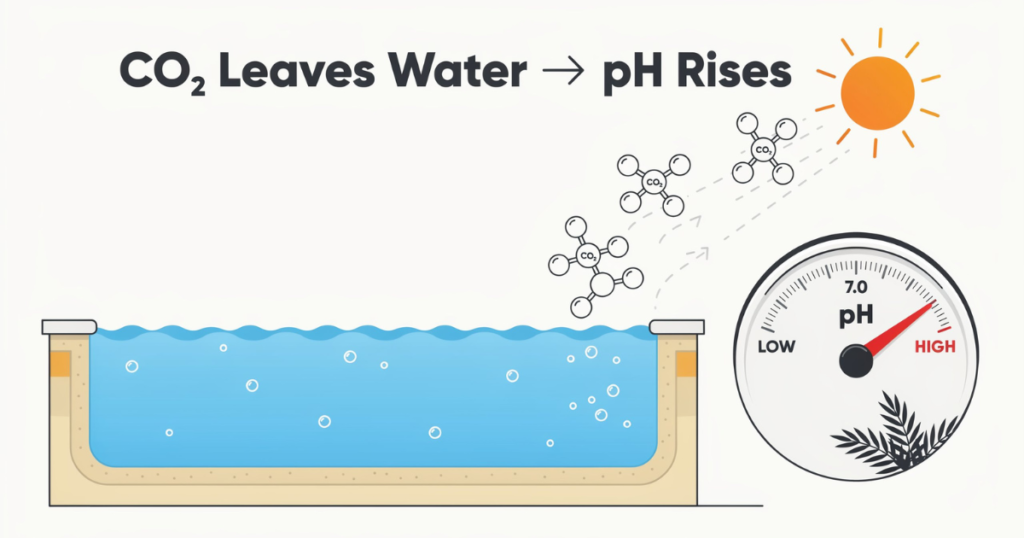
Here’s the thing: pH drift upward is normal. It’s physics, not a malfunction.
Pool water loses dissolved CO₂ continuously through aeration, splashing, surface agitation, and warm temperatures. As CO₂ leaves the water, pH rises. This is called CO₂ offgassing, and it happens in virtually every pool, every day. A newly plastered surface makes it worse, plaster leaches calcium hydroxide into the water for up to 18 months, pushing pH up aggressively.
So if you only add acid to knock pH down, it climbs back within days. Every time.
The real driver is total alkalinity (TA). Think of TA as the stubbornness of your water, its resistance to pH change. When TA is above 120 ppm, your water is so buffered that pH corrections barely hold. You push it down; it bounces right back. Pool pros call this the pH seesaw effect, and it’s why you can’t keep pH stable no matter what you add.
Or maybe I should say it this way, high TA doesn’t cause high pH directly, but it makes high pH nearly impossible to fix permanently. That distinction matters.
The fix requires bringing TA down first, not just pH.
- ✓ Keeping pH in the ideal range protects your pool equipment, improves swimmer comfort, and helps chlorine work at maximum efficiency.
How to Lower Pool pH Naturally: 7 Methods That Work
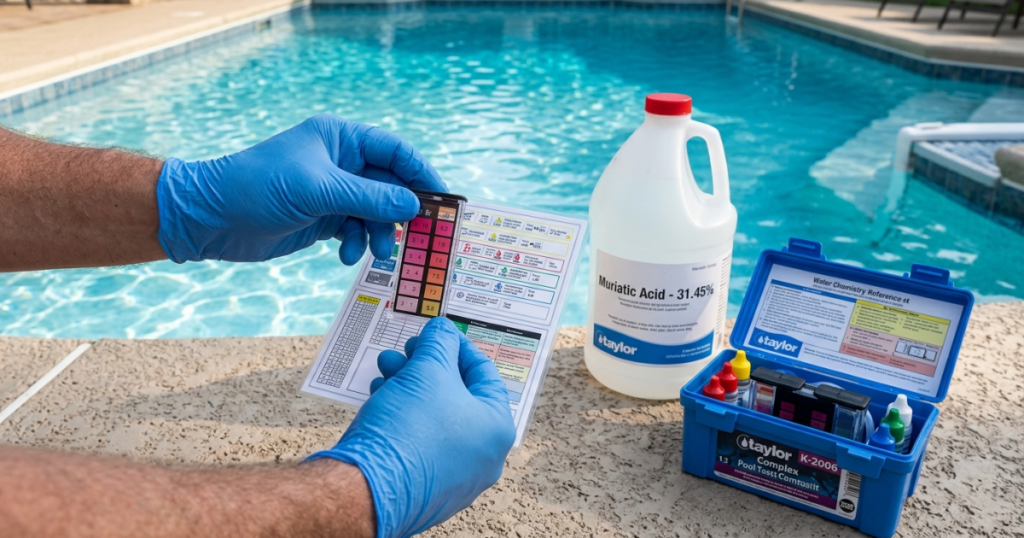
Method 1: The Acid-and-Aerate System (Most Effective)
This is the approach validated by AQUA Magazine and professional pool chemists. Two steps. Not complicated. But the order matters.
How to lower pool pH naturally using the acid-and-aerate method:
- Test pH and total alkalinity with a reliable liquid test kit (not strips).
- Add muriatic acid slowly near an active return jet with the pump running.
- Target bringing pH down to 7.0–7.2, this also reduces TA.
- Wait 30–60 minutes, then retest before adding more.
- Point return jets upward and run all water features to aerate.
- Aeration raises pH naturally via CO₂ offgassing without increasing TA.
- Retest after 12–24 hours; repeat the cycle if TA remains above 100 ppm.
The science behind step 6 is what separates this from just dumping acid in. Aeration raises pH through a physical process, driving CO₂ out of solution, not a chemical one. pH recovers toward your target while TA stays low. You’ve now broken the seesaw.
Method 2: Muriatic Acid Alone (For pH Corrections Under 0.5 Points)
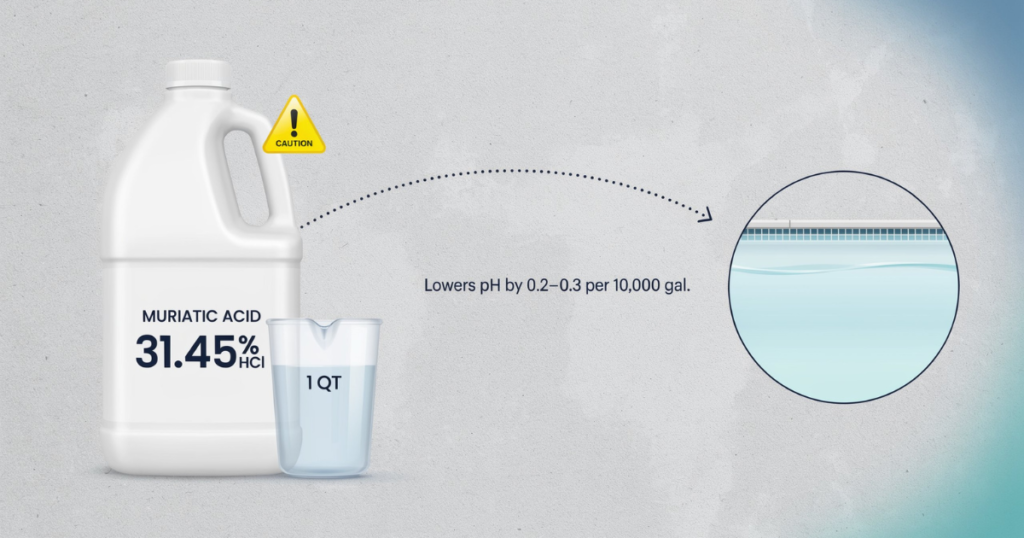
When total alkalinity is already in range (80–120 ppm) and pH only needs a modest correction, muriatic acid by itself is the fastest tool.
Dosing guide: 1 quart of 31.45% muriatic acid per 10,000 gallons drops pH by roughly 0.2–0.3 points and lowers TA by approximately 10 ppm. Never add more than 1 quart at a time. Always pre-dilute in a bucket, add acid to water, never water to acid.
Look, if you’ve got a freshly plastered pool running pH above 8.0 every three days, muriatic acid alone isn’t enough. You need the full acid-and-aerate cycle until the plaster fully cures, which can take up to a year.
Method 3: Dry Acid (Sodium Bisulfate): For Beginners and Small Adjustments
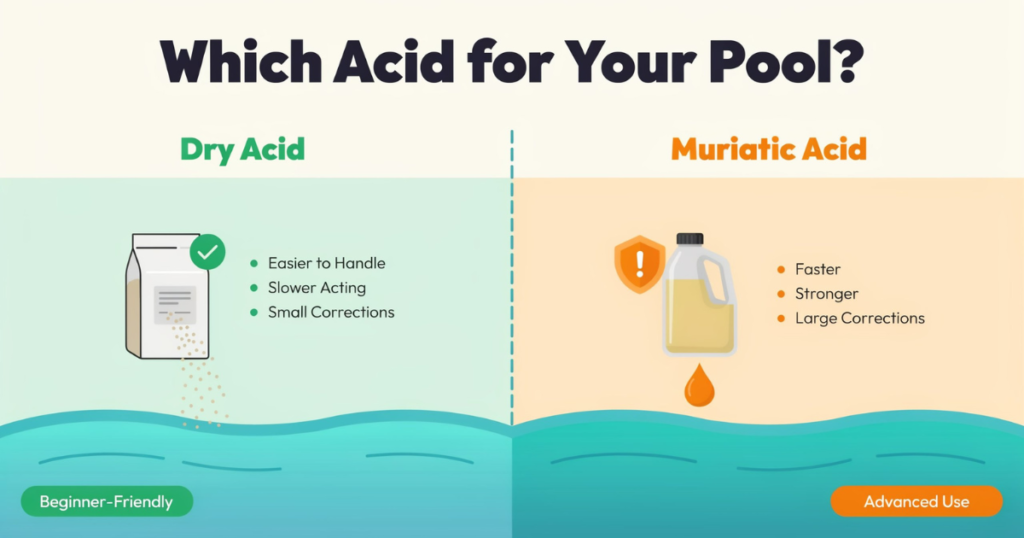
Dry acid is gentler to handle and reacts more slowly, which makes it easier to control. But it’s not a universal substitute for muriatic acid.
Quick Comparison: Muriatic Acid vs. Dry Acid to Lower Pool pH
| Option | Best For | Key Benefit | Limitation |
|---|---|---|---|
| Muriatic Acid (31.45% HCl) | Large corrections, all pool types | Fast-acting, economical, lowers both pH and TA | Requires gloves and eye protection; fumes |
| Dry Acid (Sodium Bisulfate) | Small adjustments, beginners | Easier to handle, slower reaction | Accumulates sulfates, avoid in plaster or saltwater pools |
| CO₂ Injection | Saltwater/SWG pools | Lowers pH with zero effect on TA | Requires dedicated equipment; higher upfront cost |
| Aeration Only | Post-acid pH recovery | Zero chemicals; raises pH without touching TA | Cannot lower pH, only raises it |
Dry acid should not be used in plaster pools or pools with a saltwater chlorine generator. Sulfate accumulation over time damages pool surfaces and salt cell equipment. For pH corrections under 0.3 points in vinyl or fiberglass pools, it’s a reasonable, lower-fuss choice.
Method 4: Controlled Aeration — The Zero-Chemical pH Manager
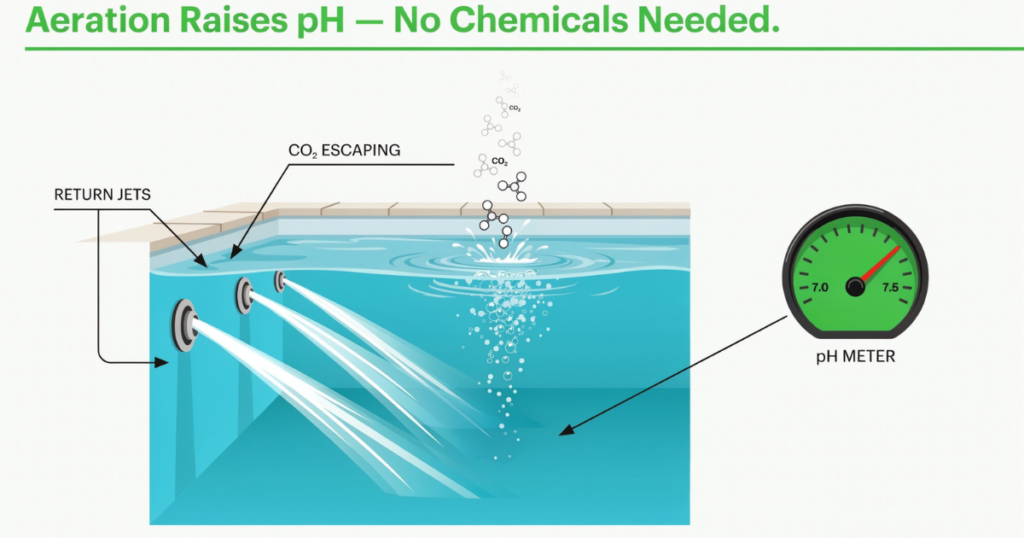
Aeration is the most underused tool in residential pool care. It costs nothing to run and does work that no chemical can replicate.
When you point your return jets toward the water surface, run a pool fountain, or switch on a waterfall, you’re agitating the water and accelerating CO₂ loss. As dissolved CO₂ leaves the water, the carbonic acid concentration drops and pH rises. According to research cited by AQUA Magazine, reducing TA from 200 ppm to 80 ppm with acid may initially push pH to around 6.1, but with normal surface aeration and CO₂ equilibration, pH naturally recovers to approximately 7.5 within 24–48 hours, without any chemical addition.
That’s the power of this step. You’re using physics to do the pH recovery work for you.
Aeration techniques, ranked by effectiveness:
- Running a dedicated pool aerator or fountain (most effective)
- Pointing all return jets upward toward the surface
- Running a spa spillover or waterfall feature
- Vigorous brushing of pool walls and surface (minimal but adds up)
Quick note: Do NOT run aeration while adding acid. Turn off all water features, add acid, let it circulate for 30–60 minutes, then switch to aeration mode.
Method 5: Lower Fill Water Impact — Know Your Source Water
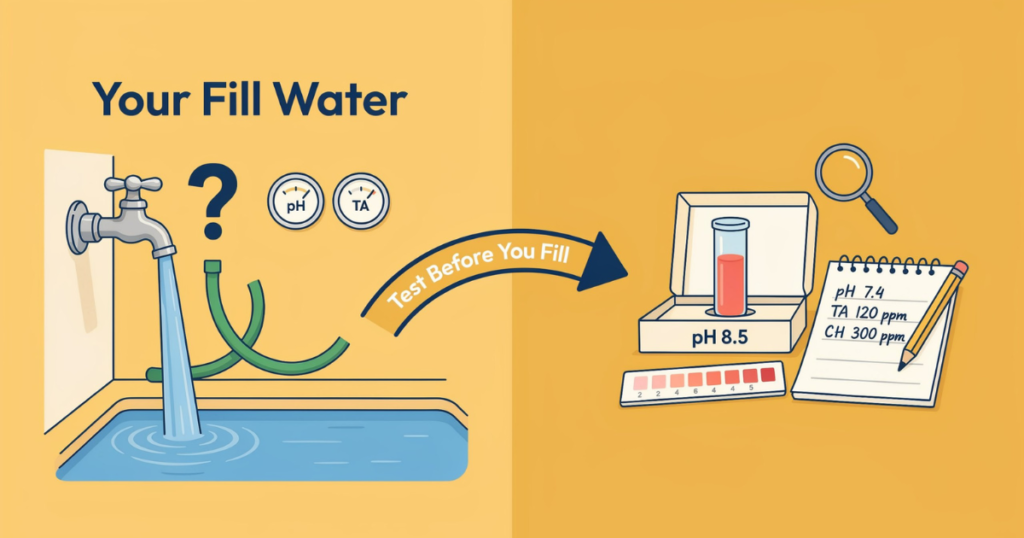
Every gallon of water you add to maintain pool level brings its own pH and alkalinity. Most tap water sits between pH 6.5 and 8.5, but some municipal suppliers raise pH as high as 9.0 to prevent corrosion in residential pipes.
If your fill water comes in at pH 8.5 with TA at 200 ppm, you’re fighting an uphill battle every time you top off the pool. The fix: test your fill water separately using the same liquid test kit you use for pool water, then factor those numbers into your correction calculations.
This single step explains why two identical pools on the same street can behave completely differently.
Method 6: CO₂ Injection — Best for Saltwater Pools
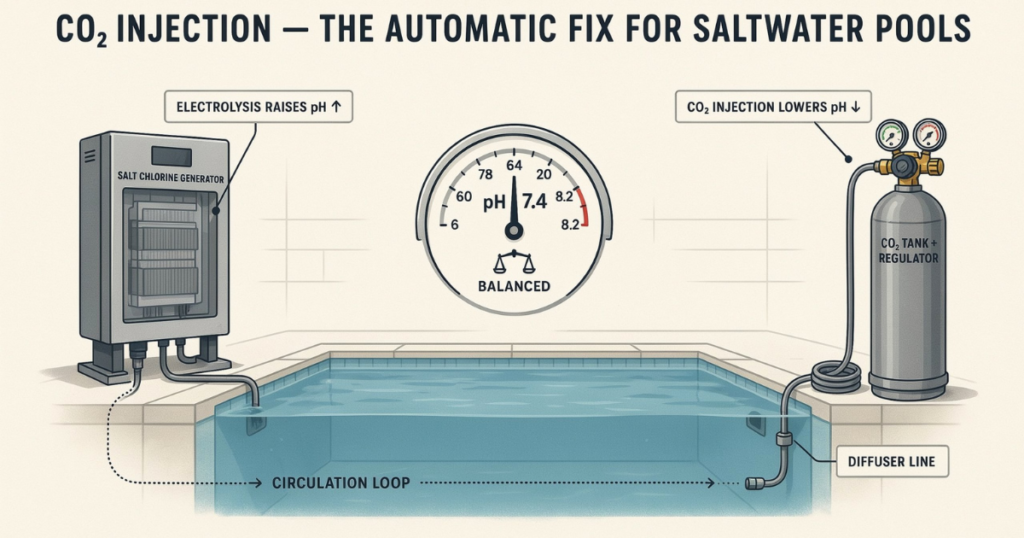
If you have a saltwater chlorine generator (SWG), you’ve probably noticed that pH climbs faster and more stubbornly than in a traditionally chlorinated pool. That’s because the electrolysis process naturally produces hydroxide ions, which push pH up.
CO₂ injection systems address this directly. Carbon dioxide dissolved into pool water forms carbonic acid, which lowers pH without affecting total alkalinity at all. It’s the only method that selectively reduces pH while leaving TA completely untouched.
The trade-off is equipment cost, a basic CO₂ injection setup runs $300–$800 installed, and a CO₂ tank that needs refilling. For pools where pH climbs daily and manual correction is a constant chore, it pays for itself quickly in saved chemical costs and time.
Method 7: Stabilize TA With Borax — Stop the Seesaw Permanently
Once you’ve used the acid-and-aerate method to get TA into the 80–100 ppm range, the last step is preventing the seesaw from restarting.
20 Mule Team Borax adds borate ions to your water, which act as a secondary pH buffer, stabilizing pH in the 7.2–7.8 range without affecting TA. At 50 ppm borates, pH becomes significantly more resistant to both upward and downward drift. The Trouble Free Pool community recommends dropping TA to 50 ppm and adding 50 ppm borates as the most stable long-term chemistry configuration for pools.
One caution: adding borax raises pH. Always pair a borax addition with a small muriatic acid dose to counteract the pH increase, then let aeration do the fine-tuning.
Testing Accurately — Why Test Strips Fail for Alkalinity
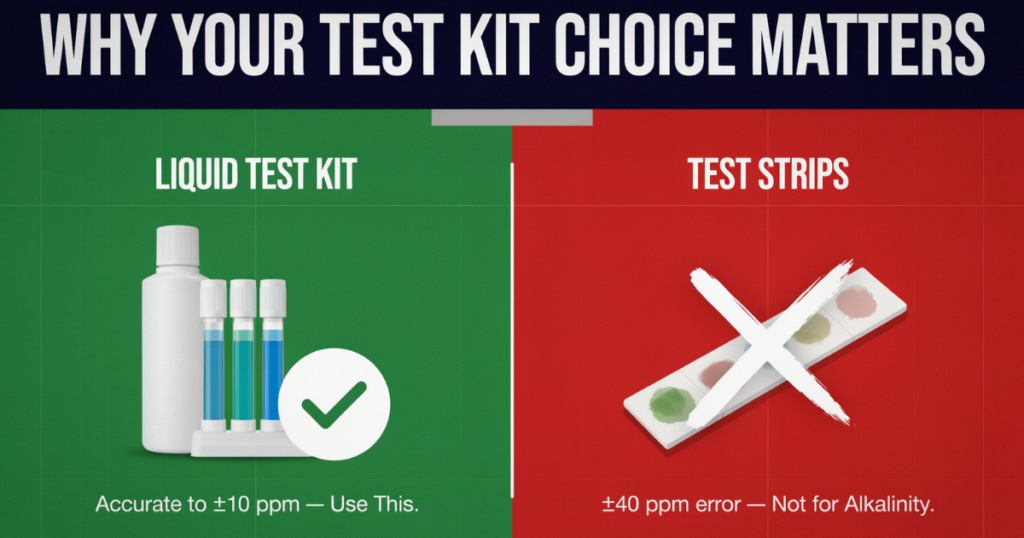
The Taylor K-2006C Complete Test Kit is the standard recommended by pool chemistry professionals. Test strips are fine for quick chlorine spot-checks, but they’re notoriously unreliable for total alkalinity readings.
If you’re basing your alkalinity correction on a strip reading of “80 ppm” when the real value is 160 ppm, you’ll under-dose acid every single time. The K-2006C uses a titration method that gives precision to within 10 ppm. That accuracy is the difference between a correction that holds for two weeks and one that collapses in three days.
I’ve seen conflicting data on test strip accuracy across brands, some premium strips perform reasonably well for pH in the normal range, others are wildly off for TA. My read is this: for the acid-and-aerate method to work correctly, you need alkalinity accuracy, and strips don’t reliably deliver it.
Why High pH Quietly Destroys Your Chlorine
This is the part most pool owners don’t realize until they’ve spent months wondering why algae keeps coming back.
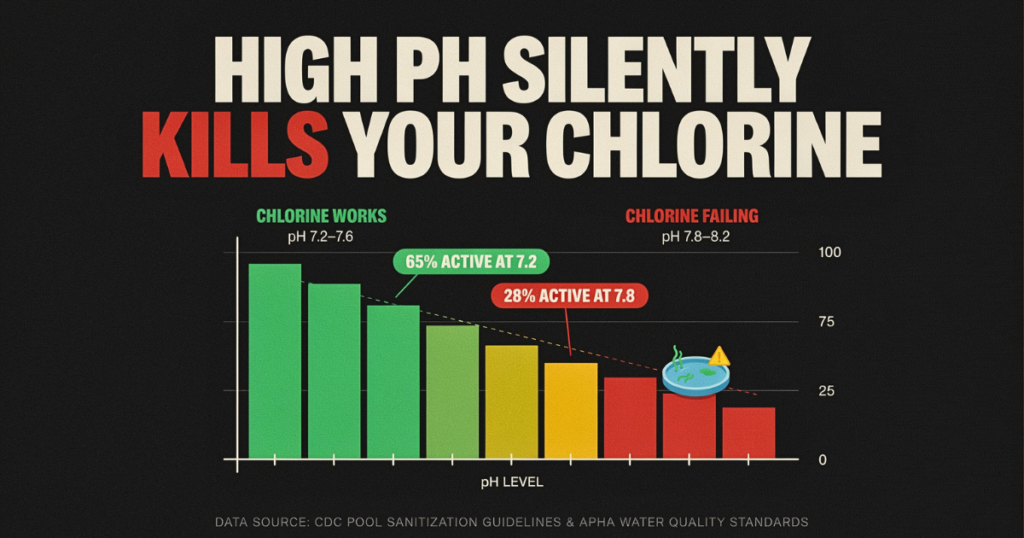
You’d assume that adding more chlorine fixes a dirty or cloudy pool. At high pH, it doesn’t. According to Fluidra’s 2024 technical water chemistry analysis, at pH 7.2, approximately 65% of free chlorine exists as hypochlorous acid (HOCl), the active disinfecting form. At pH 7.8, that percentage drops to just 28%. Above pH 8.0, it collapses further.
A pool running at pH 8.0 can have three to four times as much chlorine in the water as a properly balanced pool and still be significantly under-sanitized. Algae, bacteria, and cloudy water are often symptoms, not of low chlorine, but of high pH making the chlorine already in the water nearly useless.
Some pool professionals argue you should shock aggressively when water looks off. That’s valid as an emergency measure. But if pH isn’t corrected first, you’re burning through chlorine at a rate that’s entirely preventable.
Frequently Asked Questions: How to Lower Pool pH Naturally
What’s the best natural way to lower pool pH?
The acid-and-aerate method: use muriatic acid to lower both pH and total alkalinity, then aerate using return jets or water features to let pH recover naturally through CO₂ offgassing. Most cycles complete in 12–48 hours.
How do I lower pool pH without using harsh chemicals?
You can’t lower pH without some form of acid, aeration only raises pH. However, by fixing total alkalinity first, ongoing maintenance doses become much smaller. After the initial acid-and-aerate correction, many pools only need minor acid touch-ups monthly.
Why does my pool pH keep rising after I add pH Down?
Total alkalinity (TA) is too high. When TA is above 120 ppm, it buffers pH so strongly it drifts back up within days regardless of how much acid you add. Lower TA first using the acid-and-aerate method, pH stays stable after.
Should I use muriatic acid or dry acid to lower pool pH naturally
Muriatic acid for most pools, it’s more effective, economical, and lowers both pH and TA simultaneously. Use dry acid only for minor corrections, and avoid it in plaster pools or saltwater pools due to sulfate accumulation.
When should I test pool pH again after adding acid?
Wait at least 30–60 minutes with the pump running, then retest. For a full aeration cycle, retest after 12–24 hours before adding more acid. Never test immediately after adding chemicals, readings won’t be stable.
One Edge Case: pH Drops Too Low After Acid Treatment
If the acid-and-aerate cycle pushes pH below 7.2 and you need to raise it, 20 Mule Team Borax is the correct tool, not baking soda.
Baking soda (sodium bicarbonate) raises both pH and TA. Since you just lowered TA intentionally, adding baking soda restarts the seesaw immediately. Borax raises pH without meaningfully affecting TA, making it the right choice when you need to nudge pH upward mid-cycle.
This is what most guides skip entirely.