
You got a pool quote. It came back at $70,000. You closed the tab.
Now you’re looking at swim spas — and you want a straight answer: what exactly is a swim spa, what does it actually cost all-in, and is it a real solution or just an overpriced hot tub? This guide covers all of it.
This guide covers residential swim spas in the $15,000–$50,000 range. It does not address commercial installations or custom inground swim spa builds.
What Is a Swim Spa?
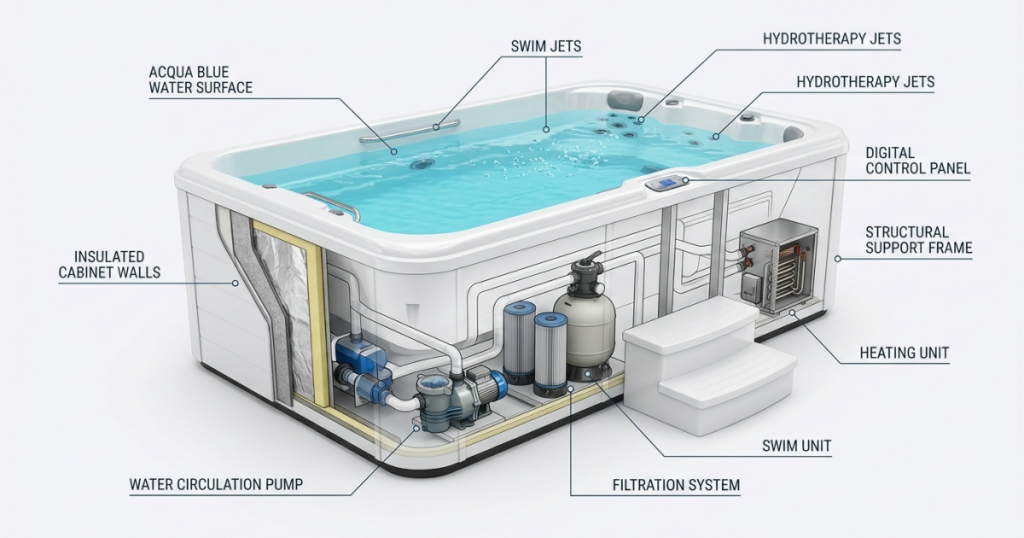
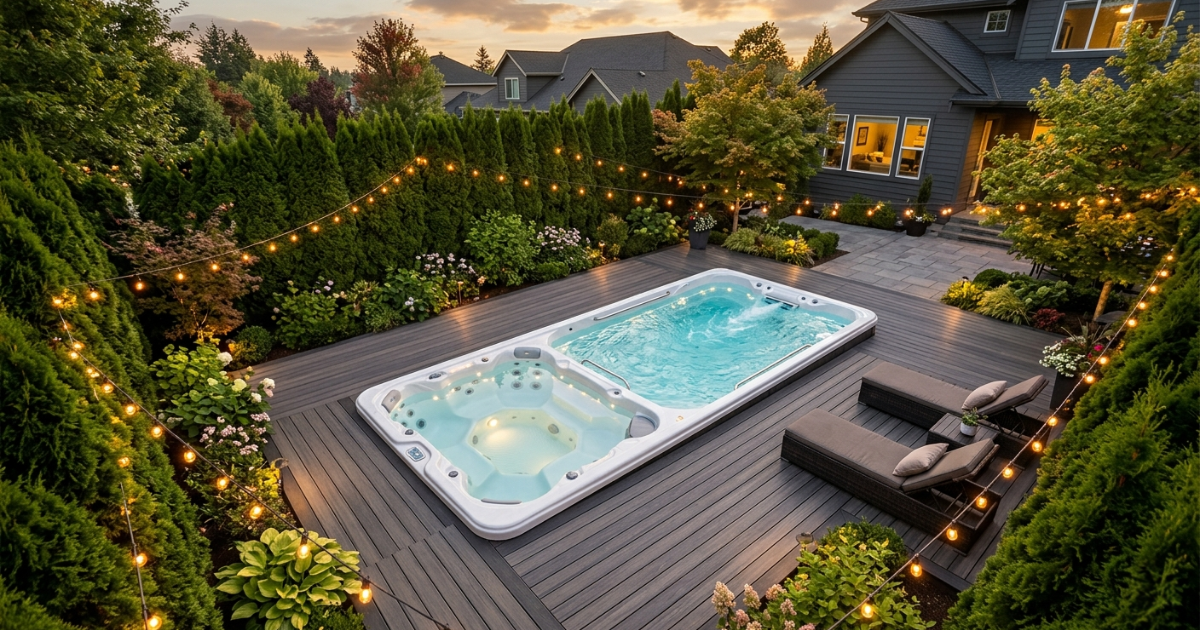
A swim spa is a self-contained, heated water unit that combines a continuous-current swimming system with hydrotherapy massage jets. The swimmer stays stationary while a motor-driven current flows toward them. Most residential units measure 12 to 19 feet long — usable year-round, unlike a traditional outdoor pool.
According to Verified Market Reports (2024), the global swim spa market was valued at $1.5 billion, with 75% of all sales being residential purchases driven by the growth in home wellness spending. This isn’t a niche product anymore.
The acrylic shell sits inside an insulated cabinet. Inside: an adjustable water circulation system, a filtration system for water sanitation, and a heating system that keeps water between 50°F and 104°F regardless of outdoor temperature. A pool in Chicago gives you 5 usable months. A swim spa gives you 12.
Single-Zone vs. Dual-Zone
Single-zone units run at one temperature — a daily compromise between “warm enough to soak” and “cool enough to train hard in.” Fine for casual users. Frustrating for anyone who swims seriously.
Dual-zone units have a physical divider separating a cooler swim lane (78–84°F) from a heated spa section (98–104°F). Both run simultaneously. If fitness swimming is a real weekly priority, dual-zone is worth the price difference. Hydropool’s AquaTrainer and Master Spas’ H2X lineup are the leading dual-zone options in North America.
How Does a Swim Spa Work?
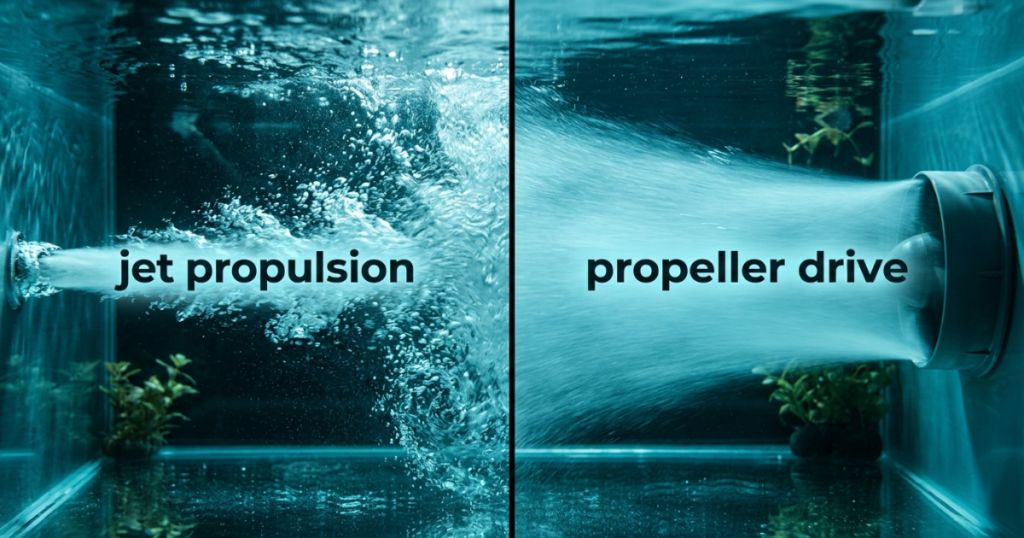
Here’s the thing: the current system is the single most important specification — and most swim spa articles never explain it. Getting this wrong is a $20,000 mistake.
Jet-propulsion systems push water through scaled-up nozzles in the front wall, similar to hot tub jets. The Jacuzzi PowerPro series uses this approach. It works well for water aerobics and casual resistance training. At high speeds, the stream narrows and gets turbulent — swimmers describe it as fighting chop rather than swimming cleanly.
Propeller-drive systems use a wide impeller to generate smooth, laminar-flow current across the full swim lane. The Michael Phelps Signature Series by Master Spas is the most recognized example. The current is wide, stable, and consistent at competitive training speeds. It costs more and needs specialized service — but for serious swimmers, it’s the only choice.
Quick Comparison: Current System Types
| Feature | Jet-Propulsion | Propeller-Drive |
|---|---|---|
| Current width | Narrow / targeted | Full lane width |
| Turbulence at speed | Moderate–high | Low (laminar) |
| Best for | Water aerobics, light training | Lap training, athletes |
| Brands | Jacuzzi PowerPro, Cal Spas | Master Spas, SwimEx |
| Price range | $15,000–$28,000 | $25,000–$50,000+ |
What Can You Do in a Swim Spa?
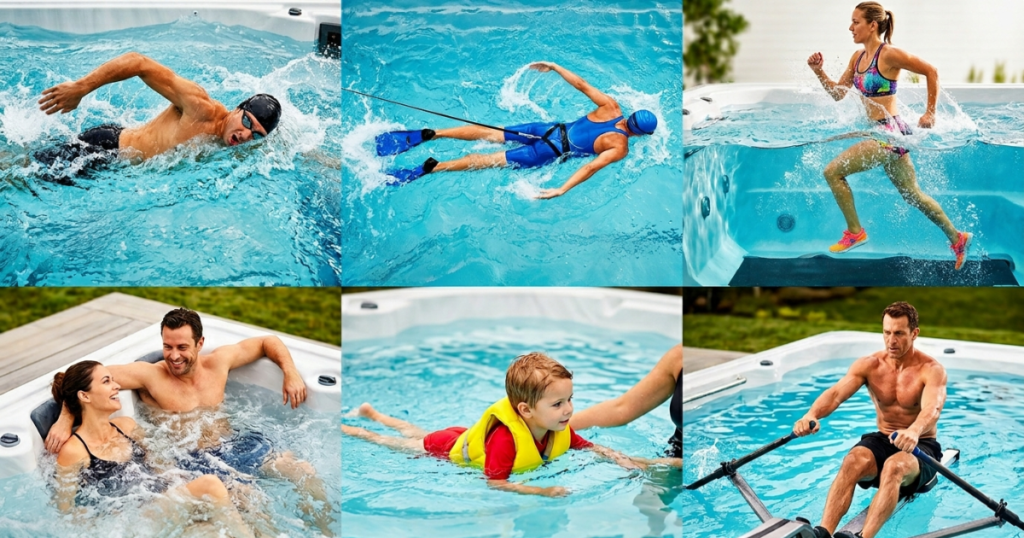
This is where swim spas genuinely shine — versatility no single product matches.
Open water swimming. A swim spa eliminates turning and produces a continuous current comparable to a 50-minute Ironman pace. No backflow, no turbulence breaking your stroke, no fire-hose-like jet forcing you sideways. Serious athletes and casual lap swimmers use it the same way — swimming in place against an adjustable current.
Tethered resistance swimming. One of the most effective low-impact workouts available. Tethered from behind, you swim at full intensity — freestyle, backstroke, butterfly, or breaststroke — with no lane lines interrupting your kick. Upper body engagement and body tension are significantly higher than untethered lap swimming.
Tethered aquatic jogging and cross-training. Water-based jogging reduces injury risk, builds lean muscle, strengthens cardiovascular health, and is ideal for recovery periods — post-marathon, end of a racing season, or managing shin splints and tendinitis. Physical therapists call this rehabilitation therapy for a reason.
Hydrotherapy and recovery. The spa section isn’t a bonus — it’s a core benefit. Therapeutic massage jets target specific muscle groups. Combined with warm water and buoyancy, this is aquatic therapy without a clinic appointment. Water provides roughly 12 times more resistance than air, making even light movement genuinely therapeutic.
Family use. All models offer kid-friendly depth for first-time swimmers. Turn off the current and you have a splash pool. Keep the current on and the kids have a wave feature. Adults relax in the heated spa section while the pool section stays in use.
Fitness accessories. Most swim spas support a universal aquatic gym setup — elastic or hydraulic resistance systems that mirror sport-specific movement patterns for functional cross-training. Many models also accommodate aquatic rowing machines using stainless steel oars with swivel resistance — working legs, back, core, shoulders, and arms simultaneously.
What a Swim Spa Actually Costs
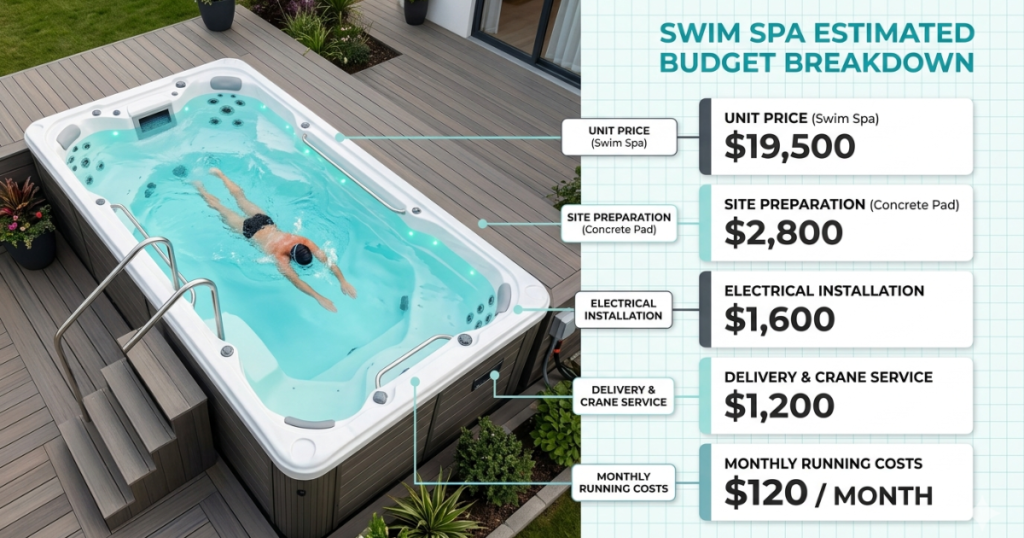
Look — the sticker price is only part of the budget. Most buyers discover this after committing. Here’s the full picture upfront.
| Unit Category | Low End | High End |
|---|---|---|
| Entry-level (jet, single-zone) | $15,000 | $22,000 |
| Mid-range (dual-zone) | $22,000 | $35,000 |
| Premium (propeller, dual-zone) | $35,000 | $50,000+ |
Installation adds $4,500–$11,000. A fully loaded swim spa weighs 15,000–25,000 lbs with water — it needs a reinforced concrete pad ($2,000–$5,000), a dedicated 240V/60-amp electrical circuit with GFCI protection ($1,500–$3,000), delivery and crane service ($800–$2,500), and local permits ($150–$600).
Running costs: $75–$150/month. Electricity runs $50–$100/month depending on climate and insulation quality. Water chemicals add $20–$50/month. Filter maintenance is $5–$10/month. Or maybe I should say it this way — over 10 years, operating costs add $9,000–$18,000 to the total investment. That’s a planning number, not a warning.
To budget accurately, follow these steps:
- Pick a unit tier based on your primary use — fitness, therapy, or both
- Add $7,000 as a baseline for installation costs
- Multiply your estimated monthly running cost by 120 (10 years)
- Add 10% contingency for site complications or panel upgrades
- Compare the 10-year total to 10 years of gym membership plus pool costs
Swim Spa vs. Pool vs. Hot Tub
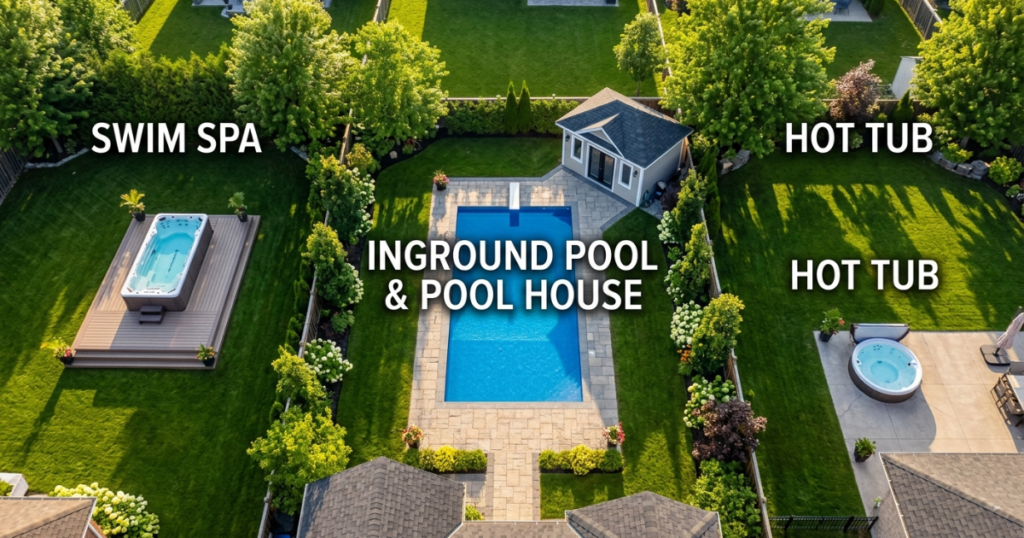
Swim spa vs. pool: A swim spa suits small yards and year-round fitness use because the powered current replaces lane length. A pool works better for multiple simultaneous swimmers and recreational use. The key difference is footprint and seasonality.
Swim spa vs. hot tub: A swim spa costs 3–5x more but adds fitness capability. Choose a hot tub if relaxation is the only goal. Choose a swim spa when fitness AND recovery both matter regularly.
| Option | Best For | Key Benefit | Main Limitation |
|---|---|---|---|
| Swim spa | Fitness + therapy, small yards | Year-round, dual function | High cost, 1–2 swimmers max |
| Inground pool | Recreation, large families | Capacity, resale value | $50K–$100K+, seasonal |
| Hot tub | Relaxation only | Low cost, small footprint | No fitness capability |
I’ve seen conflicting data on swim spa resale value — some reports claim $10K–$20K added home value, others show minimal real-world impact. My read: buy it because you’ll use it, not because you expect to recover the cost when selling.
The Real Disadvantages
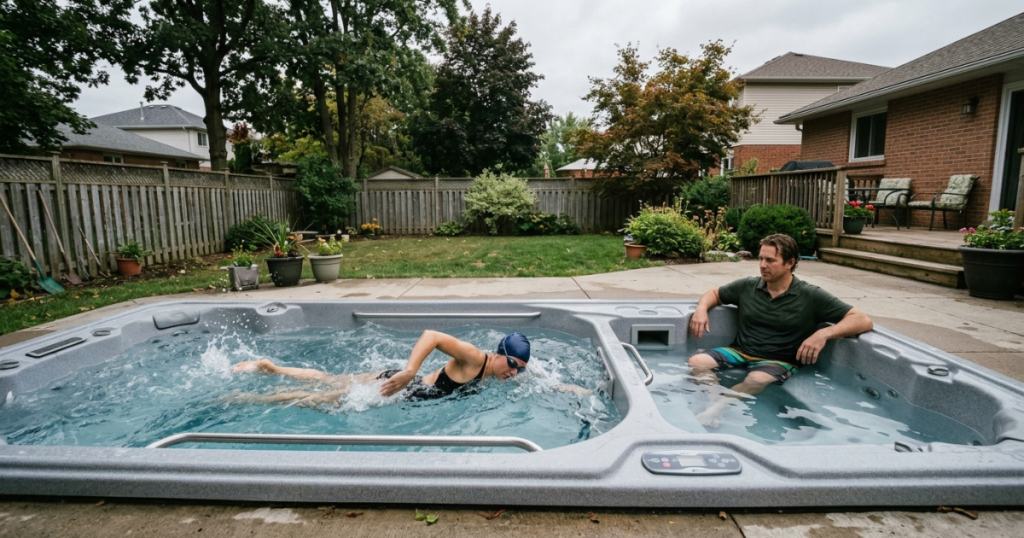
Parrot Bay’s article won’t mention these. We will.
- One swimmer at a time — the swim lane fits one adult. No side-by-side training.
- Shallow depth (48–54 inches) — workable for resistance swimming, not for diving or unsupervised small children.
- Current speed ceiling (~8 mph) — fit swimmers outpace most jet systems within months. It’s a fitness tool, not a competitive venue.
- Weekly maintenance is non-negotiable — heated water shifts chemistry fast. Skipping a week risks bacterial growth and equipment damage.
- Jet motor noise — jet-propulsion systems are noticeably loud. A consideration for suburban lots or backyard relaxation goals.
Anyone who tells you a swim spa has no real downsides is selling one.
Should You Buy a Swim Spa?
Buy one if all of these are true:
- You have at least 15 × 10 feet of accessible, level space
- Both fitness swimming AND hydrotherapy are weekly priorities
- You live somewhere cold enough that year-round access matters
- Your all-in budget is realistically $25,000–$65,000
- You’ll commit 25–30 minutes per week to water maintenance
Don’t buy one if:
- Your goal is recreational swimming for 3+ people at once
- Your budget ceiling is under $15,000
- You plan on occasional or seasonal use only
Frequently Asked Questions :
What’s the best swim spa for serious lap training?
Michael Phelps Signature Series by Master Spas — propeller-drive current, full lane width, stable at competitive speeds. Budget $30,000–$45,000.
How much does a swim spa cost monthly to run?
$75–$150/month covering electricity and water chemicals. Insulation quality and climate are the two biggest variables.
Single-zone or dual-zone — which should I choose?
Dual-zone if you’ll use both the swim section and spa section in the same session. The temperature compromise in a single-zone unit frustrates serious swimmers fast.
How do I maintain a swim spa?
Test water chemistry 2–3x per week, shock treat weekly, clean filter monthly, drain and refill every 3–4 months. About 25–30 minutes per week total.
When does a swim spa make more sense than an inground pool?
When your yard is under 500 sq ft, budget is under $60K all-in, you want 12-month access, or fitness and therapy are the primary goals — not family recreation.
The Verdict
A swim spa is a real, well-defined product — not a gimmick, not a pool replacement, but a specific tool that solves a specific problem well when your situation matches it.
Hydropool AquaTrainer — best for dual-zone performance and self-cleaning filtration. Master Spas H2X / Michael Phelps line — best for fitness-first buyers who need the best current quality. Jacuzzi PowerPro — solid jet-based option with strong hydrotherapy seating.
Pick the current system first. Everything else follows.