
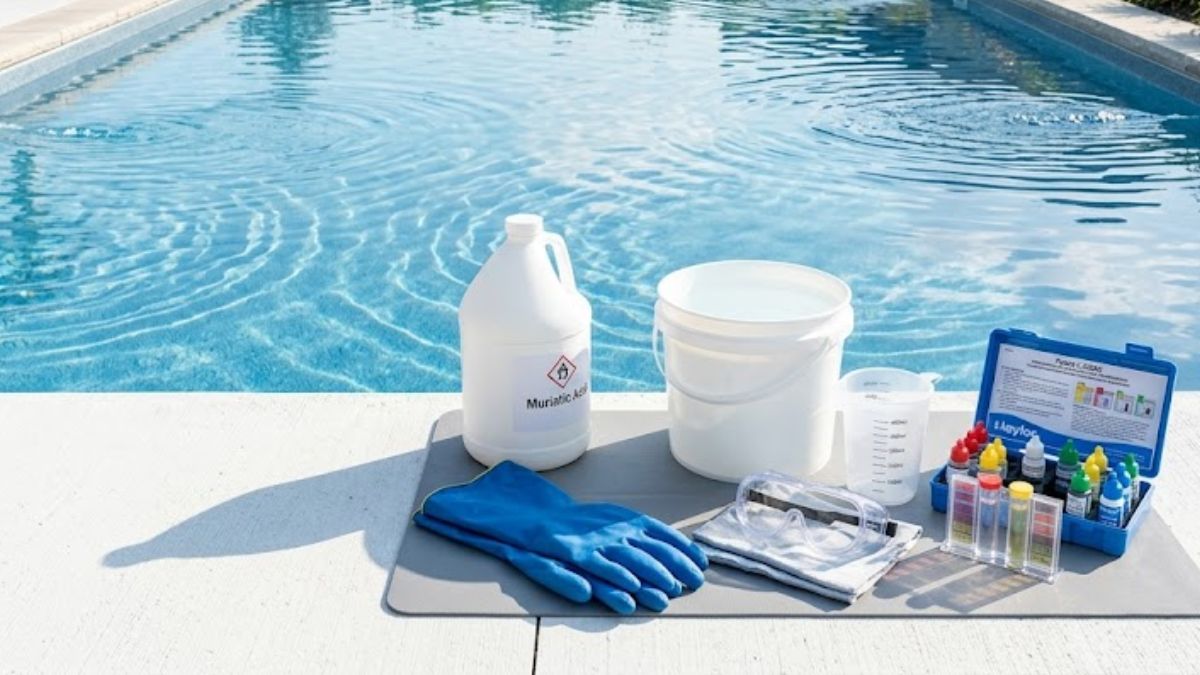

Your pool pH is above 7.8 and you have a jug of muriatic acid on the shelf. The fix is straightforward, but the order of steps matters more than most guides admit.
How to Add Muriatic Acid to Pool
Here is exactly how to add muriatic acid to a pool without damaging your surface, stressing your equipment, or overshooting the target.
Quick Answer:
To add muriatic acid to a pool, test the water, calculate the correct dose, dilute the acid in a bucket of pool water, pour it slowly near the return jets with the pump running, brush the pool floor, circulate the water for at least 4 hours, and retest before swimming.
How to Add Muriatic Acid to Pool
What Muriatic Acid Does in a Pool
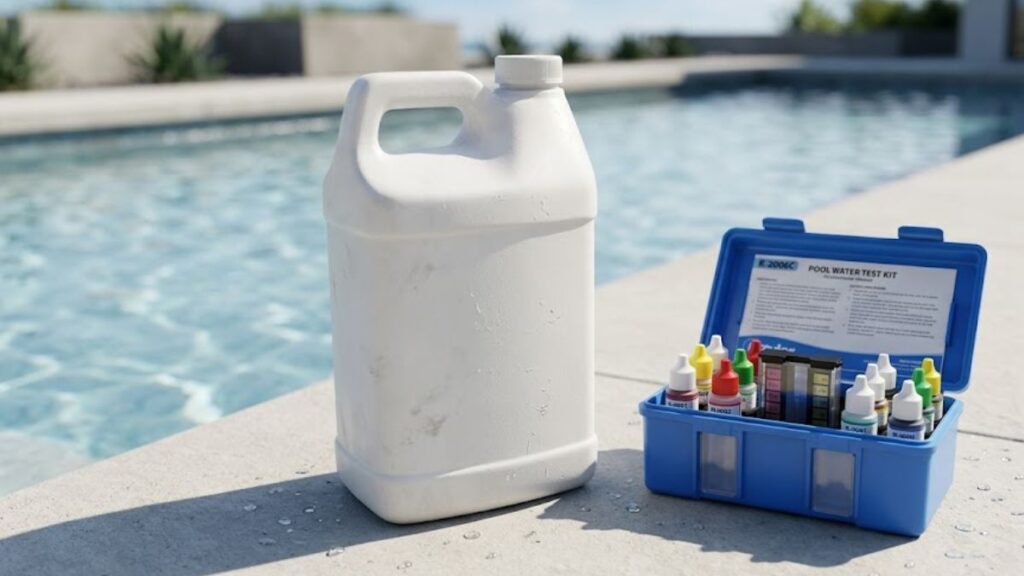
Muriatic acid is a diluted form of hydrochloric acid. It lowers two things in pool water: pH and total alkalinity. When pH climbs above 7.8, chlorine stops working properly. Scale builds on tile. Water turns cloudy. Swimmers get red eyes and itchy skin.
Adding muriatic acid to your pool brings pH back into the 7.2 to 7.6 range where chlorine is effective and water stays clear.
One thing most guides skip: muriatic acid affects pH faster than it affects alkalinity. If your goal is to lower alkalinity specifically, the technique is slightly different. That is covered in the dedicated guide to lowering pool alkalinity with muriatic acid.
Test Your Water Before Adding Muriatic Acid to the Pool
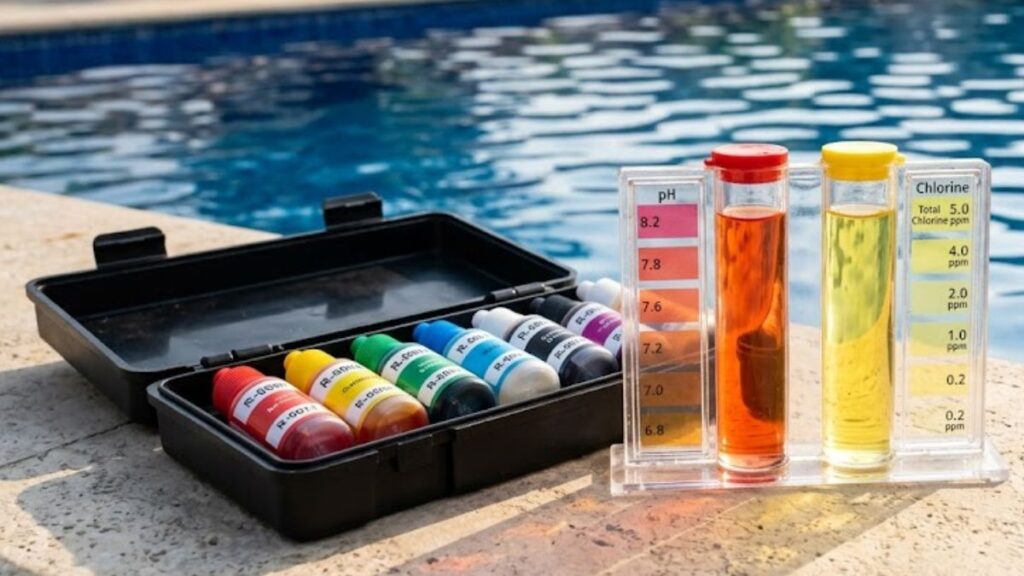
Adding muriatic acid to a pool without testing first is the most common mistake pool owners make. You need three numbers before you do anything else: current pH, total alkalinity, and pool volume in gallons. Without all three, you cannot calculate the right dose.
Test your water with a reliable drop-test kit. Test strips have a wider margin of error and can send you in the wrong direction. The Taylor Technologies K-2006 is the standard among pool professionals because it gives accurate free chlorine and pH readings that strips cannot match.
According to the Pool and Hot Tub Alliance, pool water should be tested at least twice a week during swimming season to catch pH drift before it becomes a bigger problem.
Target numbers before adding muriatic acid:
✓ pH: 7.2 to 7.6
✓ Total alkalinity: 80 to 120 ppm
✓ Do not add muriatic acid if pH is already at or below 7.2
How Much Muriatic Acid to Add to Your Pool
Dose depends on your pool volume and how far pH needs to drop.
Quick reference for 31.45% strength muriatic acid:
| Pool Size | Lower pH by 0.2 | Lower pH by 0.4 |
|---|---|---|
| 10,000 gallons | 13 fl oz | 26 fl oz |
| 15,000 gallons | 20 fl oz | 40 fl oz |
| 20,000 gallons | 26 fl oz | 52 fl oz |
| 25,000 gallons | 32 fl oz | 64 fl oz |
If you have the 20% strength version, multiply those numbers by 1.57 to get the right dose.
Do not try to fix a full 1.0 pH drop in one session. Split it into two doses, 4 to 6 hours apart, and retest between them. Overshooting pH low is harder to fix than undershooting.
For an exact dose based on your actual readings, the free muriatic acid pool calculator does the math for you in seconds.
How to Add Muriatic Acid to a Pool: 7 Steps
To add muriatic acid to a pool correctly, follow these steps in order:
- Test pH and confirm it is above 7.6
- Calculate the correct dose for your pool volume
- Put on gloves, goggles, and old clothing
- Fill a plastic bucket three-quarters full with pool water
- Slowly pour the measured acid into the bucket, acid into water, never the reverse
- Walk along the deep end near the return jets and pour the diluted solution slowly
- Run the pump for 4 hours, then retest pH before swimming
Here is each step in detail.
Step 1: Test the Water First
Check pH, total alkalinity, and free chlorine before starting. Write the numbers down. If free chlorine is above 5 ppm, wait until it drops before adding muriatic acid. High chlorine and acid added together at the same time can create unpredictable water chemistry.
Step 2: Calculate the Correct Dose
Use the dosage table above or the free calculator. When in doubt, start with the lower dose. You can always add more after retesting. You cannot easily undo an overdose.
Step 3: Put on Protective Gear
Acid-resistant gloves and safety goggles are not optional. Muriatic acid splashes unexpectedly, even from a bucket. One drop in the eye without goggles is a serious injury. Wear old clothes you would not mind throwing away.
Step 4: Dilute Muriatic Acid in a Bucket
Fill a clean plastic bucket three-quarters full with pool water. Then slowly pour the measured acid into the water. Never pour water into acid. Pouring water into acid creates a fast heat reaction that can splash acid back toward your face.
Step 5: Pour Near the Return Jets
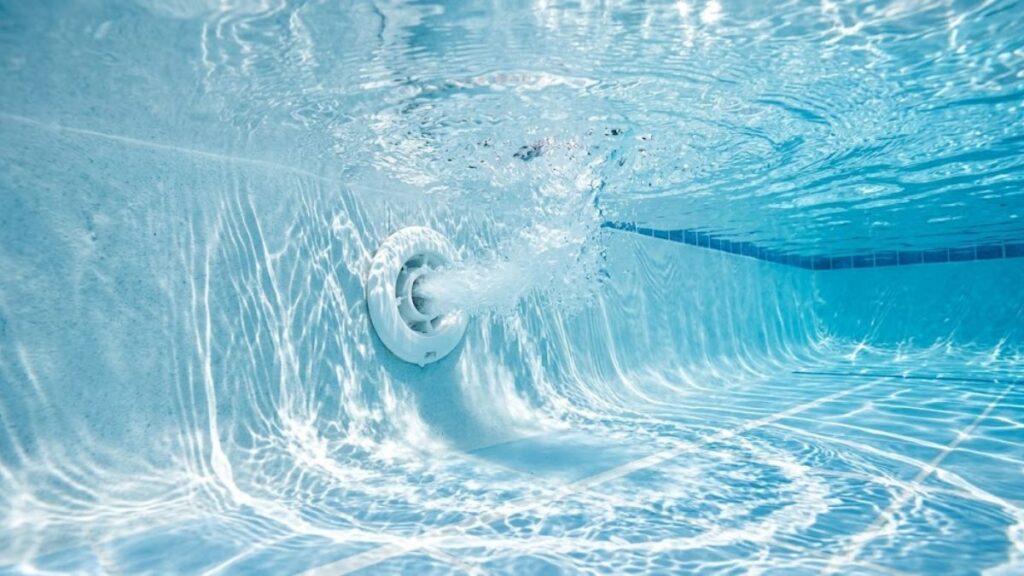
With the pump running, slowly pour the diluted muriatic acid near the return jets in the deep end. Walk the perimeter as you pour. Do not dump it all in one spot. Acid is heavier than water and will sink to the bottom and concentrate if you let it sit still.
Step 6: Brush the Pool Floor
After pouring, use your pool brush to sweep the bottom of the deep end for 2 to 3 minutes. This one step prevents the acid from sitting on plaster or vinyl and causing an etch mark or bleach spot. Most guides skip this step entirely. Do not skip it.
Step 7: Run the Pump and Retest
Run the pump for at least 4 hours. Retest pH before anyone swims. If pH is still above 7.6, add a second dose and repeat the process. If pH dropped below 7.2, point the return jets upward to aerate the water and let pH rise naturally.
Always start with the smaller acid dose, let the pump run for 4 hours, and retest before adding more. It’s much easier to lower pH further than to fix a pool that has become too acidic.
How Long to Wait Before Swimming After Adding Muriatic Acid
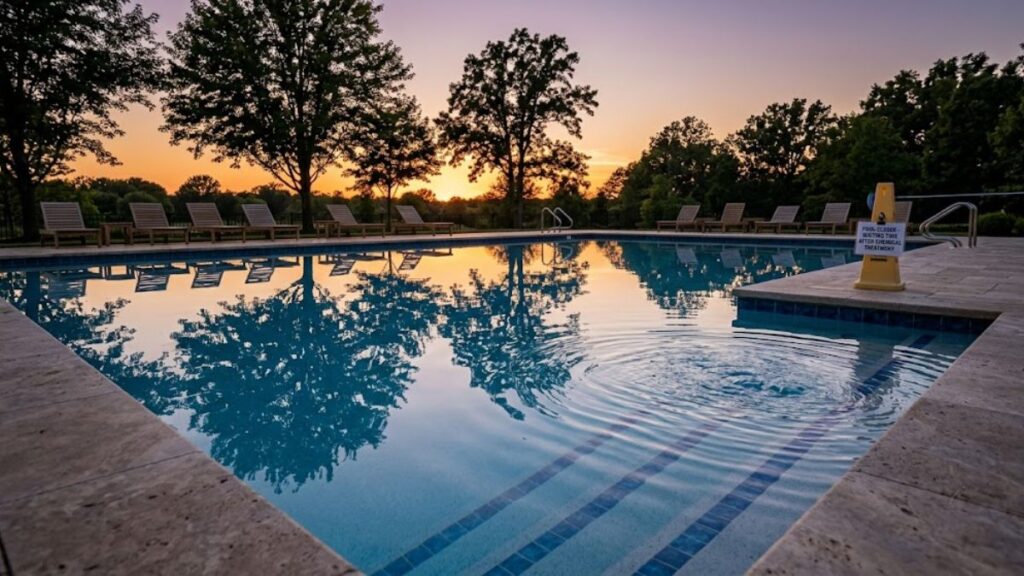
Wait at least 30 minutes for a small correction with the pump running. For larger doses, anything over half a gallon, wait 4 hours and retest before anyone gets in.
The wait time is not arbitrary. You are waiting for two things: the acid to fully dilute through all the water and the pH to stabilize at the new level. Getting in before retesting means guessing at your own safety.
Quick note: never add pool shock within 4 hours of adding muriatic acid to your pool. Add one chemical, let the pump run, retest, then handle the other.
Best Time of Day to Add Muriatic Acid to a Pool
Add muriatic acid in the evening or early morning, not at midday in direct sunlight. UV exposure slightly degrades the treatment, and heat speeds up fume off-gassing near the water surface.
If you have to add acid during the day, stand upwind of the pour point. Muriatic acid fumes are sharp. You will know right away if you are breathing them.
Always add muriatic acid after shocking is finished and chlorine has dropped back to a normal range. Never treat a pool with multiple chemicals in the same 30-minute window.
Muriatic Acid for Pool pH vs Alkalinity: Two Different Techniques
Most guides treat pH and alkalinity as the same task. They are not.
To lower pool pH: add muriatic acid with the pump running so it disperses quickly through the full water volume. Fast circulation hits pH efficiently.
To lower total alkalinity: turn the pump OFF after adding the acid. Let it concentrate in the deep end for 10 to 15 minutes before turning the pump back on. Concentrated acid has a much stronger effect on alkalinity than dispersed acid does. Pool professionals call this slug dosing, and it is the detail most guides leave out completely.
If both pH and alkalinity are high, lower alkalinity first using the slug dose method. Then let pH drift down naturally over the next day or two before deciding whether more muriatic acid is needed.
Common Mistakes When Adding Muriatic Acid to a Pool
Adding too much at once. Never try to fix a full pH point in one session. Split large corrections into two doses with a retest in between.
Pouring directly from the jug. Undiluted acid hitting pool surfaces causes etching and bleach spots. Always dilute in a bucket first.
Adding acid right before shock. Leave at least 4 hours between muriatic acid and any chlorine-based shock treatment.
Not brushing the pool floor after pouring. Acid sinks and sits. A 2-minute brush sweep after pouring prevents surface damage on both plaster and vinyl.
Skipping the retest. A drop-test kit costs under $30. A pool resurfacing job costs thousands.
Common Questions About Adding Muriatic Acid to a Pool
Q: How do I add muriatic acid to my pool? Dilute the measured dose in a bucket of pool water first. Then pour slowly near the return jets in the deep end with the pump running. Brush the floor after pouring. Retest pH after 4 hours before swimming.
Q: How long after adding muriatic acid to a pool can you swim? At least 30 minutes for a small dose with good circulation. For larger corrections, wait 4 hours and confirm pH is between 7.2 and 7.6 before anyone gets in.
Q: Can I add muriatic acid directly to the pool without diluting? No. Always dilute in a bucket of pool water first, acid into water, never reverse. Direct pouring from the jug concentrates acid in one spot and etches or bleaches pool surfaces.
Q: When should I add muriatic acid to my pool? When pH tests above 7.6. Evening is the best time. UV is lower, air is cooler, and the pump can run overnight to fully circulate the treatment before morning use.
Q: How much muriatic acid do I need to lower pool pH? For a 10,000-gallon pool using 31.45% strength acid, about 13 fl oz drops pH by 0.2 points. Use the free muriatic acid pool calculator for your exact pool size and current readings.
Q: Should the pump be on or off when adding muriatic acid to a pool? For pH correction, keep the pump running so the acid spreads quickly through all the water. For alkalinity reduction only, turn the pump off for 10 to 15 minutes after pouring, then switch it back on. That concentrated dose is what moves alkalinity down.
Q: What should I do if I added too much muriatic acid to my pool? Stop adding chemicals immediately. Run the pump and point the return jets upward to aerate the water. Aeration raises pH naturally without extra chemicals. Retest after 4 hours. If pH is still below 7.0, add soda ash (sodium carbonate) in half-pound doses and retest after each addition until pH reaches 7.2.
Q: Why is my pool pH still high after adding muriatic acid? High total alkalinity is almost always the reason. Alkalinity acts as a buffer and resists pH change. If TA is above 120 ppm, the pool fights every correction you make. Lower alkalinity first using the slug dose method, and pH will become much easier to manage.
Q: Can I add muriatic acid to an above ground pool? Yes, the process is the same. Dilute in a bucket, pour near the return jet with the pump running, and brush the liner floor gently after pouring. With vinyl liners, brushing right after is especially important since acid sitting on vinyl causes bleach spots faster than on plaster.
Q: Can I add shock and muriatic acid on the same day? Yes, but not at the same time. Add one chemical, run the pump for at least 4 hours, retest the water, then add the other. Adding both in the same window creates unpredictable reactions and makes it impossible to diagnose any problem that follows.
Conclusion
Test before you add. Dilute in a bucket. Pour near the return jets with the pump on. Brush the pool floor after pouring. Run the pump for 4 hours. Retest before swimming. Split large corrections across two sessions.
Adding muriatic acid to your pool is straightforward when the steps are in the right order.
The Pool and Hot Tub Alliance (PHTA) recommends keeping pool pH between 7.2 and 7.8 for safe and effective sanitization. Staying in that range means your chlorine works, your surfaces stay intact, and your swimmers stay comfortable all season.
Still unsure how much acid to add? Try our free Muriatic Acid Pool Calculator to get an accurate dose based on your pool size, pH, and alkalinity.