
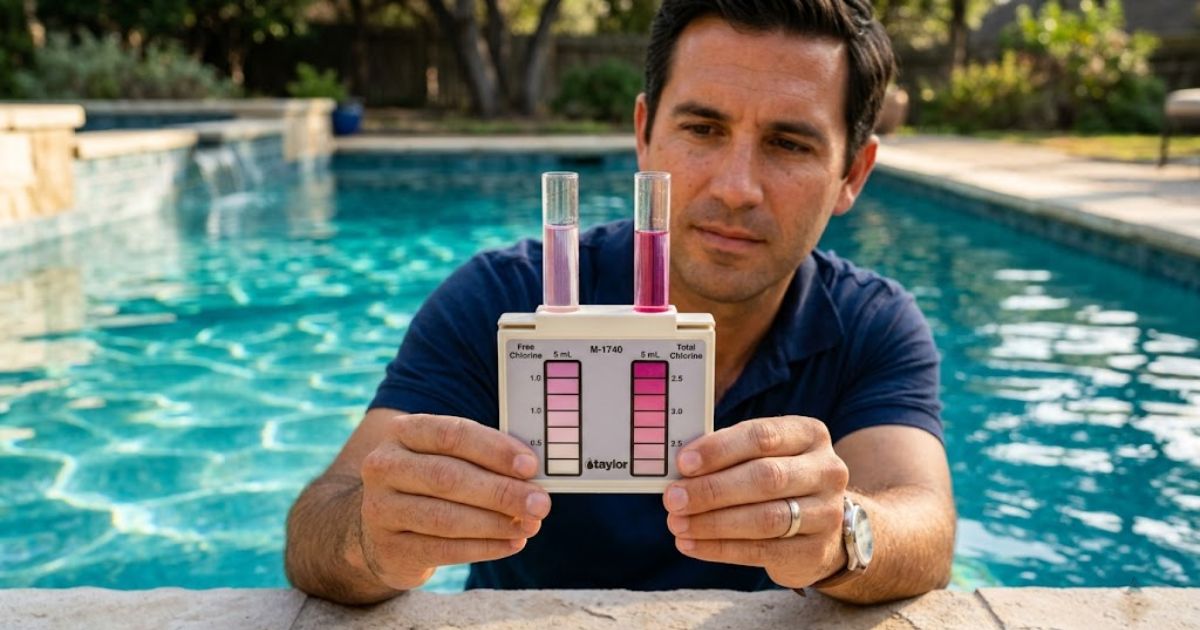

Your pool test reads 3 ppm total chlorine. Sounds fine. But swimmers are getting red eyes and the water smells sharp. Something is wrong, and it’s not what most people think.
Total chlorine and free chlorine are not the same number. The gap between them is one of the most misunderstood concepts in pool chemistry, and getting it wrong means people swim in water that feels over-chlorinated even when free chlorine has actually been depleted.
This guide explains the difference clearly, shows you how to test for each, and tells you exactly what to do when combined chlorine is the real problem.
📌 KEY TAKEAWAYS
- Free chlorine = active sanitizer — the only number that determines if your pool is safe
- Combined chlorine = spent, non-sanitizing chlorine (chloramines) — causes pool smell and irritation
- Total chlorine = free + combined — a high reading does not mean the pool is safe
- If total chlorine significantly exceeds free chlorine, chloramines are the problem
- The fix for high combined chlorine is shock treatment — not reducing chlorine
- Standard yellow OTO test strips only measure total chlorine — they don’t show the split
Free Chlorine vs Total Chlorine: The Simple Explanation
Free chlorine is the active sanitizing agent in pool water, the portion that kills bacteria, algae, and viruses on contact. Total chlorine is free chlorine plus combined chlorine (chloramines). Combined chlorine has been chemically consumed and no longer sanitizes. A pool with high total chlorine but low free chlorine can be simultaneously over-smelling and under-sanitizing.
Think of it this way.
You hire ten security guards for an event. Six are actively patrolling, stopping problems in real time. Four are sitting at a table eating sandwiches. Technically present. Not doing the job.
Free chlorine = the guards actively patrolling. Combined chlorine = the ones at the table. Total chlorine = all ten, regardless of what they’re doing.
A test that only shows total chlorine tells you how many guards you hired. It doesn’t tell you how many are actually working. That distinction is everything when it comes to whether your pool is genuinely safe.
“See the complete pool chemistry reference chart with ideal ranges for all six parameters”
What Is Combined Chlorine (Chloramines)?
Combined chlorine, also called chloramines, forms when free chlorine reacts with nitrogen-containing compounds introduced by swimmers, urea, sweat, amino acids, and personal care products. According to the CDC, chloramines are the primary cause of eye irritation, skin discomfort, and respiratory issues in indoor and outdoor pools. They provide no sanitizing benefit despite appearing on total chlorine test readings.
When free chlorine encounters nitrogen compounds in pool water, from sweat, urine, sunscreen, and body oils, it reacts to form chloramines. Three main types exist:
Monochloramine (NH₂Cl) — the mildest form, minimally irritating, still slightly effective at very low concentrations.
Dichloramine (NHCl₂) — more volatile, more irritating. Eye irritation begins at this stage.
Trichloramine (NCl₃) — the most volatile and most irritating. This is the compound responsible for that sharp, suffocating pool smell, especially intense in indoor pools where it concentrates above the water surface.
Here’s the thing: chloramines are the signal that free chlorine has been consumed, not that there’s too much of it. When your pool smells aggressively of chlorine, it almost always means free chlorine has been depleted by organic contaminants. The pool doesn’t need less chlorine. It needs more, specifically, a shock treatment to destroy the chloramine bonds through breakpoint chlorination.
Why Does a Pool Smell Like Chlorine?
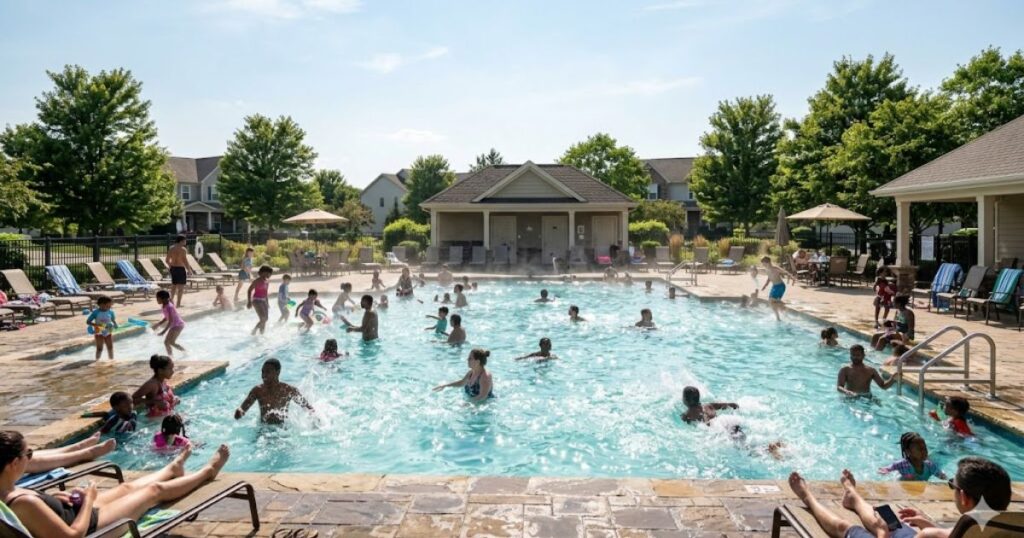
The smell that hits you at a busy pool is trichloramine gas rising from the water surface.
Not free chlorine. Not excess sanitizer. Chloramines.
This is the most counter-intuitive fact in pool chemistry, and understanding it changes how you respond to pool odour permanently.
A well-maintained pool with ideal free chlorine and minimal combined chlorine has almost no smell. The “chlorine smell” associated with swimming pools is specifically trichloramine, the byproduct of free chlorine reacting with bather contamination. The stronger the smell, the more chloramines are present, and the more free chlorine has been consumed.
An indoor pool that reeks of chlorine after a busy weekend is almost certainly a pool with high combined chlorine and depleted free chlorine, not a pool with too much sanitizer.
The fix: breakpoint chlorination, shocking to a free chlorine level high enough to chemically destroy all combined chlorine. Not dilution. Not reducing chlorine. Shock.
“How to shock a pool step by step — the correct process to eliminate chloramines and restore water clarity”
How to Test Free Chlorine vs Total Chlorine
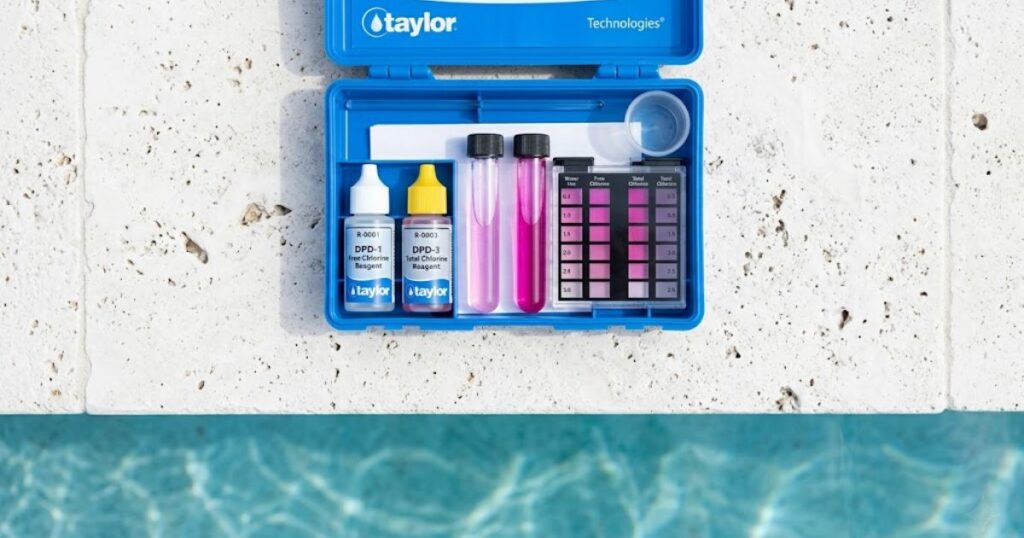
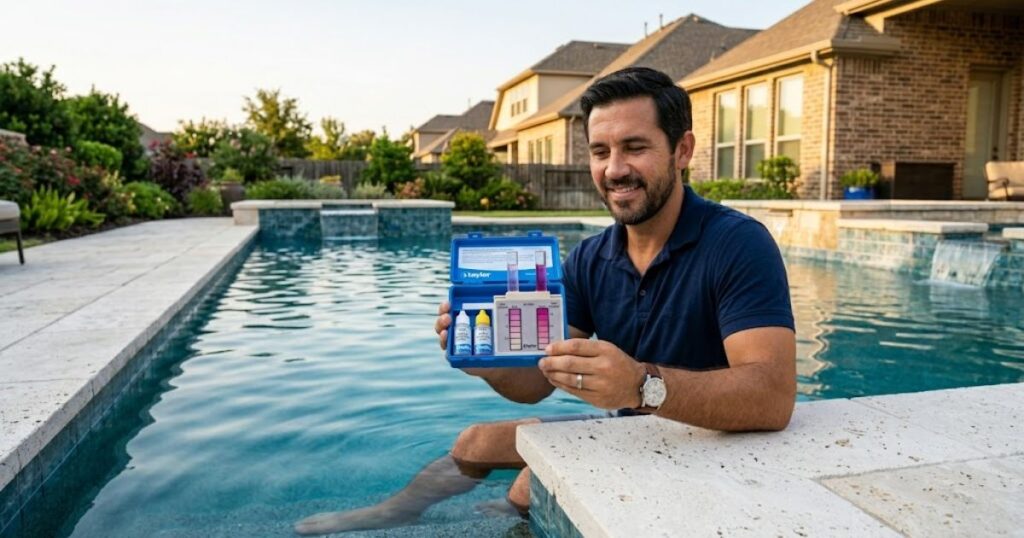
To test free chlorine vs total chlorine separately, use a DPD liquid test kit with two reagent stages. DPD-1 reagent develops a pink colour proportional to free chlorine only. Adding DPD-3 reagent to the same sample reacts with combined chlorine to show total chlorine. Subtracting free from total gives combined chlorine. Test strips and OTO kits typically show total chlorine only.
DPD liquid test kit — the professional standard:
- Add DPD-1 reagent → pink colour reading = free chlorine only
- Add DPD-3 reagent to the same tube → deeper pink = total chlorine
- Free chlorine minus total chlorine = combined chlorine — the problem number
OTO test (yellow comparator): Only measures total chlorine. Completely blind to the free/combined split. Doesn’t tell you whether that chlorine is working or spent. Still widely sold, avoid it for any meaningful chemistry management.
Standard test strips: Most strips measure total chlorine only. For diagnosing a chloramine problem specifically, always use a liquid DPD kit, accuracy at elevated combined chlorine levels on strips is insufficient.
Pool store photometer testing: The most accurate method available. A calibrated photometer separately reads free, combined, and total chlorine in ppm. If a persistent odour or irritation problem doesn’t resolve with shock treatment, a photometer test often reveals calibration errors in home kits rather than water issues.
What Should the Numbers Look Like?
A healthy pool maintains a very small or zero gap between free and total chlorine:
| Reading | Ideal | Acceptable | Action Needed |
|---|---|---|---|
| Free Chlorine | 1–3 ppm | 1–5 ppm | Below 1 ppm or above 5 ppm |
| Combined Chlorine | 0 ppm | Below 0.2 ppm | Above 0.5 ppm → shock |
| Total Chlorine | Equal to free | Free + up to 0.2 ppm | Gap exceeds 0.5 ppm |
The key diagnostic: if total chlorine is significantly higher than free chlorine, combined chlorine has accumulated. That gap is the smell, the irritation, and the ineffective sanitation.
Worked example:
- Total chlorine: 4.0 ppm
- Free chlorine: 2.0 ppm
- Combined chlorine: 2.0 ppm — this pool needs immediate shock treatment
When Is Combined Chlorine the Real Problem?
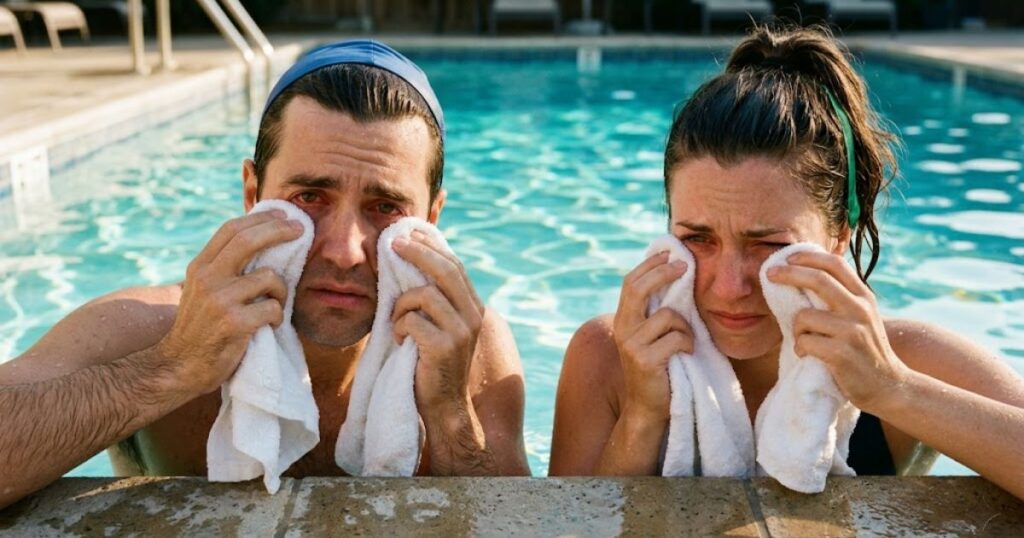
You’re dealing with combined chlorine, not free chlorine, when:
- Your pool smells sharply of chlorine despite an adequate total chlorine test reading
- Swimmers get red eyes after short swims in a pool that “tested fine”
- The gap between total and free chlorine exceeds 0.5 ppm
- The pool went through heavy use — a party, busy weekend, or heat wave
- Free chlorine reads normal but the water looks slightly hazy with no obvious cause
- You’re managing an indoor pool where trichloramine accumulates above the water surface
Quick note: rain doesn’t directly cause chloramine problems. Rain dilutes free chlorine, which allows organic matter to build up — which then reacts with fresh chlorine to form chloramines once you re-dose. The sequence matters when diagnosing the root cause.
How to Fix High Combined Chlorine
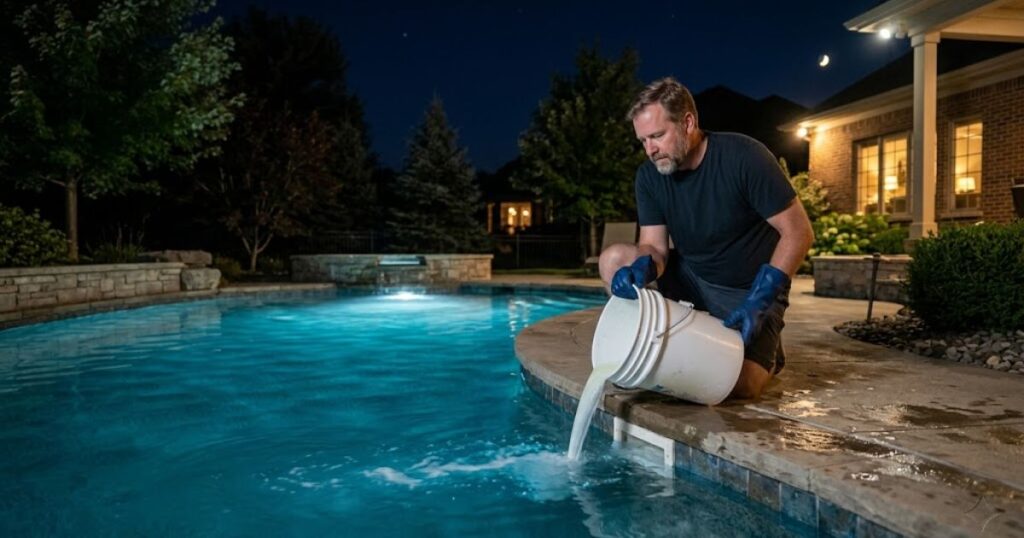
One method. No shortcuts.
Breakpoint chlorination shock the pool to a free chlorine level that chemically destroys all existing chloramine bonds. The breakpoint is the specific free chlorine concentration at which the reaction switches from forming chloramines to destroying them. For residential pools this means raising free chlorine to approximately 10 times the combined chlorine reading.
Example: combined chlorine is 1.0 ppm → shock to 10 ppm free chlorine to reach breakpoint.
Steps:
- Test and record free chlorine, total chlorine, and calculate combined chlorine
- Check and adjust pH to 7.2–7.4 before shocking, high pH reduces effectiveness by 50%+
- Calculate your target: combined chlorine × 10 = target free chlorine ppm
- Dose calcium hypochlorite shock accordingly using your pool volume
- Add shock after dark, UV degrades cal-hypo within the first hour of sunlight
- Run the pump overnight at full speed
- Re-test free and combined chlorine in the morning, confirm combined is below 0.2 ppm before swimming
Not dilution. Not reducing chlorine. Shock.
“After shocking, if free chlorine overshot the target here is how to lower it back to the safe range quickly confirms trichloramine as primary pool irritant and health risks of sustained chloramine exposure
FAQs
What is the difference between free chlorine and total chlorine?
Free chlorine is the active sanitizer that kills bacteria and algae. Total chlorine is free plus combined chlorine (chloramines) — the spent byproduct. High total chlorine doesn’t mean your pool is safe if free chlorine is low.
Why does my pool smell like chlorine if the reading is high?
That smell is trichloramine — a chloramine compound — not excess free chlorine. It means free chlorine has been consumed and converted into a non-sanitizing waste product. Fix it by shocking the pool, not by reducing chlorine.
What should combined chlorine be in a pool?
Below 0.5 ppm — ideally below 0.2 ppm. Calculate it by subtracting your free chlorine reading from your total chlorine reading using a DPD liquid kit. Above 0.5 ppm, the pool needs shock treatment immediately.
Can test strips measure free and total chlorine separately?
Most strips only measure total chlorine. For an accurate free vs combined reading, use a liquid DPD kit — add DPD-1 for free chlorine, DPD-3 for total chlorine. The difference between the two readings is combined chlorine.
How do I lower combined chlorine in a pool?
Shock to breakpoint chlorination — raise free chlorine to approximately 10 times the combined chlorine reading. Adjust pH to 7.2–7.4 first, add shock at night, run the pump overnight, re-test the next morning. Dilution doesn’t work — it spreads chloramines, it doesn’t destroy them.
The Bottom Line
The numbers on a total chlorine test don’t tell you whether your pool is safe. Free chlorine tells you that. Total chlorine tells you what’s present, active and inactive together.
When the gap between those two numbers grows, combined chlorine is accumulating. That gap is the smell. That gap is the red eyes. That gap is the reason swimmers feel irritated in a pool that “tested fine.”
Fix it with shock. Fix pH first. Every time.
