
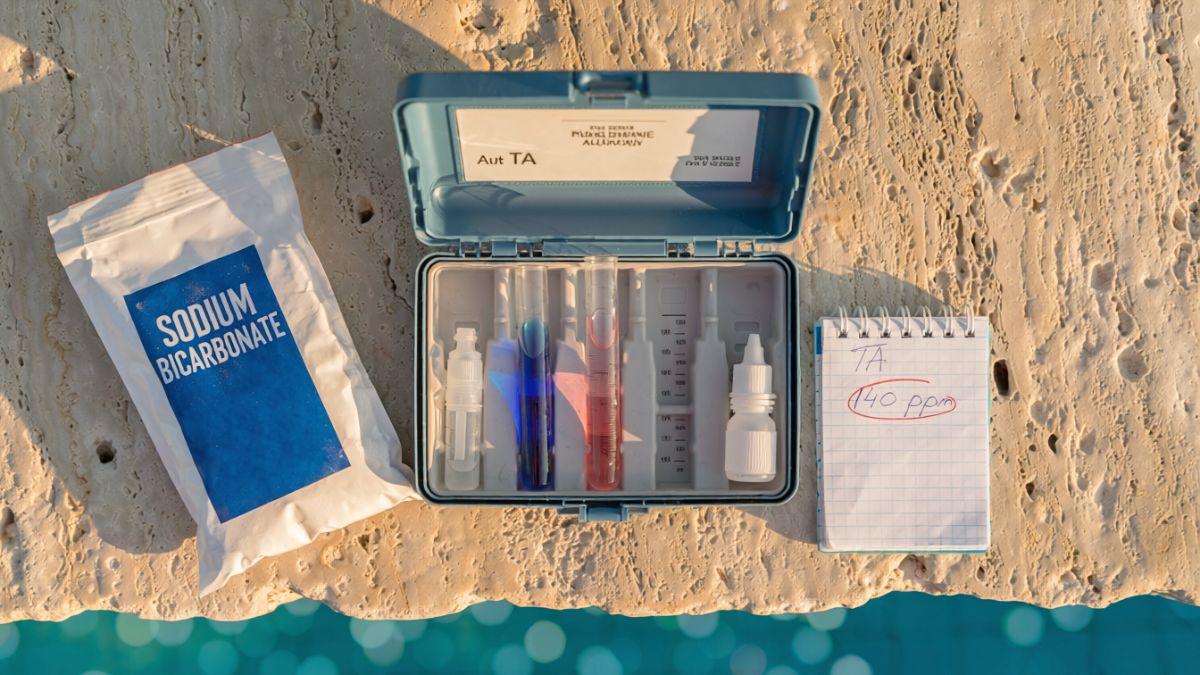

Pool alkalinity levels chart is what you need right now if your test result is sitting in front of you and you are not sure what the number means. This guide gives you the answer in seconds, then tells you exactly what to do next.
Quick Answer: Normal pool alkalinity is 80 to 120 ppm. Below 80 causes pH swings and corrosion. Above 120 causes cloudy water and scale.
Key Takeaways
✓ Ideal total alkalinity for most pools is 80 to 120 ppm
✓ Always fix alkalinity before adjusting pH
✓ Sodium bicarbonate raises low TA, muriatic acid lowers high TA
✓ Saltwater pools work better at 70 to 100 ppm
✓ Test once per week during swim season
Pool Alkalinity Levels Chart
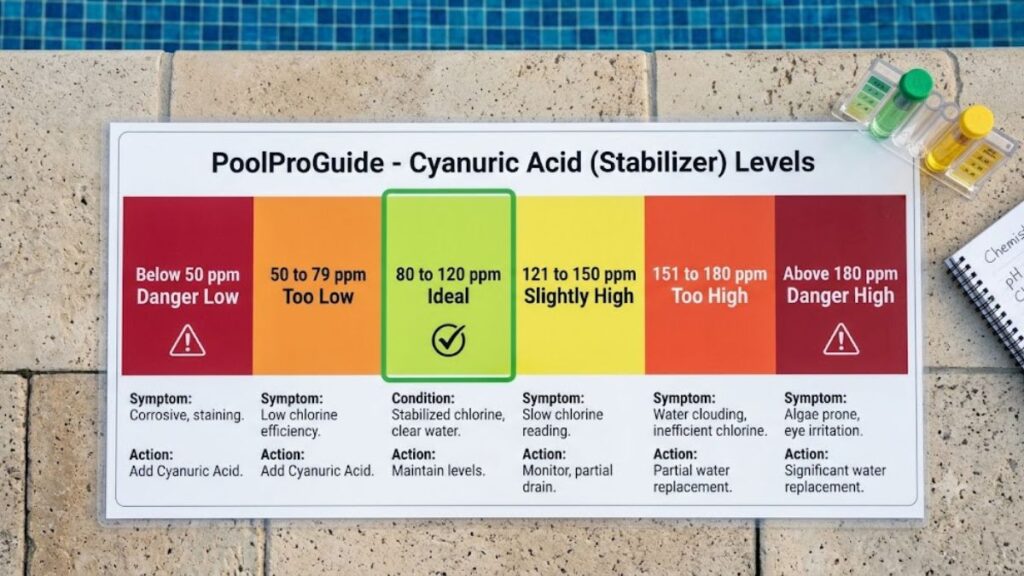
Find your reading and read across. This is everything you need to know at a glance.
| Total Alkalinity | Status | What Is Happening | What to Do |
|---|---|---|---|
| Below 50 ppm | Danger Low | pH crashing, surfaces corroding | Add sodium bicarbonate immediately |
| 50 to 79 ppm | Too Low | pH unstable, corrosion risk | Raise with sodium bicarbonate |
| 80 to 120 ppm | Ideal | Water balanced, chlorine effective | Nothing, maintain weekly testing |
| 121 to 150 ppm | Slightly High | pH starting to lock, mild cloudiness | Monitor, treat if symptoms appear |
| 151 to 180 ppm | Too High | Cloudy water, pH resists acid | Lower with muriatic acid |
| Above 180 ppm | Danger High | Severe cloudiness, chlorine failing | Treat immediately |
Ideal Pool Alkalinity by Pool Type
The 80 to 120 ppm standard is not right for every pool. Your pool type changes the target.
| Pool Type | Ideal TA Range |
|---|---|
| Chlorine Concrete or Plaster | 80 to 120 ppm |
| Chlorine Vinyl Liner | 80 to 120 ppm |
| Saltwater Pool | 70 to 100 ppm |
| Fiberglass Pool | 80 to 100 ppm |
| Spa or Hot Tub | 100 to 150 ppm |
Saltwater pools need a lower TA because salt cells naturally push pH upward. A lower TA ceiling means you add acid less often. Our guide on why pool pH keeps rising explains the full relationship.
Signs Your Alkalinity Is Too High
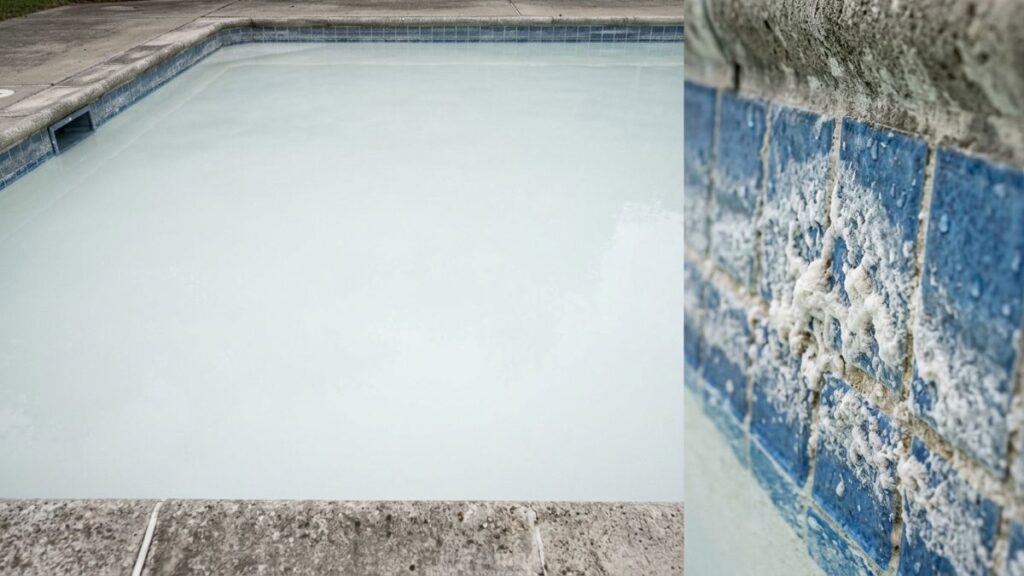
Two or more of these showing up at once means your TA is worth checking before you spend money on anything else.
| Symptom | What Is Causing It |
|---|---|
| Cloudy or milky water | High pH forcing calcium out of solution |
| White scale on tile or equipment | Calcium carbonate depositing on surfaces |
| pH will not drop after adding acid | High TA buffering against correction |
| Chlorine disappearing fast | Elevated pH weakening sanitizer |
| Green water despite normal chlorine reading | Ineffective chlorine at high pH |
For the step-by-step fix, see our complete guide: how to lower alkalinity in a pool.
Signs Your Alkalinity Is Too Low
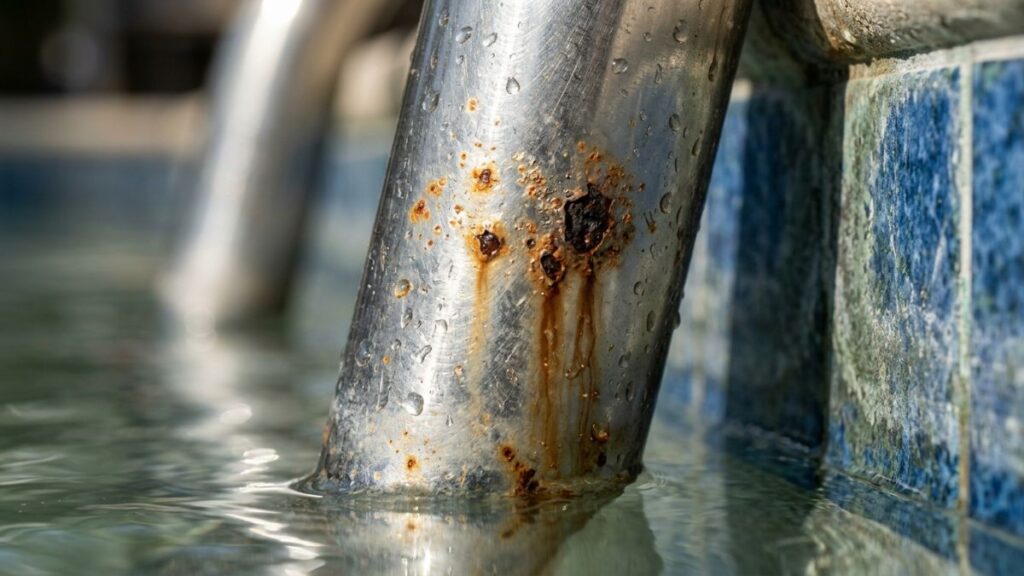
Low TA damage happens faster than high TA. Corrosion can start within days of dropping below 60 ppm.
| Symptom | What Is Causing It |
|---|---|
| pH swings 0.5 to 1.0 units overnight | No buffering capacity in the water |
| Eye and skin irritation after swimming | Acidic water below safe pH range |
| Metal fittings corroding or leaving stains | Acid attacking metal surfaces |
| Plaster or grout etching | Acid dissolving pool surface material |
| pH drops immediately after adding chlorine | Unstable water chemistry |
Can You Swim With Incorrect Alkalinity?
| TA Reading | Safe to Swim? |
|---|---|
| Below 60 ppm | Not recommended, treat first |
| 60 to 79 ppm | Short periods only, treat within 48 hours |
| 80 to 120 ppm | Yes, ideal conditions |
| 121 to 150 ppm | Yes, watch for eye irritation |
| Above 150 ppm | Check pH first, hold if both are elevated |
According to the CDC’s pool water guidelines, stable pH between 7.2 and 7.8 is required for safe disinfection, which depends directly on correct alkalinity.
How to Fix High Pool Alkalinity
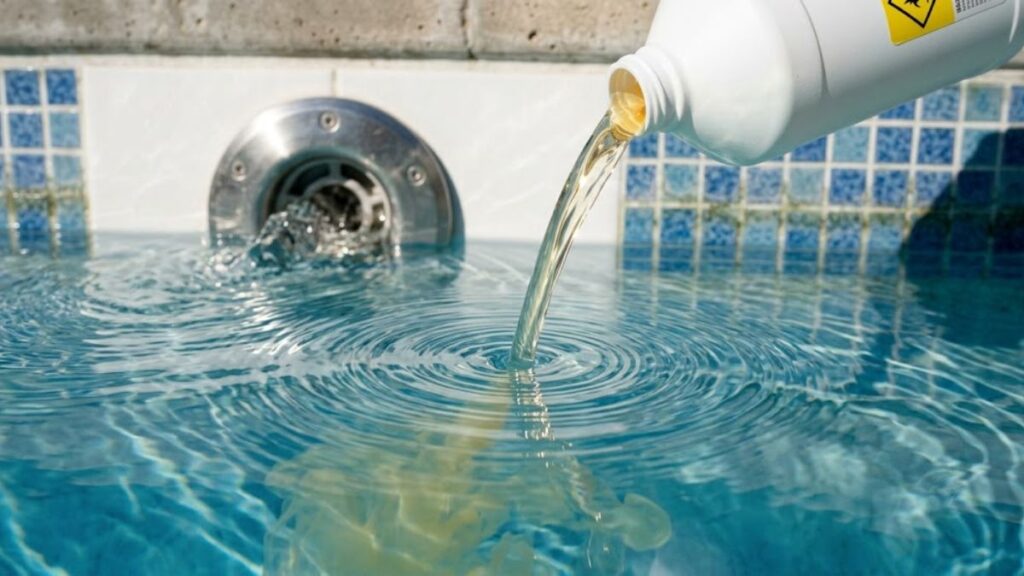
Add muriatic acid (concrete and plaster pools) or dry acid (vinyl and fiberglass pools).
- Confirm TA is above 120 ppm with a drop-test kit, not strips
- Pre-dilute acid in a bucket of pool water first
- Pour slowly near a return jet with the pump running
- Wait 6 to 8 hours before retesting
- Do not lower TA more than 20 ppm per session
- Run aeration for 8 to 12 hours after to recover pH naturally
Full dosing table for every pool size: how to lower alkalinity in a pool.
How to Fix Low Pool Alkalinity
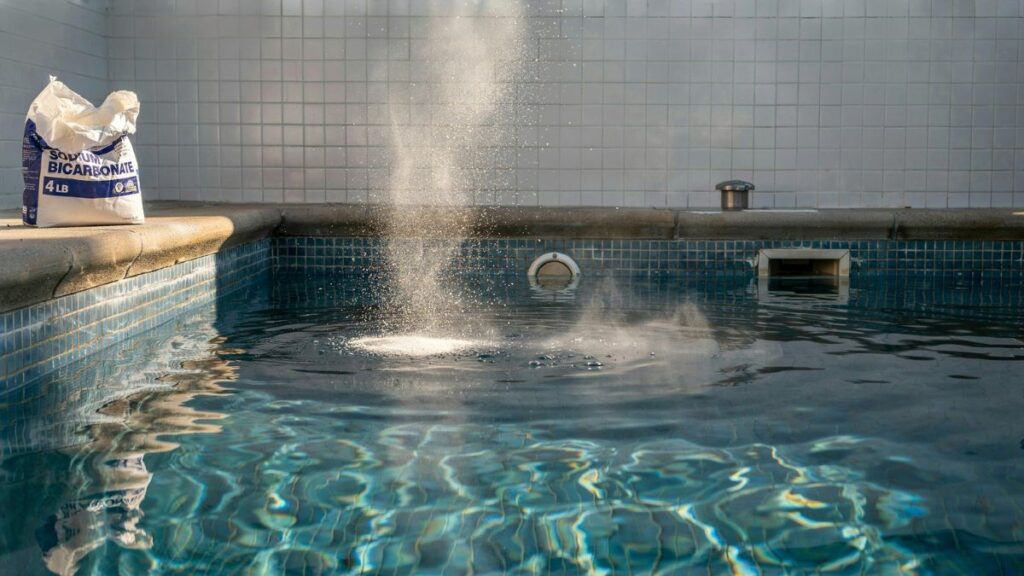
Use sodium bicarbonate only. Not soda ash, which raises both TA and pH together.
- Confirm TA is below 80 ppm
- Add 1.5 lbs of sodium bicarbonate per 10,000 gallons to raise TA by 10 ppm
- Broadcast across the deep end with the pump running
- Wait 6 hours before retesting
- Adjust pH only after TA is corrected
How Alkalinity Affects pH and Chlorine
TA is what keeps pH stable between tests. When TA is in range, a small acid addition moves pH a predictable amount. When TA is too low, any input, rain, bathers, or even CO2 from the air, sends pH swinging by a full unit overnight.
At high pH caused by high TA, roughly 10 percent of your chlorine is in the active form that kills bacteria. At ideal pH of 7.4 to 7.6, that rises to 50 to 60 percent. Same chlorine reading, completely different results. Our pool chlorine levels chart shows this at every pH reading.
This is why alkalinity is always corrected before pH. Fix the foundation first and everything else becomes controllable.
If your pH keeps bouncing back after adding acid, stop adjusting pH and test your total alkalinity first. A TA above 120 ppm means acid cannot work properly. Fix the alkalinity and pH adjustments will finally hold.
Frequently Asked Questions
What is the ideal pool alkalinity level? 80 to 120 ppm for most pools. Saltwater and fiberglass pools work better at 80 to 100 ppm.
Is 150 ppm alkalinity too high? It is at the high end. If you are also seeing cloudy water or pH that resists acid, treat it. If water is clear and pH is stable, monitor it weekly.
Should I fix alkalinity or pH first? Always alkalinity first. Adjusting pH while TA is wrong means your adjustment will not hold.
Does baking soda raise pool alkalinity? Yes. Sodium bicarbonate raises TA with minimal effect on pH. Do not use soda ash for this, it raises both at once.
Can high alkalinity cause cloudy water? Yes. High TA raises pH, which forces dissolved calcium out of solution as a milky cloudiness that shocking will not clear.
Final Thoughts
Alkalinity is the foundation of your pool chemistry. When it is in range, everything else is manageable. When it drifts, no other adjustment holds for long.
Use the chart above to find your reading, match it to the right action, and correct TA before touching pH or chlorine. That sequence alone solves most recurring pool chemistry problems without buying extra chemicals.