
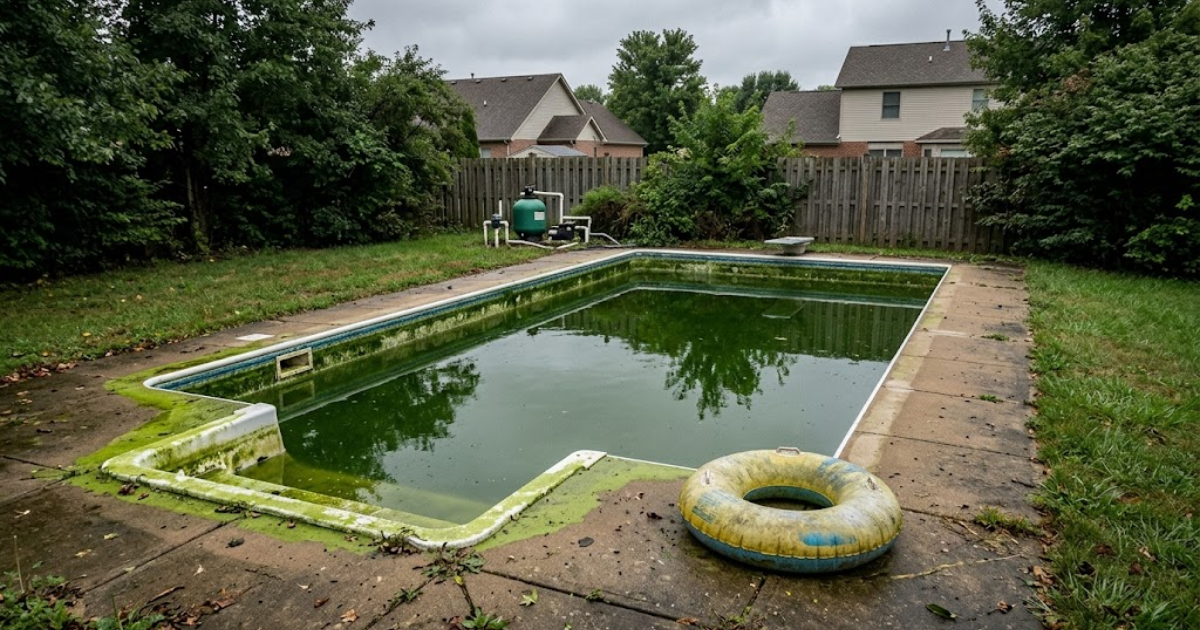
You walked outside and the pool is green. Not slightly off — actually green.
Maybe it happened overnight after a storm. Maybe you came back from two weeks away to find it. Either way, you’re looking at an algae bloom, and the question isn’t whether you can fix it, you can , it’s whether you’re going to do it in the right order so you don’t waste $50 of chemicals on a treatment that doesn’t work.
Here’s exactly what to do, step by step, with dosing based on your actual pool size.
📌 KEY TAKEAWAYS
- Do not swim in a green pool — algae hosts bacteria including E. coli
- Green pool shock dose: double or triple the normal maintenance amount
- Always brush walls and floor before shocking — this is what most people skip
- After shocking: run filter 24–48 hours continuously and backwash every 4–6 hours
- Light green clears in 1–2 days. Dark green takes 5–7 days with repeated treatment
- Black algae spots on walls require a completely different treatment strategy
This guide covers residential swimming pools. Swim spa and hot tub green water has different causes and requires different treatment — pool shock volumes are far too large for small units.
New to pool shocking? Read our full step-by-step pool shock guide first”
Why Did Your Pool Turn Green?
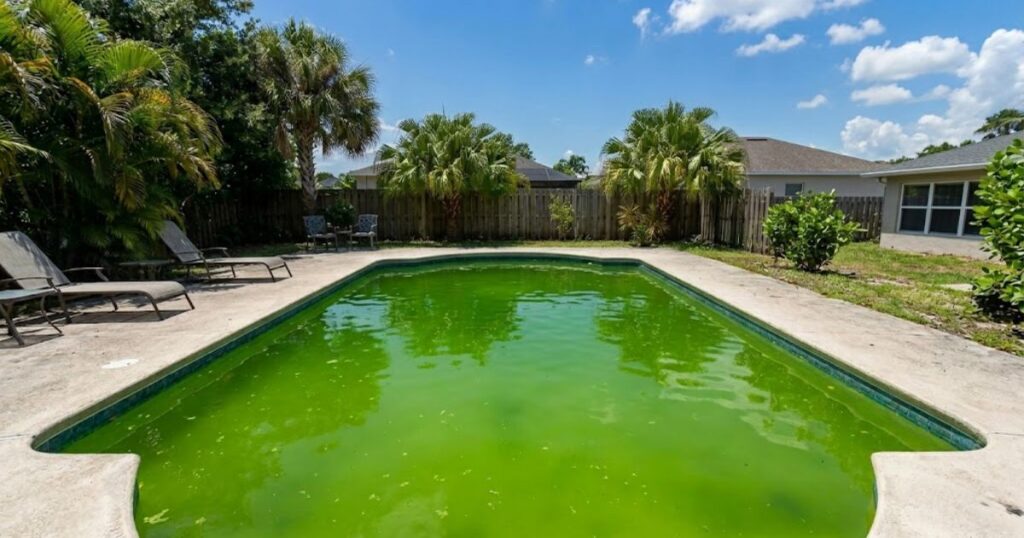
Pools turn green when algae — most commonly green algae (Chlorella or Cladophora), colonises the water and surfaces due to a drop in free chlorine. Algae spores are present in virtually all outdoor pool water at all times; they bloom when chlorine falls below 1 ppm, especially when combined with warm temperatures, sunlight, and elevated phosphate levels from rain runoff.
The short answer: your chlorine crashed, algae spores found the right conditions, and they multiplied fast.
Algae grows through photosynthesis, it uses sunlight and dissolved nutrients in the water to reproduce. In a properly chlorinated pool, free chlorine kills algae spores before they establish. Once chlorine drops below 1 ppm in warm weather, spores can go from invisible to a visible bloom within 24–48 hours.
The four most common triggers:
Heavy rain. Rain dilutes chlorine, washes phosphates and organic matter into the pool, and shifts pH, all at once. A summer storm on a Friday evening can produce a green pool by Sunday morning.
Heat and UV exposure. High summer temperatures accelerate algae growth while simultaneously degrading chlorine faster. A well-balanced pool in June may need twice the chlorine dose it needed in April.
Forgetting to dose. A week away, a holiday weekend, an inconsistent maintenance schedule. Chlorine demand doesn’t pause.
High cyanuric acid (CYA). CYA above 80–100 ppm reduces chlorine’s ability to kill algae even when ppm readings look normal. The chlorine is present but shielded from reacting, a condition called chlorine lock.
Is It Safe to Swim in a Green Pool?
No. Not even briefly.
Green pool water isn’t just discoloured. Algae provides a habitat for bacteria, including E. coli and other pathogens, that free chlorine would normally eliminate. When algae is thriving, chlorine is no longer effectively sanitizing. Swimmers risk skin rashes, ear infections, eye irritation, and gastrointestinal illness from swallowing the water.
Keep everyone out until the water is completely clear, a DPD test confirms 1–3 ppm free chlorine, and the pool floor is fully visible from the deck.
How Green Is It? Diagnosing Before You Treat
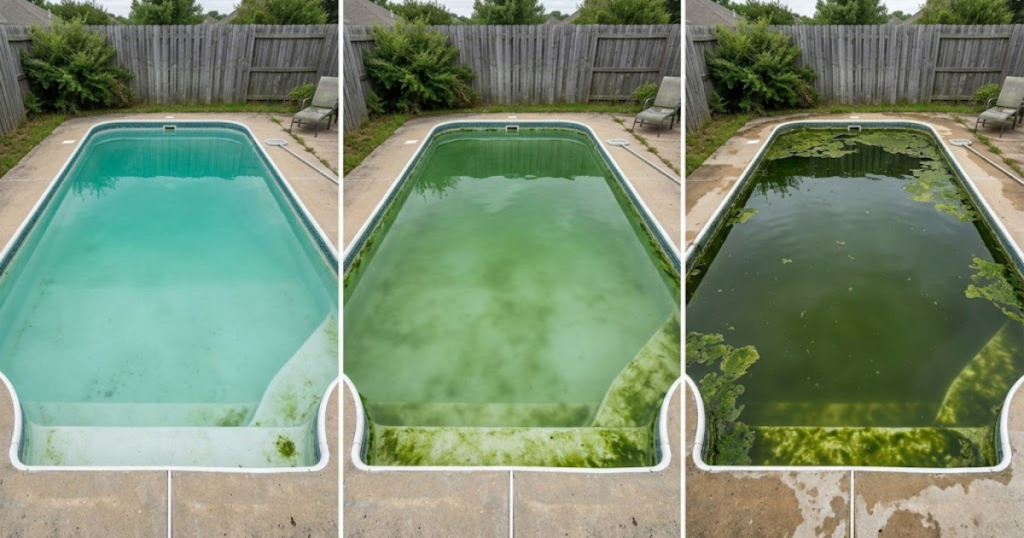
The dose you need depends entirely on how severe the bloom is. Under-dosing is the single most common reason green pool treatments fail.
| Pool Appearance | Algae Severity | Floor Visible? | Recommended Dose | Est. Clear Time |
|---|---|---|---|---|
| Slight teal or green tint | Early / mild bloom | Yes — clearly | 2× maintenance dose | 24–48 hours |
| Cloudy green, walls coated | Moderate bloom | Partially | 3× maintenance dose | 2–4 days |
| Dark green, opaque water | Heavy bloom | No | 3× dose × 2 treatments | 5–7 days |
| Black or dark patches on walls | Black algae (Cyanobacteria) | No | Specialist treatment needed | Weeks |
A note on black algae: Black algae is not actually algae, it’s a bacterium with a protective outer layer making it highly resistant to standard shock. If you have dark spots on pool walls that won’t brush off, you’re dealing with a problem that requires dedicated algaecide, aggressive scrubbing with a stainless steel brush, and sustained high-chlorine treatment over several weeks. Standard shock dosing alone will not clear it.
How to Shock a Green Pool — 4 Steps in Order
To shock a green pool, follow four steps in order: test and adjust pH to 7.2–7.4, brush all pool surfaces thoroughly before adding any chemical, add the correct shock dose (2–3 times the maintenance amount) after dark, then run the filter continuously for 24–48 hours while backwashing every 4–6 hours. Skipping the brushing step is the most common reason treatments fail.
Step 1 — Test and Fix pH First
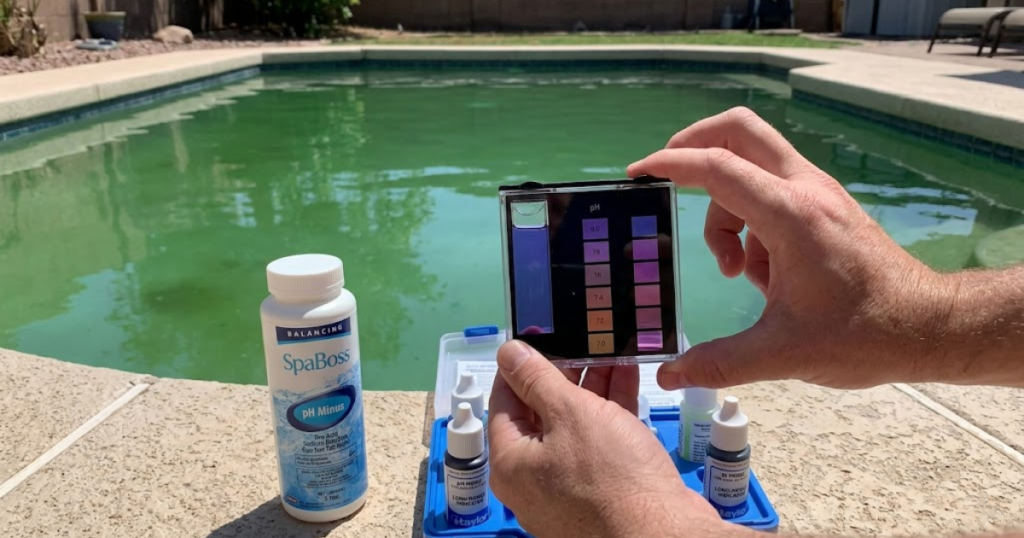
pH is the most important pre-treatment step and the one most people skip when they’re staring at a green pool wanting to fix it immediately.
Chlorine-based shock loses more than half its effectiveness at pH 7.8 or above. At pH 8.0, the treatment is barely working at all. You can pour in three times the required dose and get a fraction of the result.
Test pH first. If it’s above 7.4, add pH minus (sodium bisulfate) and wait 30 minutes before adding anything else. Target: 7.2–7.4.
Step 2 — Brush Every Surface Before Adding Shock
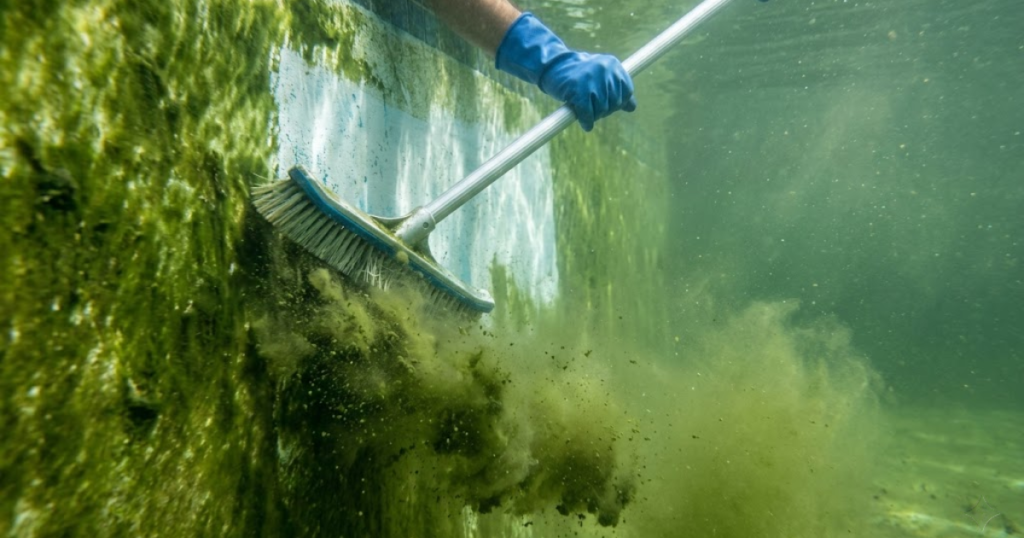
This is the step that separates effective green pool treatment from expensive guesswork.
Algae clings to pool walls, steps, floor, and behind fittings. It forms a protective biofilm on surfaces that physically shields cells from chemical contact. Shocking water full of unbrushed algae is like trying to disinfect through a layer of plastic, the shock treats the water column but never reaches the bulk of the colony.
Brush every inch. Walls first, top to bottom. Then the floor. Push algae into suspension so the shock can reach it. Use a nylon brush for vinyl or fibreglass pools. Use a stainless steel brush for concrete or plaster.
Do this before adding shock. Not after.
Step 3 — Add the Correct Dose After Dark
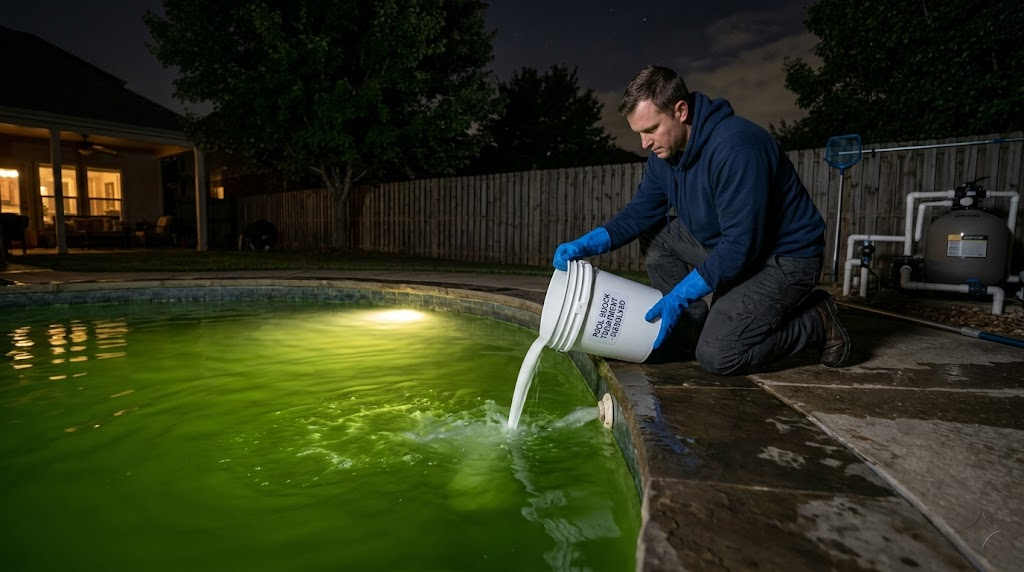
Calculate your pool volume. Use the dosing table below to find the right amount for your algae severity. Pre-dissolve cal-hypo in a bucket of pool water, never add powder directly to the pool, then pour near the return jets with the pump running at full speed.
Shock after sunset. UV radiation degrades cal-hypo within the first hour of daylight. Night-time application means the full dose works through until morning without any UV loss.
For moderate to heavy algae, split your dose in half, add the first half, run the pump for four hours, then add the second half. Two smaller applications with circulation between them penetrate the water more evenly than one large single dose.
Step 4 — Run the Filter Continuously and Backwash Often
Run your filter at full speed for a minimum of 24 hours after shocking. The filter is doing two things simultaneously, distributing shock evenly and physically capturing dead algae as it dies and clumps together.
Dead algae clogs filters fast. Backwash or rinse the filter every 4–6 hours during treatment. A clogged filter drops flow rate and significantly slows the clearing process.
If you have a sand filter, backwash aggressively. If you have a cartridge filter, rinse the cartridge every four hours during recovery.
Green Pool Shock Dosing Table
Green pool shock dosing requires 2–3 times the standard maintenance dose. For calcium hypochlorite at 73%, use 2 lbs per 10,000 gallons for a mildly green pool and 3 lbs per 10,000 gallons for a heavily green pool. Always pre-dissolve in a bucket, add after dark, and run the filter continuously for 24–48 hours after treatment.
Calculate your pool volume first:
Rectangular: Length (ft) × Width (ft) × Avg Depth (ft) × 7.48 = gallons
Round: Diameter × Diameter × Avg Depth × 5.9 = gallons
| Pool Size | Light Green (2× dose) | Medium Green (3× dose) | Dark Green (3× dose × 2 treatments) |
|---|---|---|---|
| 10,000 gal | 2 lbs cal-hypo 73% | 3 lbs | 3 lbs now + 3 lbs in 12 hrs |
| 15,000 gal | 3 lbs | 4.5 lbs | 4.5 lbs now + 4.5 lbs in 12 hrs |
| 20,000 gal | 4 lbs | 6 lbs | 6 lbs now + 6 lbs in 12 hrs |
| 25,000 gal | 5 lbs | 7.5 lbs | 7.5 lbs now + 7.5 lbs in 12 hrs |
| 30,000 gal | 6 lbs | 9 lbs | 9 lbs now + 9 lbs in 12 hrs |
⚠️ Do not use non-chlorine shock (MPS) on a green pool. It oxidizes organic matter but does not kill algae. For green pool treatment, you need chlorine-based shock, calcium hypochlorite or dichlor only.
confirms health risks of algae-contaminated pool water and minimum free chlorine requirements
What to Do After Shocking a Green Pool
The morning after your first treatment, the water will likely look cloudy and blue-grey rather than clear. That’s good, not a failure. Dead algae is white or grey, and a blue-grey cloud in the water after shocking a green pool means the algae is dead but still suspended. The filter hasn’t captured it all yet.
From that point:
Keep the filter running. Don’t stop for at least 48 hours. Let it capture dead algae continuously.
Backwash every 4–6 hours until filter pressure returns to normal and holds there. This can take 48–72 hours in a severely affected pool.
Brush again. Dead algae still clinging to surfaces needs to be pushed into suspension for the filter to capture. Brush at least twice during the recovery period.
Add algaecide 24 hours after shocking. Algaecide prevents regrowth but is degraded by very high chlorine. Wait until free chlorine drops below 5 ppm before adding, otherwise the shock destroys the algaecide before it can do anything.
Vacuum dead algae to waste. Once the water clears enough to see the floor, vacuum directly to waste — bypassing the filter — to remove settled dead algae quickly without re-clogging the filter.
Rebalance all chemicals. Once clear, test and correct pH, alkalinity, calcium hardness, and CYA. A pool recovering from algae is chemically depleted across multiple parameters, not just chlorine.
“Overshot on the shock dose? Here’s how to lower chlorine in a pool fast”
How Long Does It Take for a Green Pool to Clear?
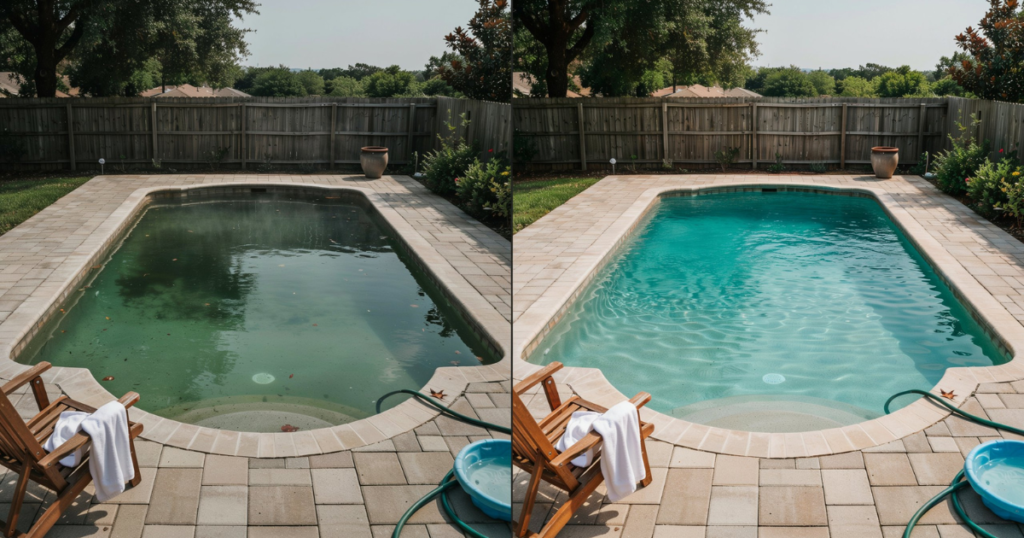
| Starting Condition | Treatment Done Correctly | Expected Clear Time |
|---|---|---|
| Slight teal tint | Single 2× shock dose, pump running | 24–48 hours |
| Cloudy green water | Single 3× shock dose + algaecide after 24 hrs | 2–4 days |
| Dark green, floor invisible | Double treatment 12 hrs apart, aggressive backwash | 5–7 days |
| Black algae present | Multiple treatments + algaecide + steel brush | 2–6 weeks |
The most common reason a pool takes longer than expected isn’t the shock, it’s the filter. A clogged filter running at reduced flow is almost no filter at all. Backwash early and often.
If the water is still green after 72 hours of correct treatment, test your CYA level. High CYA is the invisible reason many green pool treatments fail, chlorine that reads 3–5 ppm is functionally ineffective when CYA is above 80 ppm. If that’s the case, partial drain and refill is the next step, not more shock.
FAQs
How much shock does it take to clear a green pool?
Double the standard maintenance dose for a mildly green pool, triple it for a moderately green pool. For dark, opaque water, use triple dose twice — 12 hours apart — while running the filter continuously. Always calculate by pool volume for accuracy.
Can I swim in my pool after shocking the green water?
Not until the water is completely clear, free chlorine reads 1–3 ppm on a DPD test, and the pool floor is fully visible. For a moderately green pool shocked correctly, this takes 2–4 days. Always test before anyone enters — don’t judge by appearance alone.
Why is my pool still green after shocking?
Four likely causes — pH was too high before treatment, shock was added in daylight and degraded by UV, the filter wasn’t backwashed often enough, or CYA above 80 ppm is blocking chlorine effectiveness. Check all four before retreating.
Should I use algaecide or shock for a green pool?
Shock first, always. Add shock, run the filter 24 hours, then add algaecide. Don’t add algaecide at the same time as shock — the high chlorine concentration degrades the algaecide before it can work. Correct sequence: shock, filter, wait 24 hours, then algaecide.
How do I stop my pool from turning green again?
Test free chlorine twice a week in summer and dose before it drops below 2 ppm. Keep CYA between 30–50 ppm. Run the filter 8–12 hours per day in warm weather. Shock after any heavy rain or large pool party before algae has a chance to establish.
The Bottom Line
A green pool is fixable. Every time.
Test and fix pH before anything else. Brush every surface before adding shock. Use the right dose for how green the pool actually is. Run the filter hard, backwash often, and be patient — the water clears from the inside out, not all at once.
Light green recovers in a day. Dark green takes a week. Black algae is a different problem requiring a different approach.
Test. Dose correctly. Filter continuously. That’s the process.
“Want the complete pool shocking guide with all shock types and dosing? Step-by-step guide here”