
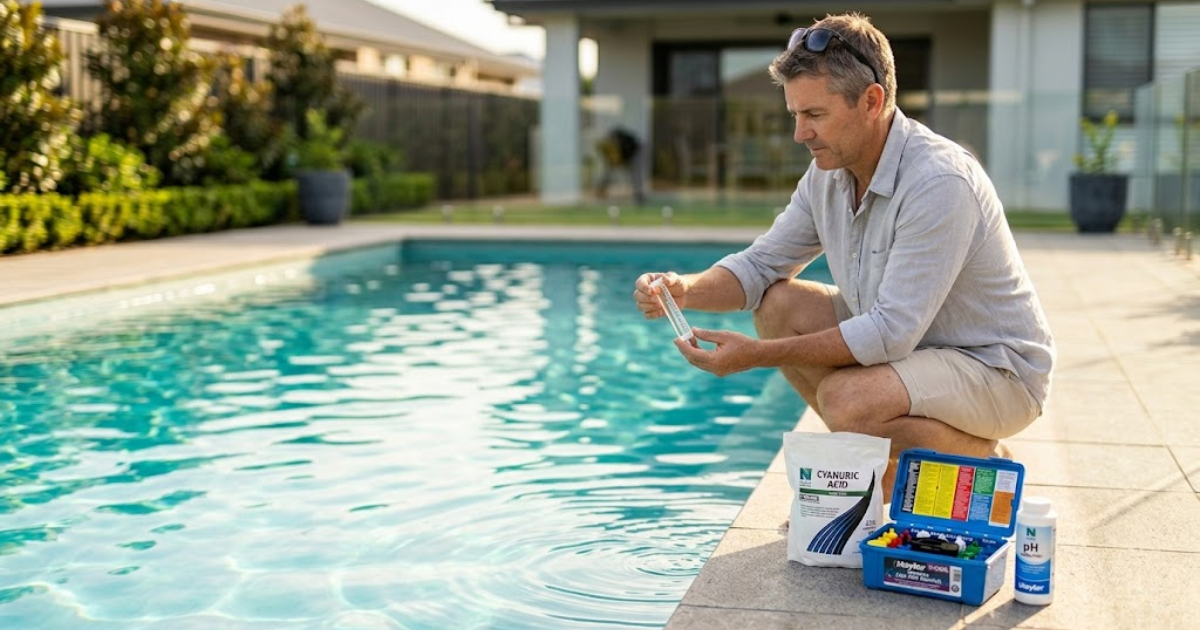

If you’ve ever wondered why your outdoor pool burns through chlorine twice as fast on sunny days, or why high chlorine readings still don’t seem to stop algae, cyanuric acid is likely involved.
It’s one of the least understood chemicals in pool care, and getting it wrong in either direction costs pool owners real money.
📌 KEY TAKEAWAYS
- Cyanuric acid (CYA) is a pool stabilizer that shields chlorine from UV destruction
- Ideal range for outdoor pools: 30–50 ppm
- Below 30 ppm: chlorine degrades rapidly in sunlight — you’ll dose constantly
- Above 80 ppm: chlorine lock reduces chlorine effectiveness severely
- The only reliable way to lower CYA: partial drain and refill
- Test CYA every 4–8 weeks — it doesn’t deplete like chlorine
This guide covers outdoor residential pools. Indoor pools don’t need CYA, without UV exposure, stabilizer provides no benefit and only creates water balance problems.
What Is Cyanuric Acid in a Pool?
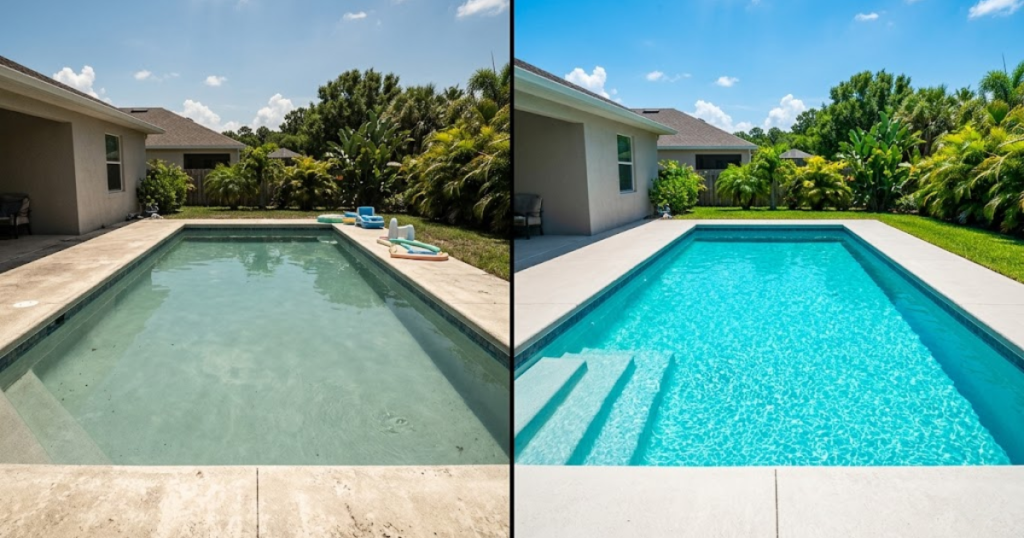
Cyanuric acid (CYA) is a chemical compound added to outdoor swimming pools to protect free chlorine from degradation by ultraviolet (UV) sunlight. Also called pool stabilizer or pool conditioner, it works by forming a temporary bond with chlorine molecules that shields them from UV rays, extending chlorine’s effective lifespan in outdoor water by 3–5 times.
Cyanuric acid goes by several names on product labels: pool stabilizer, pool conditioner, and isocyanuric acid all refer to the same compound. Its only job is to protect chlorine from sunlight.
Here’s the chemistry in plain English. Free chlorine is highly sensitive to UV radiation. Without protection, direct sunlight destroys up to 75–90% of free chlorine within two hours. That’s why pools without stabilizer require constant dosing on summer days just to maintain safe levels.
CYA bonds temporarily to chlorine molecules, forming a protective complex that UV can’t break down as easily. The chlorine is still available for sanitizing, it just releases from the CYA bond more slowly as it reacts with bacteria and contaminants. The result is chlorine that lasts through the day instead of burning off by noon.
It’s not optional for outdoor pools. Without it, maintaining consistent chlorine levels in summer is a losing battle.
Pool chlorine suddenly too high? Here’s how to lower it fast
What Is the Ideal CYA Level for a Pool?
The ideal cyanuric acid level for a residential outdoor pool is 30–50 ppm. Below 30 ppm, chlorine degrades rapidly in UV sunlight and requires constant re-dosing. Above 80 ppm, CYA begins interfering with chlorine’s ability to sanitize effectively, a condition called chlorine lock. Saltwater pools often benefit from slightly higher CYA levels of 60–80 ppm.
| CYA Level | Effect on Pool | Action Required |
|---|---|---|
| Below 30 ppm | Chlorine burns off rapidly in sunlight | Add stabilizer |
| 30–50 ppm | Ideal range — balanced UV protection | Maintain and monitor |
| 50–80 ppm | Elevated but manageable | Monitor closely |
| 80–100 ppm | Chlorine effectiveness significantly reduced | Partial drain and refill |
| Above 100 ppm | Severe chlorine lock, algae risk high | Drain 50%+ immediately |
Quick note: these ranges apply to traditional chlorinated pools. If you run a saltwater pool, your chlorinator generates chlorine continuously, most manufacturers recommend keeping CYA between 60–80 ppm to provide adequate protection without creating chlorine lock.
How Does Cyanuric Acid Affect Chlorine Effectiveness?
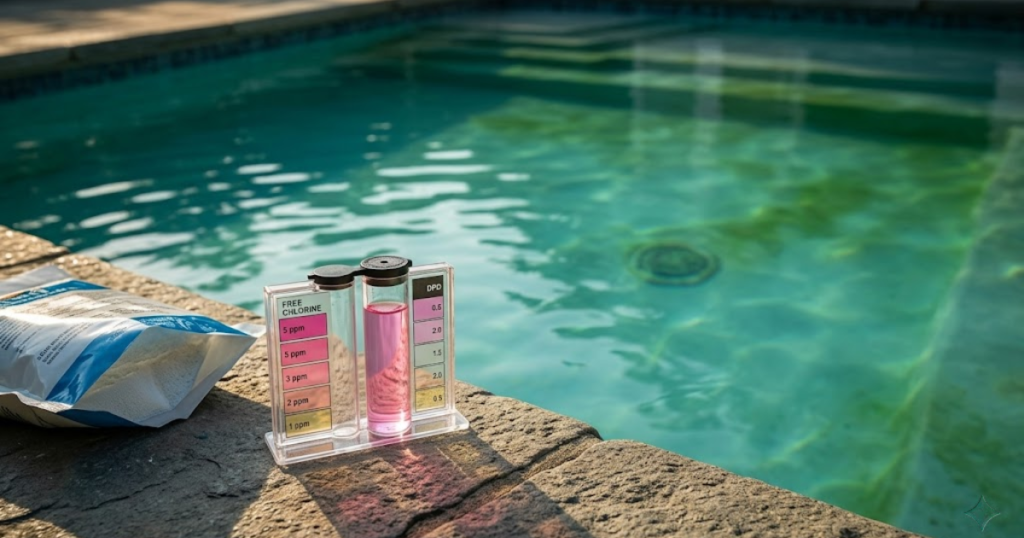
Cyanuric acid affects chlorine by reducing its oxidation-reduction potential (ORP), the measure of how aggressively chlorine reacts with contaminants. According to the World Health Organisation (WHO), a pool with 2 ppm free chlorine and zero CYA is more effective at killing pathogens than the same pool with 10 ppm free chlorine and 100 ppm CYA. More CYA means each ppm of chlorine does less work.
This is the part most pool guides skip. CYA doesn’t just protect chlorine from UV, it also changes how reactive that chlorine is when it encounters bacteria and algae.
At the ideal 30–50 ppm range, the trade-off is sensible. You lose a small amount of chlorine reactivity in exchange for dramatically better UV protection. Net result: a healthier pool with lower running costs.
The problem starts when CYA climbs higher. As the CYA-to-chlorine ratio grows, the protective bond holds chlorine back too aggressively. What reads as 5 ppm on a test kit may only be functioning as 1 ppm in terms of actual sanitizing power.
That’s the chlorine lock trap, and most pool owners don’t realize they’re in it until algae appears despite normal-looking chlorine readings.
What Is Chlorine Lock?
Chlorine lock is a condition where CYA levels are so high that free chlorine becomes effectively neutralized, present in the water on a test, but unable to sanitize at a meaningful rate.
Or maybe I should frame it this way: imagine a security guard handcuffed to their post. They’re technically there. They’re just not doing their job.
CYA above 80 ppm starts creating this condition. Above 100 ppm it becomes severe. Algae blooms appear despite chlorine readings of 3–5 ppm because the available active chlorine is too restricted to kill anything efficiently.
The fix is not more chlorine. Adding more chlorine when CYA is already high just shifts the ratio slightly, you’ll spend money on chemical and the problem won’t resolve. The only genuine fix is reducing the CYA level, which means removing water.
How to Raise Cyanuric Acid in a Pool
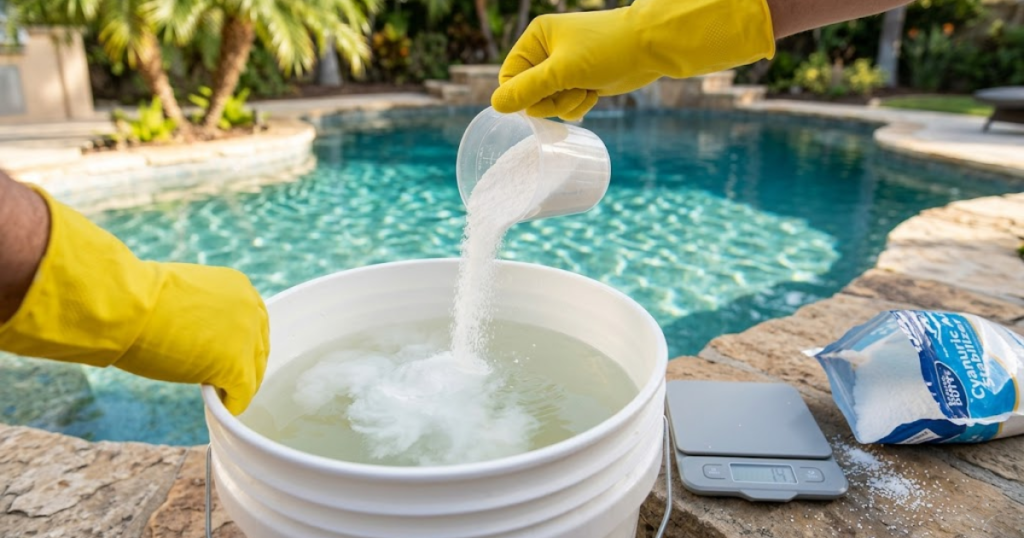
Raising CYA is simple. Two approaches, depending on your situation.
Granular cyanuric acid (pool stabilizer): The direct and controlled method. Add stabilizer granules to a bucket of warm pool water, allow to dissolve fully, then pour near the return jets with the pump running. Don’t add directly to the skimmer, undissolved CYA can clog the system.
CYA dissolves slowly. Allow 24–48 hours of full pump circulation before testing, an early test reads lower than the actual final level.
To raise CYA by 10 ppm in your pool:
- Calculate your pool volume (Length × Width × Avg Depth × 7.48 for rectangular)
- Add approximately 13 oz (370g) of granular stabilizer per 10,000 gallons
- Pre-dissolve in a bucket of warm water, never add dry powder directly
- Pour near return jets with pump running at full speed
- Wait 48 hours before retesting
Using stabilized chlorine products: Dichlor shock and trichlor tablets both contain built-in CYA and raise it with every application. If your CYA is low, switching temporarily from liquid chlorine to dichlor raises it naturally over several days. Watch closely, if you use dichlor or trichlor all season without monitoring, CYA will creep above 80 ppm by summer’s end.
How to Lower Cyanuric Acid in a Pool
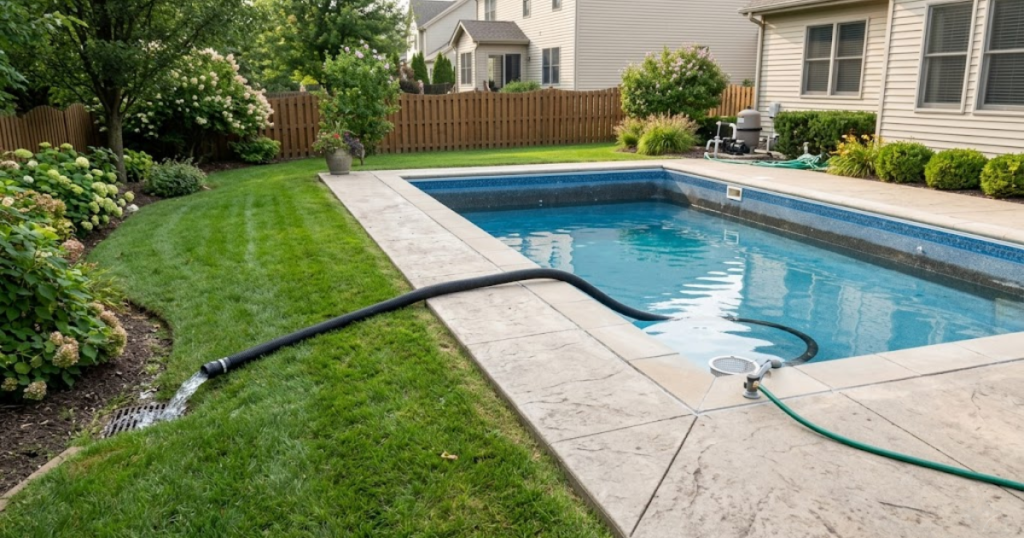
This is where the news isn’t great, but it’s honest.
There is no chemical that reliably removes CYA from pool water. Products marketed as “CYA reducers” exist, but independent testing consistently shows them unreliable and expensive for the results they deliver. The only method that actually works is dilution, drain a portion of the pool and replace with fresh water.
Calculate how much to drain:
(Current CYA − Target CYA) ÷ Current CYA = Fraction to drain
Example: CYA tests at 100 ppm. Target is 40 ppm.
(100 − 40) ÷ 100 = 0.60 → drain 60% and refill with fresh water
Drain to waste, not back through the filter. Refill with fresh water. Retest CYA after 48 hours before rebalancing other chemicals.
After refilling, here’s how to raise chlorine back to the correct level quickly
How Often Should You Test Cyanuric Acid?
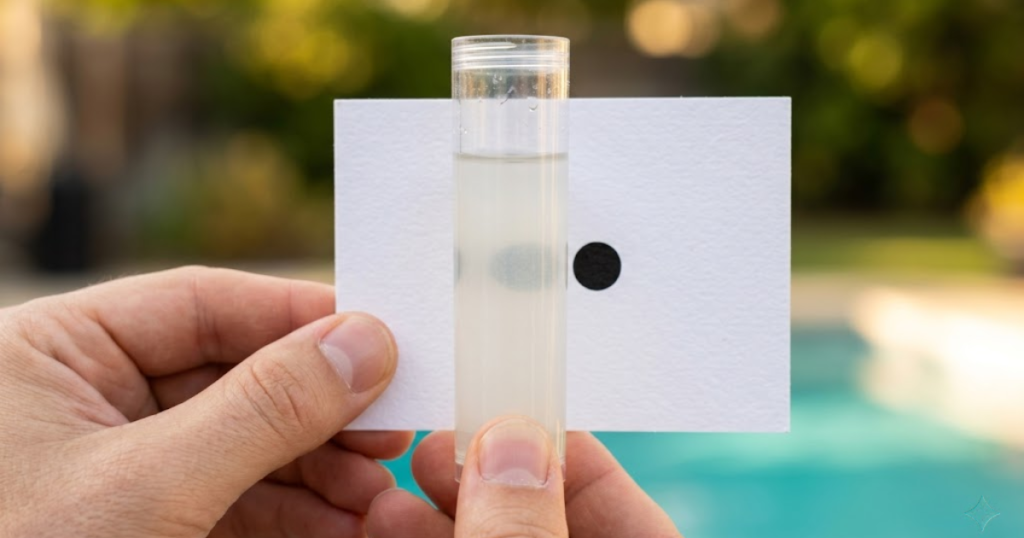
Every 4–8 weeks during the swim season. Monthly if you regularly use dichlor or trichlor.
CYA doesn’t deplete through normal pool use or sunlight, once it’s in the water it stays there, building slowly with every stabilized chlorine addition. Weekly testing is unnecessary. Quarterly testing isn’t frequent enough if you’re using stabilized products regularly.
Two things to know about testing CYA correctly:
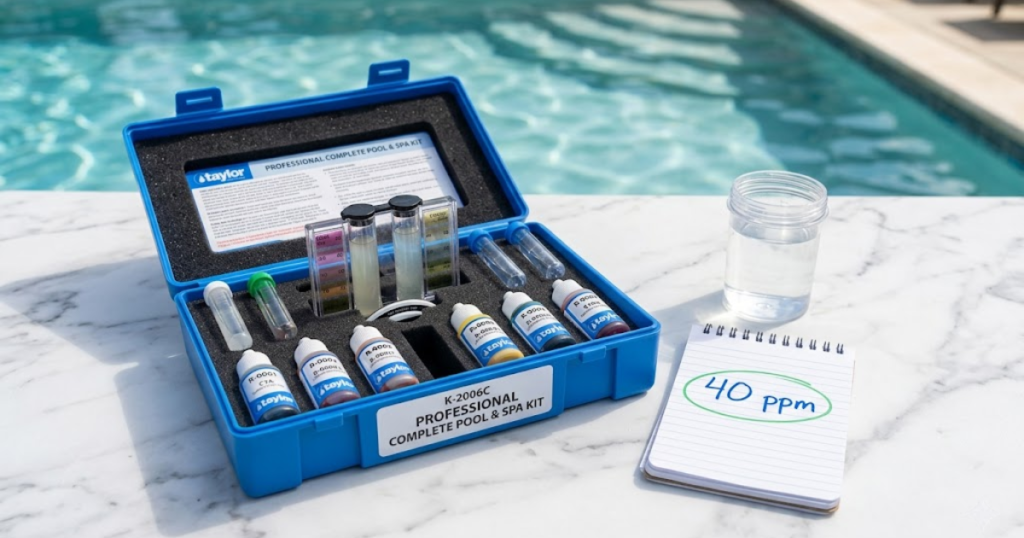
Use the right test. Standard test strips don’t measure CYA accurately. Use a dedicated turbidity-based CYA test kit, the type where you add pool water to a comparator tube until a black dot on the bottom disappears. Taylor Technologies K-2006C and LaMotte ColorQ are reliable options. For the most accurate reading of all, have a water sample analysed at a pool store using a photometer.
Test before adding stabilizer. CYA accumulates, there’s no emergency requiring fast action. Testing first prevents the common mistake of adding stabilizer to a pool already approaching the upper limit.
confirms cyanuric acid’s effect on chlorine ORP and maximum CYA thresholds for recreational pools
FAQs
What does cyanuric acid do in a pool?
It protects free chlorine from UV degradation in sunlight, extending chlorine’s effective lifespan by 3–5 times. Without CYA in an outdoor pool, sunlight destroys up to 90% of free chlorine within two hours of direct exposure.
What is the ideal cyanuric acid level for a pool?
30–50 ppm for traditional chlorinated outdoor pools. Saltwater pools benefit from 60–80 ppm. Below 30 ppm, chlorine degrades too quickly. Above 80 ppm, chlorine lock significantly reduces sanitizing effectiveness.
Can cyanuric acid be too high in a pool?
Yes. Above 80 ppm it causes chlorine lock — chlorine is present but can’t sanitize effectively. Above 100 ppm the problem becomes severe and algae can bloom despite normal-looking chlorine readings. Partial drain and refill is the only reliable fix.
How do I lower cyanuric acid in my pool?
Drain a calculated percentage of the pool and refill with fresh water. No chemical product reliably removes CYA. Formula: (Current CYA − Target CYA) ÷ Current CYA = fraction to drain. For 100 ppm dropping to 40 ppm, drain 60% and refill
Does cyanuric acid affect pH in a pool?
Minimally. CYA is a weak acid and slightly lowers pH when added, but the effect is small and self-correcting within normal water balance. Retest pH 24 hours after adding stabilizer and adjust with pH plus if needed.
The Bottom Line
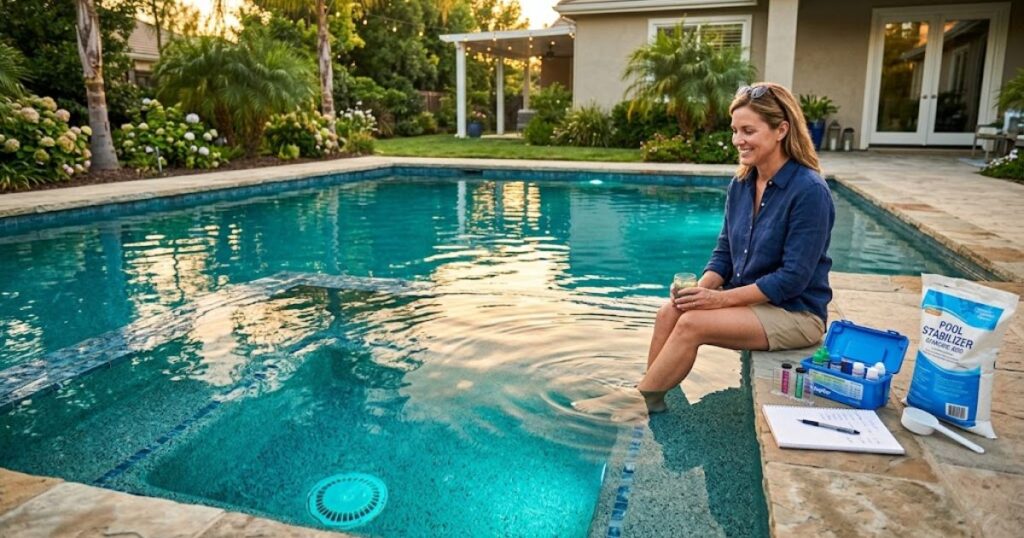
Cyanuric acid is one of the most valuable chemicals in an outdoor pool, and one of the most commonly mismanaged.
Keep it in the 30–50 ppm range and it protects your chlorine from sunlight, cuts dosing costs, and stabilizes your water chemistry. Let it creep above 80 ppm and it quietly undermines every other chemical you add, leaving you confused about why algae keeps appearing in a pool that tests fine.
Test it monthly. Dose conservatively. Drain when it’s too high. There’s no shortcut around that.
If dropping CYA also dropped your chlorine reading, here’s how to raise it back safely