
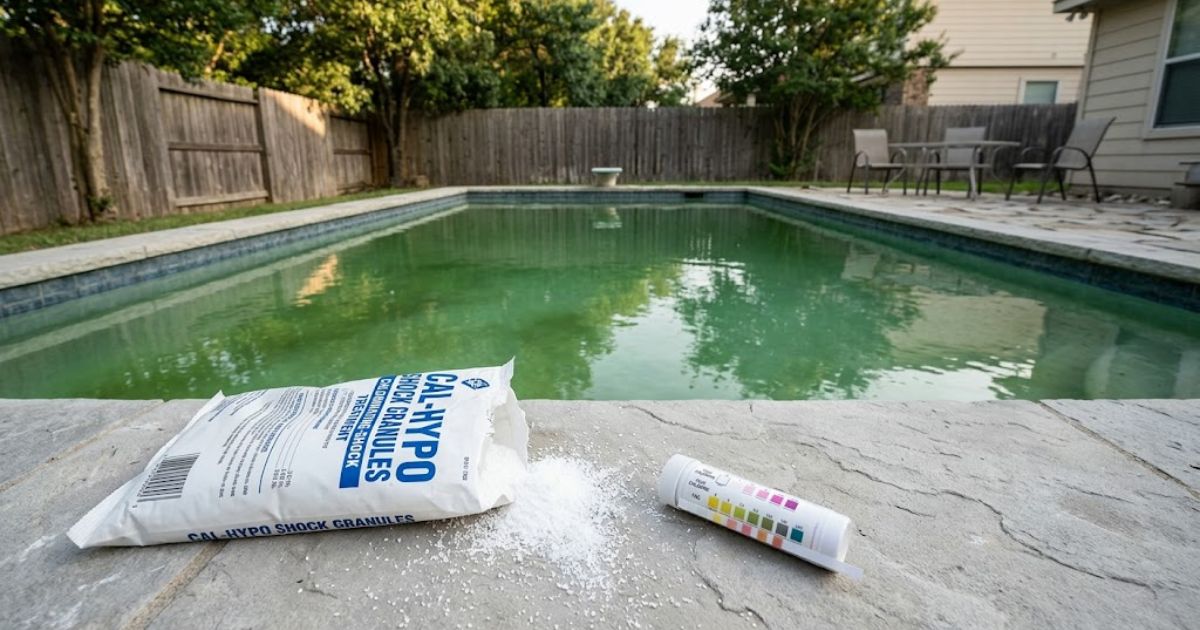
You added a full bag of shock. Maybe two. Ran the pump all night. Came back the next morning, and the water is still green, still cloudy, or the test strip is reading zero chlorine.
That’s not a faulty product. Something specific is blocking the shock from working, and it’s always measurable. This guide walks through every cause, in order of how often they actually occur.
⚡ Key Takeaways
Pool shock fails for one of seven reasons and most of them have nothing to do with the shock itself.
- pH above 7.6 makes chlorine nearly useless before it even starts working
- CYA above 80 ppm locks chlorine in an inactive form your test strip lies to you
- CYA below 20 ppm means UV destroys chlorine within hours of adding it
- High chlorine demand from algae or ammonia consumes shock instantly, you need repeated nightly treatments, not one heavy dose
- Wrong shock type (dichlor instead of cal-hypo) is significantly weaker against algae
- High phosphates feed algae so aggressively that no shock dose holds
- Dead filter/pump means chemistry can work and the pool still stays cloudy
Fix order that works: Correct pH first → Test and fix CYA → Brush surfaces → Use cal-hypo shock at dusk → Run filter 8–12 hrs → Repeat nightly until FC holds above 1 ppm through a full day of sun.
The Three Types of Chlorine You Need to Understand First
Before diagnosing why shock isn’t working, you need to know what’s actually in your water. Most pool owners look at one number on a test strip, and miss the two underneath it.
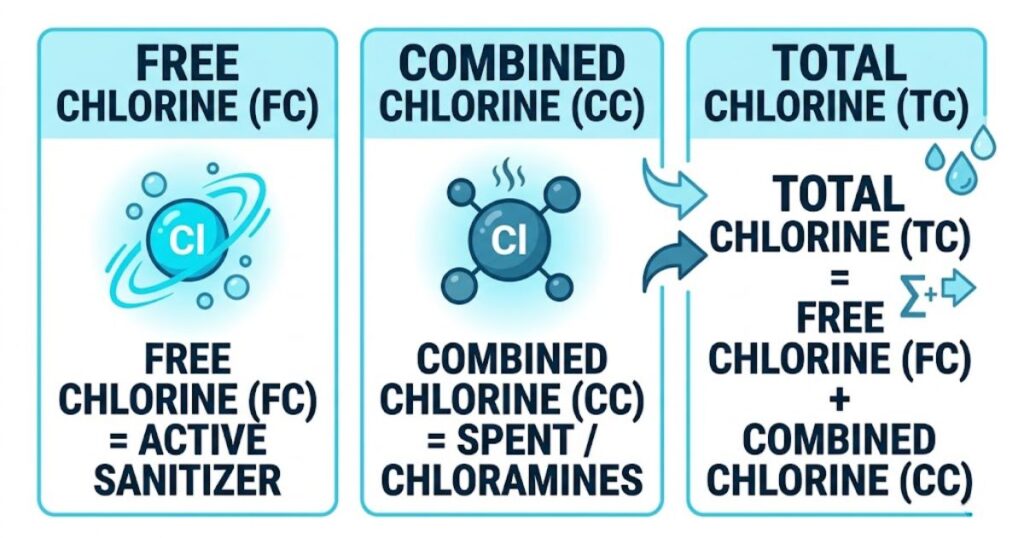
Free chlorine (FC) is the active sanitizer. It’s the hypochlorous acid and hypochlorite ion in your water that kills bacteria, viruses, and algae. This is the only number that actually matters for sanitation.
Combined chlorine (CC) called chloramines, is spent chlorine that has already reacted with nitrogen compounds from sweat, sunscreen, and urine. It’s dead weight. It doesn’t sanitize anything. Worse, it’s the compound responsible for that harsh chemical smell and eye irritation that people wrongly blame on “too much chlorine.”
Total chlorine (TC) is just the sum of both. Here’s the formula that explains why TC alone tells you nothing:
TC − FC = CC
If your test strip shows TC at 3 ppm but FC is only 0.5 ppm, you have 2.5 ppm of combined chlorine clogging your water. The pool looks like it has chlorine. It functionally doesn’t.
Ideal combined chlorine: under 0.5 ppm. Anything above that and you need to shock, not because the pool is dirty (though it might be), but because the chlorine itself is broken.
Why Combined Chlorine Causes That Harsh “Pool Smell”
Here’s the thing: most people smell a strong chemical odor and assume they’ve over-chlorinated.
The opposite is almost always true.
That sharp, eye-burning smell comes specifically from dichloramine and nitrogen trichloride, two chloramine compounds that form when free chlorine reacts with ammonia from bather waste. They’re pungent, irritating, and a clear sign that free chlorine is too low, not too high.
When CC climbs above 0.5 ppm, the fix is breakpoint chlorination, adding roughly 10× the CC reading in ppm of free chlorine. At 1.0 ppm CC, you need to shock to at least 10 ppm FC to fully oxidize and destroy the chloramines.
Or maybe I should say it this way: if your pool always smells like a public gym locker room, add more free chlorine, don’t cut back.
7 Reasons Your Pool Shock Isn’t Working
1. pH Is Too High — The Most Common Culprit
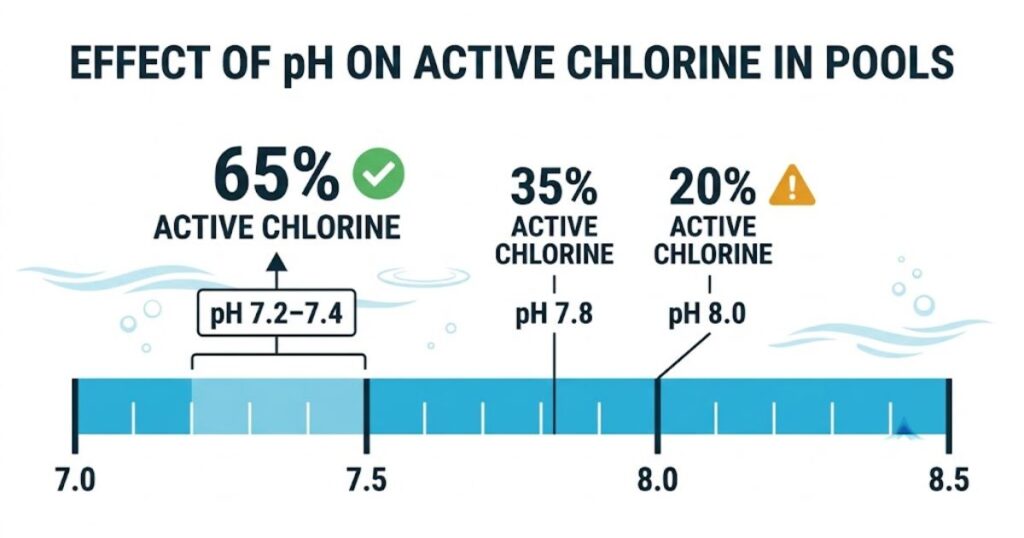
Chlorine’s sanitizing power drops sharply as pH rises. This isn’t a minor effect. It’s dramatic.
At pH 7.4, roughly 55–65% of your free chlorine exists as hypochlorous acid, the active killing molecule. Push pH to 8.0 and that number collapses to about 20%. You’re adding full-strength shock and getting one-fifth of the effect. Algae thrive freely while your test kit shows “adequate” chlorine because the TC is there, but it’s locked in the inactive hypochlorite form.
Most pools drift high after heavy use, hot weather, or rain. It happens fast.
Fix it: Bring pH to 7.2–7.4 using sodium bisulfate (dry acid) or muriatic acid. Circulate for 30 minutes, then retest before adding any shock. Shocking into high-pH water is product poured straight into a drain.
2. CYA Is Too High — Chlorine Lock
Cyanuric acid (CYA) is your chlorine stabilizer. In small amounts it’s essential, it shields free chlorine from UV destruction. But CYA accumulates over every season, especially when you use trichlor tablets or dichlor-based shock products, because every pound adds more stabilizer to the water.
Above 80 ppm, CYA “locks” your chlorine into an inactive form. Your test kit shows a normal chlorine reading. The pool water acts completely unsanitized. Algae blooms anyway.
This is commonly called chlorine lock, and it’s why you can dump four bags of shock into a pool and still read zero usable chlorine the next morning.
Fix it: Test CYA with a turbidity comparator kit (not strips, strips are unreliable for CYA readings). If CYA is above 80 ppm, drain 30–50% of the pool and refill with fresh water. No chemical removes CYA from pool water. Dilution is the only real solution.
3. CYA Is Too Low — UV Is Eating Your Chlorine
The flip side is equally destructive. With CYA below 20 ppm, free chlorine gets destroyed by UV within 2–4 hours of direct summer sun.
You shock at night, test in the morning, chlorine looks fine at 5 ppm. By noon it’s at zero. You panic, add more. Same result tomorrow.
This is a sunlight problem, not a chemistry problem.
Fix it: Add cyanuric acid (sold as pool stabilizer or pool conditioner) until CYA reaches 30–50 ppm. To confirm this is your issue, run an overnight chlorine loss test: test FC at sundown and again at sunrise before the sun hits the water. If you lose less than 1 ppm overnight but lose it all by afternoon, low CYA is your answer.
4. High Chlorine Demand — Algae, Ammonia, or Organic Overload
This is what happens after a pool party, a storm, a stretch of neglect, or when a visible algae bloom has taken hold.
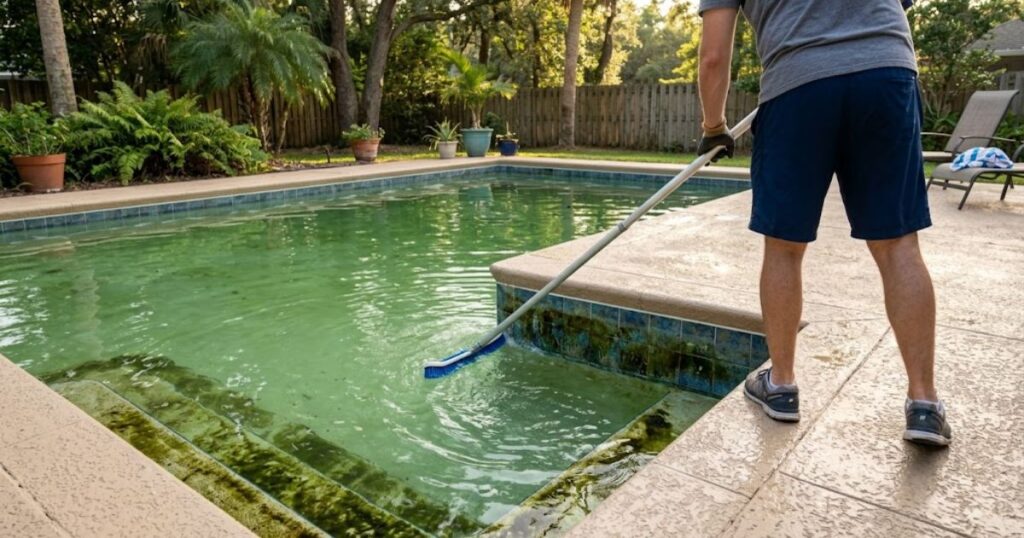
Shocking is a process, not a single event. If the water has an extremely high chlorine demand, from algae, ammonia, phosphates, or organic debris, every molecule of free chlorine you add gets consumed almost instantly. The pool tests zero because the shock is actually working. It’s just being used up the moment it enters the water.
Pools with severe algae problems commonly need 3–4 consecutive nightly treatments before chlorine starts holding above 1 ppm through a full day. Skipping even one night resets the process.
Look, if you’ve added four bags of shock and still read zero chlorine the next morning, this is almost certainly your situation. Don’t buy more shock yet. Fix the cause first.
Fix it: Brush every surface, walls, floor, steps, and behind ladders. This breaks open algae cells and exposes them to chlorine directly. Shock with cal-hypo at dusk. Run the filter all night. Test at sunrise. Repeat until you hold above 1 ppm FC after a full day of sun. If the pool is visibly green, read our full guide: How to Shock a Green Pool and Clear It in 24 Hours.
5. Wrong Type of Shock Product
Not all shock products are equal. The label matters more than people realize.
Sodium dichlor is lighter, fast-dissolving, and commonly sold as “pool shock” but it’s a significantly weaker algaecidal product. Every pound you add also raises CYA by roughly 0.9 oz per 10,000 gallons. Use dichlor regularly all season and your CYA silently climbs into the danger zone.
Calcium hypochlorite (cal-hypo) is the stronger option. It carries no CYA, delivers a higher chlorine concentration per pound, and is the recommended product for algae treatment and heavy shocking. The one tradeoff: pre-dissolve it in a bucket of water before adding to vinyl-lined pools to avoid bleach spotting on the liner.
Potassium monopersulfate, sold as non-chlorine shock, is an oxidizer, not a sanitizer. It will NOT kill algae or raise free chlorine. If you’ve been using this as your primary shock, that’s why nothing is improving.
Quick Comparison
| Shock Type | Best For | Key Benefit | Limitation |
|---|---|---|---|
| Calcium hypochlorite (cal-hypo) | Algae, heavy shock | No CYA added; strongest oxidizer | Raises calcium hardness; pre-dissolve for vinyl |
| Sodium dichlor | Light maintenance | Fast dissolving; stabilized | Adds CYA every use; weaker vs algae |
| Potassium monopersulfate | Oxidizing after swim | No chlorine smell spike | Does NOT sanitize — won’t kill algae |
| Sodium hypochlorite (liquid chlorine) | Regular shocking | No CYA; fast acting | Shorter shelf life; lower concentration |
For a full step-by-step on dosing, timing, and how to add shock safely, see our guide: How to Shock a Pool: Step-by-Step Guide That Works (2026).
6. High Phosphate Levels
Phosphates don’t directly neutralize chlorine. What they do is feed algae so efficiently that no shock dose can keep up with the growth rate.
I’ve seen conflicting data here, some sources flag anything above 500 ppb as problematic, others argue the real threshold is closer to 1,000 ppb. My read: if you’ve corrected pH, fixed CYA, used cal-hypo, shocked three nights in a row, and still can’t hold chlorine, test phosphates. It’s the last thing most people check and frequently the answer.
Fix it: Use a phosphate remover (Natural Chemistry PHOSfree is a well-regarded option). Bring phosphates down first, then restart your shock protocol from the beginning.
7. Filter and Pump Aren’t Keeping Up
Shock can work chemically and your pool can still look terrible for days if the filter isn’t removing dead algae, oxidized debris, and suspended particles fast enough.
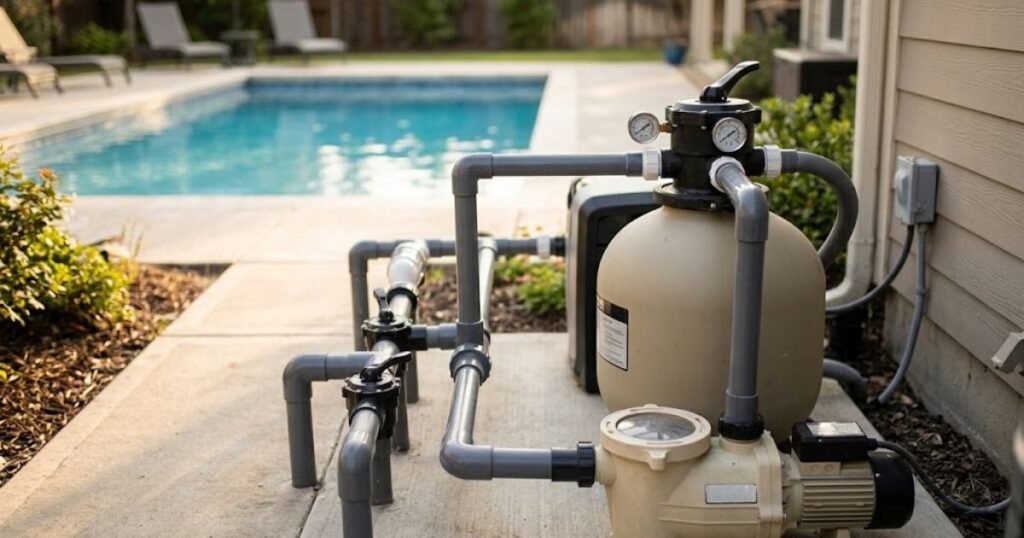
Run your pump and filter for a minimum of 8–12 hours after every shock treatment. Backwash or clean the filter mid-treatment if the pressure gauge rises more than 8–10 psi above its clean baseline, a clogged filter actively fights the clearing process.
Quick note: if you’ve just shock-treated after a storm, the organic load is especially high. Consider running the filter for 24 hours straight. For the full rain-specific protocol, see our guide: How to Shock a Pool After Heavy Rain (Step-by-Step).
How to Test Free Chlorine vs Combined Chlorine Correctly
Test strips measure total chlorine on most brands, they don’t separate FC from CC. That’s the core problem. You think you have chlorine. You have spent chlorine.
Recommended test kits:
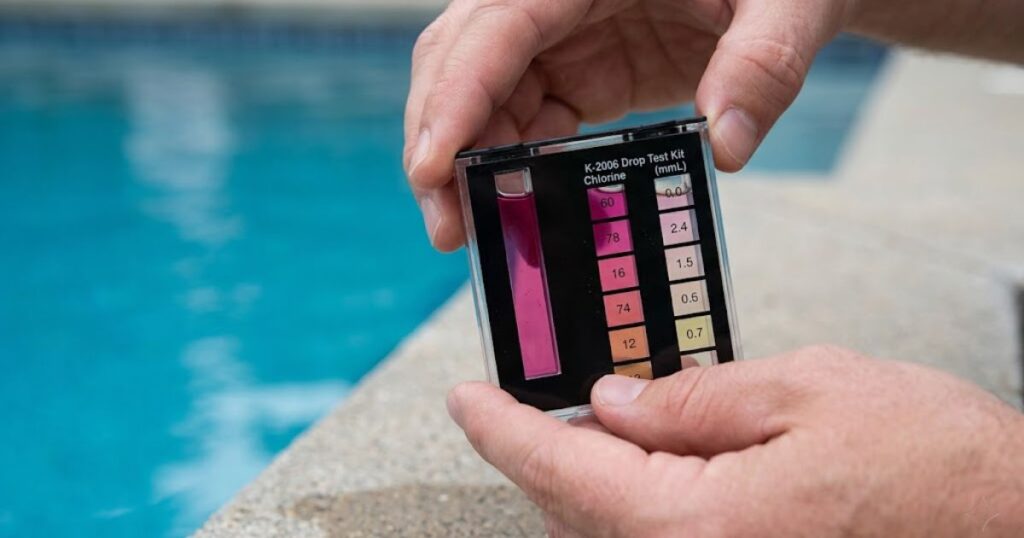
- Taylor K-2006 drop-test kit measures FC and TC separately with DPD reagents; industry standard
- LaMotte ColorQ Pro 7 digital photometer; removes the color-matching guesswork
- Pentair AquaCheck Select strips that do separate FC and TC (more reliable than budget strips)
How to test free chlorine vs total chlorine step by step:
- Fill the comparator cell to the fill line with fresh pool water
- Add DPD #1 reagent and swirl gently this reads free chlorine
- Add DPD #3 reagent to the same cell and swirl this reads total chlorine
- Subtract FC from TC: the result is combined chlorine
- If CC is above 0.5 ppm, your pool needs shock not more tablets
Test in the shade. Direct sunlight bleaches the sample and gives false-low readings.
Ideal Chlorine Ratios at a Glance
| Parameter | Ideal Range | Problem If Below | Problem If Above |
|---|---|---|---|
| Free Chlorine (FC) | 1–3 ppm | Algae, bacteria growth | Irritation; wait before swimming |
| Combined Chlorine (CC) | Under 0.5 ppm | — | Pool smell; shock to breakpoint |
| Total Chlorine (TC) | FC + CC | Alone tells you nothing | Test FC separately — always |
| CYA | 30–50 ppm | UV destroys FC in hours | Chlorine lock above 80 ppm |
| pH | 7.2–7.4 | Corrosion; irritation | Chlorine loses effectiveness fast |
FAQs
Why does my pool still look green after I shocked it?
High pH, excessive CYA above 80 ppm, or high phosphates are most likely blocking the shock. Correct pH to 7.2–7.4 first, test CYA, brush all surfaces, then re-shock with cal-hypo.
How do I know if my pool has chlorine lock?
Test CYA. If it reads above 80 ppm and chlorine won’t hold despite repeated shocking, chlorine lock is the cause. The only fix is a partial drain of 30–50% and refilling with fresh water.
Why does my pool smell like chlorine when levels are low?
That smell is combined chlorine — spent chloramines, not active sanitizer. It means you need more free chlorine, not less. Shock to breakpoint chlorination to oxidize and destroy them.
Should I shock my pool at night or during the day?
Always at dusk or after dark. UV destroys unstabilized free chlorine rapidly — shocking during the day wastes the majority of the product before it can work.
How many times do I need to shock a green pool?
Severely green pools typically need 3–4 consecutive nightly treatments. Test each morning. Miss one night and algae recovery resets your progress — consistency is the whole point.
The Bottom Line
Pool shock failing isn’t random and it’s not bad luck.
It’s always caused by something specific and measurable. Fix pH first, always. Test CYA and get it into the 30–50 ppm window. Use cal-hypo, not dichlor, when you’re fighting algae. Shock at night. Run the filter. Test the next morning and repeat until chlorine holds.
The single most expensive mistake is adding more shock without fixing the underlying chemistry. More product into a high-pH or high-CYA pool is money that disappears without doing anything.
If your pool is already visibly green, start with our guide on How to Shock a Green Pool and Clear It in 24 Hours. If heavy rain just hit, begin with the How to Shock a Pool After Heavy Rain protocol instead, the rain changes your starting chemistry. And when you’re ready to run a clean shock process from scratch, our How to Shock a Pool step-by-step guide covers exact dosing by pool volume, timing, and the five mistakes most people make.
The single most expensive mistake is adding more shock without fixing the underlying chemistry. More product into a high-pH or high-CYA pool just gets wasted. Ensure your water chemistry follows established authority guidelines, like the [CDC’s recommended FC/CC levels for residential pools], before attempting to shock again.