
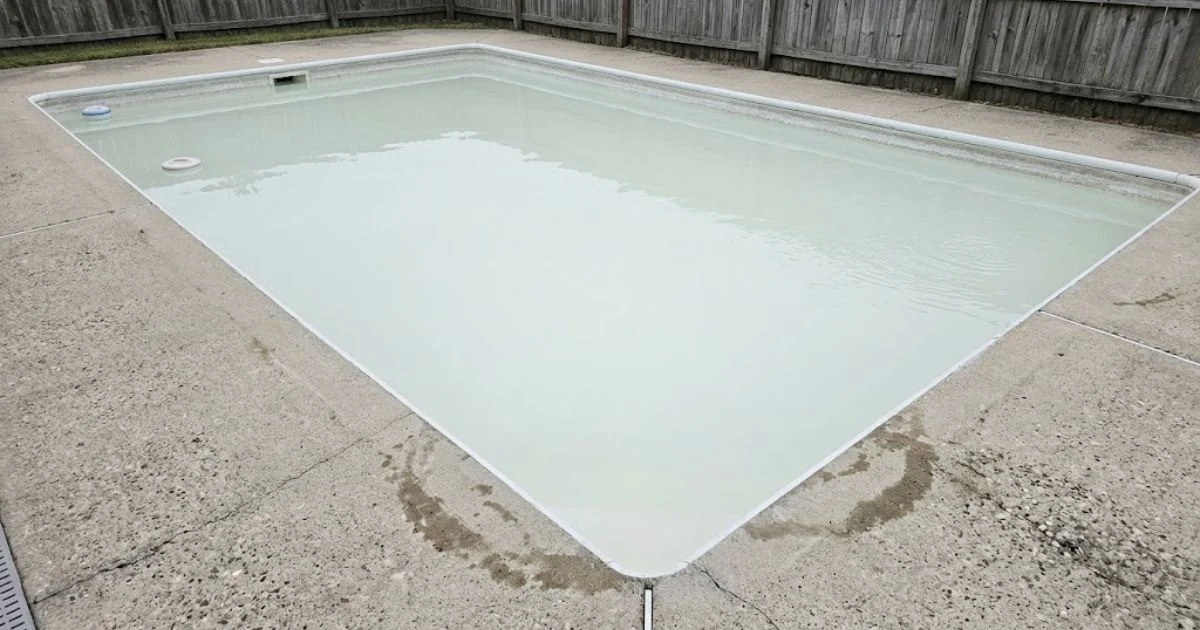

You shocked your pool. The water got cloudier. That’s the opposite of what’s supposed to happen, and now you’re staring at milky white or blue gray water wondering what went wrong.
Quick Answer: A pool cloudy after shock happens because the treatment oxidized bacteria, algae, and organic debris into tiny suspended particles the filter hasn’t removed yet. Other causes include calcium precipitation from the shock product itself, a dirty filter that can’t keep up, or unbalanced pH and calcium hardness. Most cloudiness clears in 12 to 48 hours. If it hasn’t, something specific needs fixing.
Here’s the thing: the water color after shock tells you exactly which problem you’re dealing with. That’s where to start, not with adding more chemicals.
Step 1: Read the Water Color First
Most guides skip this. They list causes in a random order and leave you guessing. The color tells you the cause before you even test the water.
| Water Color | What It Means | Priority Fix |
|---|---|---|
| Milky white or chalky | Calcium precipitation from cal-hypo shock | Lower pH, run filter |
| Blue-gray or hazy blue | Dead algae still suspended | Run filter 24 to 48 hrs, flocculant if severe |
| Green and cloudy | Algae still alive, shock failed | Correct pH, re-shock properly |
| Faint haze, water looks dull | Normal post-shock debris | Just run the filter continuously |
Milky white is the most misdiagnosed. Pool owners add more shock thinking something didn’t work. It makes the cloudiness worse because calcium hypochlorite shock is the cause, not the solution.
if your pool is green and cloudy after shock
Why Pool Water Turns Cloudy After Shocking
Calcium Precipitation From Cal Hypo Shock
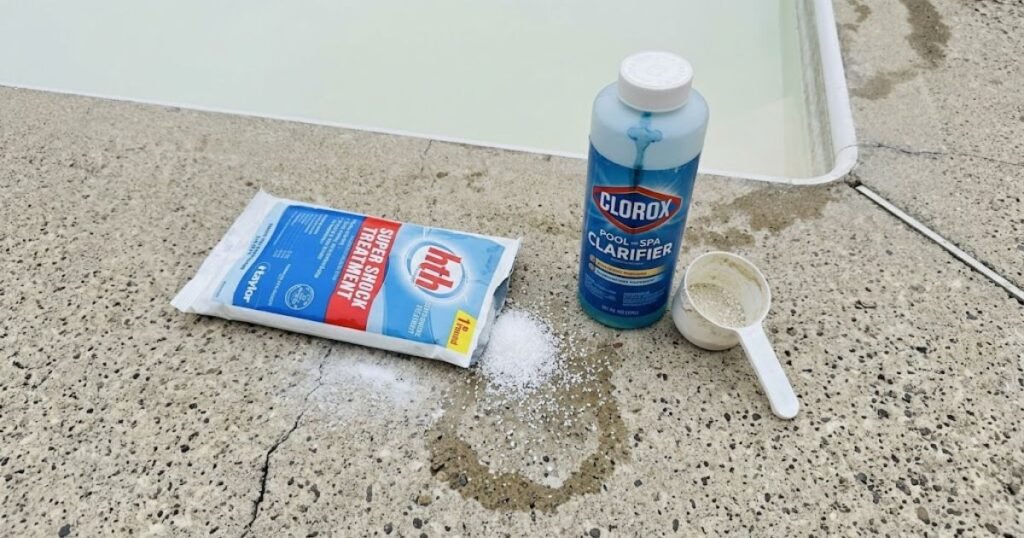
Calcium hypochlorite, the active ingredient in HTH Pool Shock and most granular shock products, contains 65 to 78 percent available chlorine. It also adds calcium to your water every time you use it.
If your pool already has high calcium hardness (above 400 ppm) or your pH is above 7.6, that added calcium has nowhere to go. It falls out of solution as fine white particles. That’s calcium precipitation, and it’s why your pool turned milky white after shocking.
The fix is not more shock. Lower pH to 7.2 using muriatic acid, run the filter continuously, and backwash every 8 to 12 hours. The cloudiness usually clears in one to three days once chemistry is corrected.
Or maybe I should say it this way: the shock worked fine. The water chemistry created the cloudiness, not the product.
Quick Comparison: Shock Types and Cloudiness Risk
| Shock Type | Best For | Cloudiness Risk |
|---|---|---|
| Calcium hypochlorite (cal-hypo) | Heavy algae, severe contamination | High if calcium or pH is elevated |
| Sodium dichloro (dichlor) | Routine weekly shocking | Low, but raises CYA over time |
| Potassium monopersulfate | Weekly oxidation, non-chlorine maintenance | Very low, does not kill algae |
choosing the right shock type for your pool
Dead Algae Still Floating in the Water
Blue or blue gray cloudiness after shock is actually good news. It means the shock killed the algae. The dead cell debris is now suspended in the water column waiting to be filtered out.
Pool owners who see this often add more shock or clarifier immediately, which isn’t wrong, but running the filter is what actually solves it. Dead algae particles are small. A sand filter running continuously for 24 to 48 hours with regular backwashing handles most cases on its own.
If it’s still hazy after 48 hours of continuous filtration, use a pool flocculant. It sinks the particles to the bottom overnight so you can vacuum them to waste directly.
A Dirty Filter That Can’t Keep Up
Shock kills contaminants. The filter removes them. These are two different jobs.
If the filter is dirty, overloaded, or hasn’t been backwashed recently, it doesn’t matter how well the shock worked. The debris stays in the water. This is the most overlooked reason pools stay cloudy for days after treatment. backwashing and rinsing your filter after shocking
Unbalanced Water Chemistry
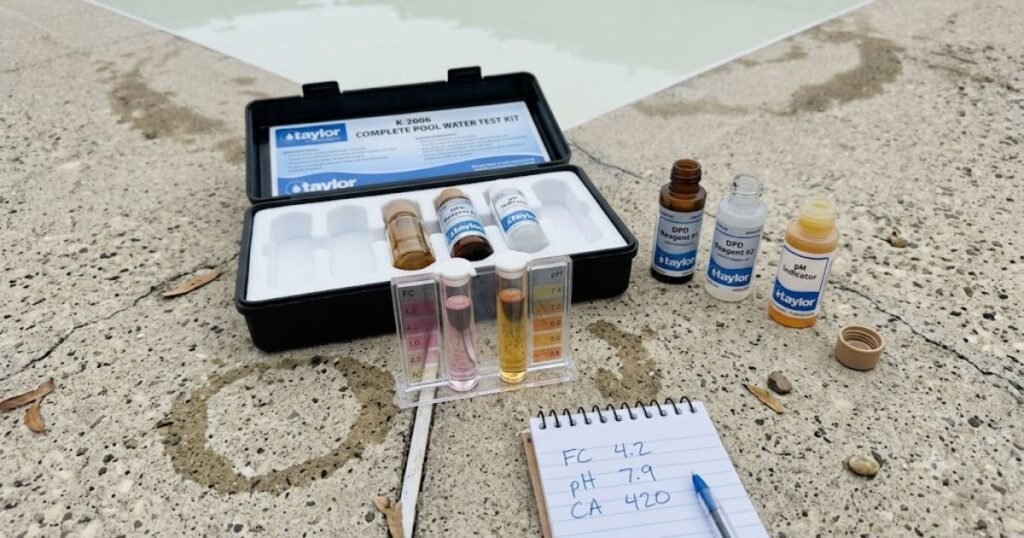
According to the CDC’s 2024 Healthy Swimming Program, free chlorine should be maintained at minimum 1 ppm with pH between 7.2 and 7.8 for effective pool sanitation. When pH is above 7.8 before shocking, chlorine efficiency drops sharply and the water balance shifts toward conditions that create cloudiness rather than clarity.
High total alkalinity above 120 ppm makes pH harder to lower and compounds the problem when combined with elevated calcium hardness. Test all five parameters before and after shocking: free chlorine, pH, total alkalinity, calcium hardness, and cyanuric acid (CYA).
The Taylor Technologies K-2006 Test Kit covers all five and gives you accurate liquid readings rather than color-matched strip estimates that can be hard to read in sunlight.
How to Clear a Cloudy Pool After Shocking (5 Steps)
To clear a cloudy pool after shocking, follow these steps:
- Test the water free chlorine, pH, total alkalinity, calcium hardness.
- Lower pH to 7.2 to 7.4 if it’s above range before adding anything else.
- Clean the filter backwash sand filters, rinse cartridge filters, recharge DE filters.
- Run the pump continuously for 24 to 48 hours without interruption.
- Add Clorox Pool and Spa Clarifier for white or mild haze, or use flocculant for heavy blue-gray dead algae cloudiness, then vacuum to waste.
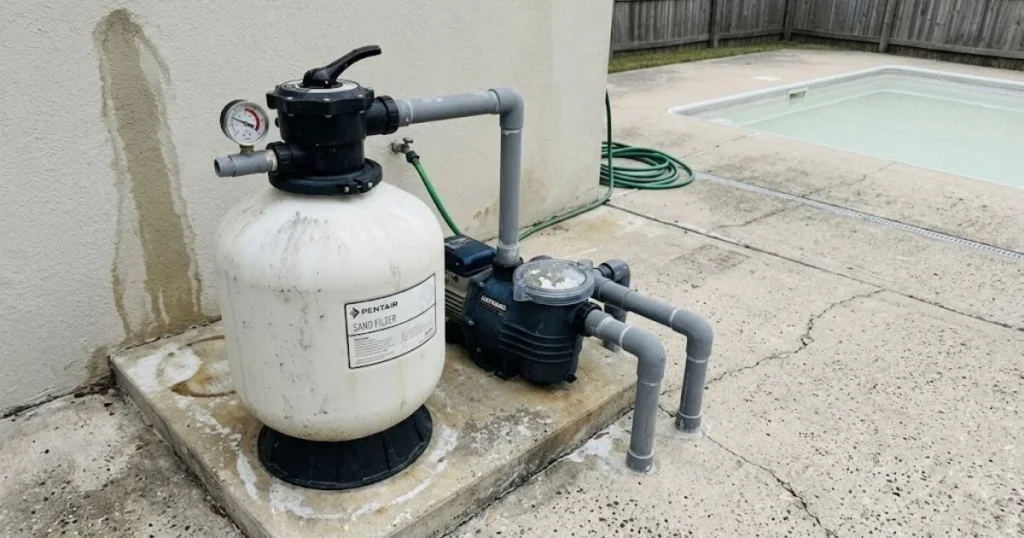
Look: if your pool is still cloudy after 48 hours with the pump running, the filter needs cleaning before you add anything else. A clogged filter renders clarifier useless because the clumped particles have nowhere to go.
Target water balance for clearing cloudy water:
| Parameter | Target Range |
|---|---|
| Free Chlorine | 2 to 4 ppm |
| pH | 7.2 to 7.4 |
| Total Alkalinity | 80 to 120 ppm |
| Calcium Hardness | 200 to 400 ppm |
| Cyanuric Acid (CYA) | 30 to 50 ppm |
balancing all five parameters for clear pool water
How Long Does a Pool Stay Cloudy After Shock?
| Cause | Clears In |
|---|---|
| Normal debris and oxidation | 12 to 24 hours |
| Dead algae (blue-gray cloudiness) | 24 to 72 hours |
| Calcium precipitation (mild) | 1 to 3 days with pH correction |
| Calcium precipitation (heavy) | Up to 5 days |
| Dirty or clogged filter | Until the filter is cleaned |
I’ve seen sources say calcium cloudiness clears in 24 hours with the filter running. That’s only true when pH is corrected simultaneously. Without lowering pH, the precipitation keeps forming and the filter is working against a problem that isn’t stopping. My read: pH correction comes before filter runtime, not after.
Can You Swim in a Cloudy Pool After Shocking?
No. Not until three conditions are met:
✓ Free chlorine is back between 2 and 4 ppm
✓ You can clearly see the pool floor at the deepest point
✓ pH is in the 7.2 to 7.8 range
According to the CDC’s Healthy Swimming guidelines, visibility to the pool floor is a baseline safety requirement, not just an aesthetic preference. If you can’t see the drain, don’t swim.
The fastest way to slow down post-shock cloudiness is to test pH before you shock, not after. Most calcium precipitation problems never happen if pH is at 7.2 going in.
Frequently Asked Questions
Why is my pool cloudy after shocking?
Dead algae particles, calcium precipitation from cal-hypo shock, a dirty filter, or unbalanced pH and calcium hardness. The water color tells you which cause to address first.
How long will my pool be cloudy after shock?
Mild cloudiness from normal oxidation clears in 12 to 24 hours. Dead algae takes 24 to 72 hours. Calcium precipitation can take up to 5 days if pH isn’t corrected.
Why does my pool look white and milky after I added shock?
That’s calcium precipitation. Cal-hypo shock adds calcium, and if your pH or calcium hardness is already high, it falls out of solution as white particles. Lower pH to 7.2 first.
Should I run my pump continuously after shocking?
Yes. Run it 24 to 48 hours straight. Backwash your sand filter or rinse your cartridge every 8 to 12 hours during that window.
When is it safe to swim in a cloudy pool after shocking?
When free chlorine is between 2 and 4 ppm, pH is in range, and you can see the pool floor at the deepest point without distortion.
Final Thoughts
A pool cloudy after shock is rarely a reason to panic. In most cases, the cloudiness is a temporary result of successful oxidation, dead algae, or fine particles waiting to be filtered out. The key is identifying whether your pool water cloudy after shock treatment is caused by normal cleanup, calcium precipitation, poor filtration, or an imbalance in chlorine, pH, total alkalinity, or calcium hardness. By testing the water, maintaining proper circulation, cleaning your filter, and applying the correct treatment, you can restore crystal-clear pool water quickly and prevent recurring cloudiness after future shock treatments.