
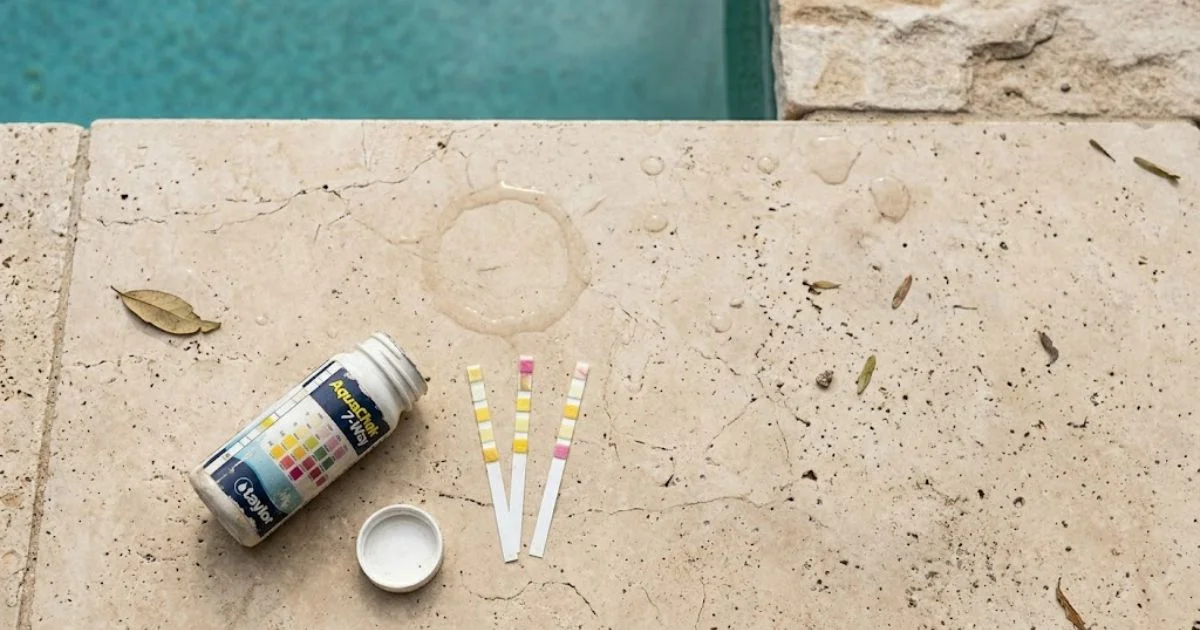
Choosing between pool test strips and a liquid test kit comes down to one thing: how much you trust the numbers before adding chemicals. If you’ve ever added chlorine based on a strip reading and watched your pool turn green anyway, you already know which one failed you.
pool test strips vs liquid test kit
Quick Answer: Liquid test kits are more accurate than pool test strips because they measure water chemistry using reagent drops instead of color pads. Test strips are best for quick routine monitoring, while liquid kits are the better choice when you’re adjusting chlorine, pH, total alkalinity, calcium hardness, or cyanuric acid and need the number to actually be right.
This guide isn’t going to tell you strips are useless. They’re not. But there’s a specific point where they stop being good enough for real pool chemistry decisions, and most comparison articles gloss right over it.
I ran into this exact problem myself a couple summers ago. My strips kept showing chlorine “somewhere between 1 and 3,” and I couldn’t tell if I was looking at a healthy pool or one about to turn. I finally grabbed a Taylor K-2006C from our pool chemical testing guide and found out my actual free chlorine was sitting at 1.2 ppm, low enough that algae was already starting in the shallow end. That single test told me more in five minutes than two weeks of strip guessing had.
What’s the Real Difference Between Test Strips and Liquid Kits?
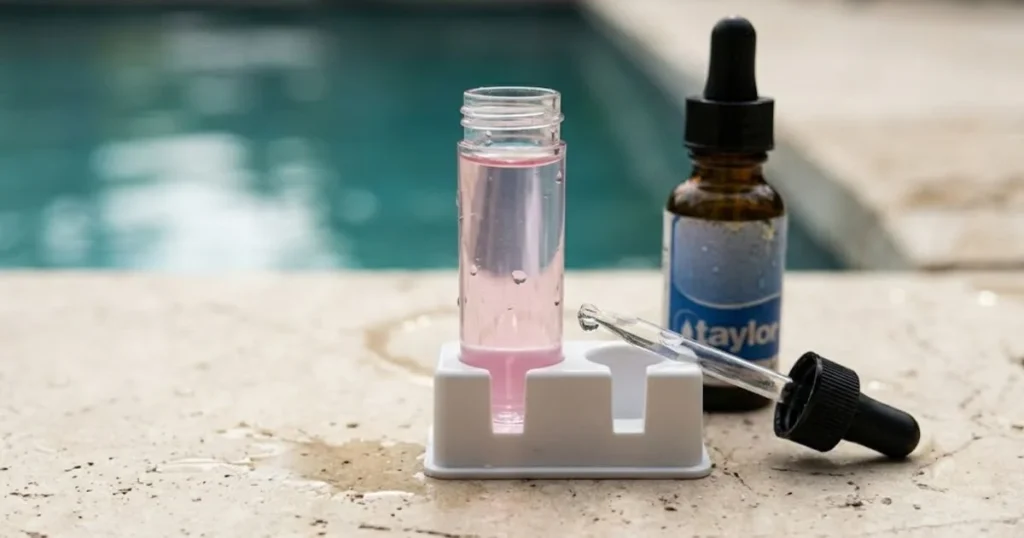
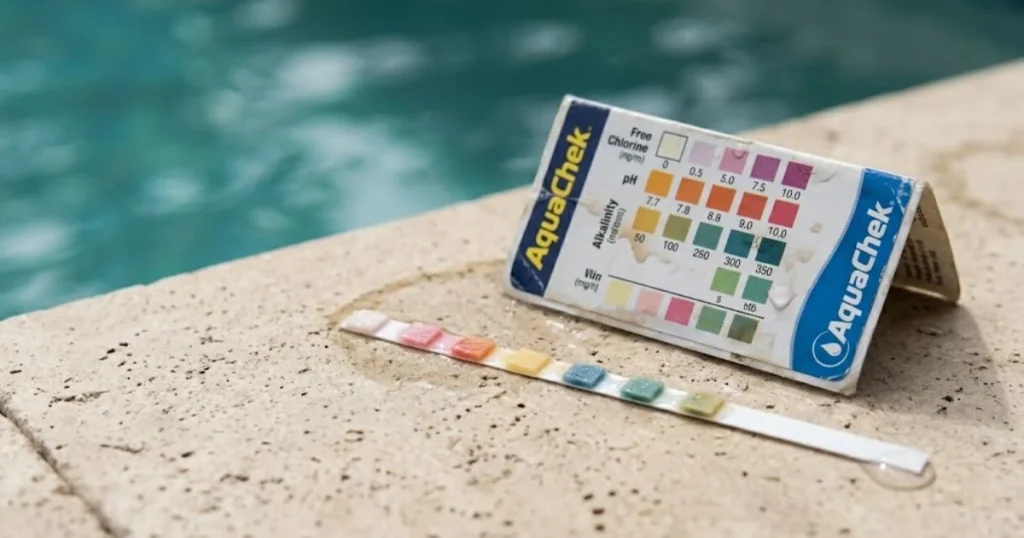
Test strips use color pads that react to chemicals in your water. You dip, wait a few seconds, and match the resulting color to a printed chart. Liquid kits use reagent drops added to a water sample, either matching a color (DPD) or counting drops until a color change happens (FAS-DPD).
That second method matters more than most guides admit. FAS-DPD isn’t a color matching test at all. It’s a drop count test, which means the result isn’t “somewhere between 1 and 3 ppm.” It’s a specific number, tied to how many drops it took to shift the color.
Good pool chemistry always comes back to water balance, meaning free chlorine, pH, total alkalinity, calcium hardness, and cyanuric acid all sitting in range at the same time. Miss one and the rest get harder to manage. Our water balance calculator can help you see how these numbers interact once you have accurate readings in hand.
Why a 1 to 3 ppm Guess Actually Costs You
Say your strip shows free chlorine in that 1 to 3 ppm range. If the real number is 1 ppm, you’re already at risk of algae taking hold in warm weather. If it’s actually 3 ppm, adding more chlorine on top of that wastes product and, over time, pushes your cyanuric acid level higher than it needs to be. A FAS-DPD kit would have told you the number was 1.2 ppm, not a range. That’s the difference between treating a real problem and guessing at one.
Test Strips vs Liquid Test Kit: Quick Comparison
| Option | Best For | Key Benefit | Limitation |
|---|---|---|---|
| Test strips (AquaChek 7-Way) | Daily quick checks, new owners | Fast, no skill needed, cheap upfront | Wide accuracy range, poor CYA reading |
| Liquid FAS-DPD kit (Taylor K-2006) | Troubleshooting, dosing decisions | Precise drop count reading | Takes 5 to 10 minutes, learning curve |
| Digital tester | Frequent testers, color blind users | No color matching required | Doesn’t measure CYA reliably, higher cost |
Which Test to Use for Each Chemical
| Test | Best Method | Time | Best For |
|---|---|---|---|
| pH | Liquid kit | 5 min | Chemical adjustments |
| Free chlorine / combined chlorine | FAS-DPD | 5 min | Shocking, sanitizer level checks |
| Total alkalinity | Liquid kit | 5 min | Weekly water balancing |
| Calcium hardness | Liquid kit | 5 min | Preventing scale or corrosion |
| Daily sanitizer check | Test strip | 30 sec | Routine monitoring |
Test strips work better for a fast daily glance at your sanitizer level. Liquid kits work better whenever you’re about to make a chemical decision that costs real money if you’re wrong. The key difference isn’t convenience. It’s whether you can trust the number enough to act on it.
How to Use Each Method Correctly
Getting a bad sample ruins either method equally, so this part matters no matter which you pick.
- Run the pump for at least one hour before testing.
- Pull water from 12 to 18 inches below the surface.
- Stay away from the return jets when sampling.
- Dip the strip or fill the vial, following the timing on the package.
- Read the strip in natural, indirect light, or count reagent drops carefully for FAS-DPD.
Skip any of those steps and even a kit that cost you real money will lie to you. If you’re not sure your readings are trustworthy yet, our how to test pool water correctly walkthrough covers sample collection in more detail.
When Test Strips Are Actually Fine
Strips get dismissed too quickly in some comparison articles, and that’s not fair to them.
✓ Daily or every-other-day checks. You just want to know sanitizer is present and pH is roughly in range.
✓ Confirming a dose worked. After shocking the pool, a quick strip dip tells you chlorine registered.
✓ Vacation or rental checks. Easy to pack, no reagent bottles to spill in a suitcase.
✓ Brand new pool owners. A low friction way to start testing weekly before buying a full kit.
Quick note: plenty of long time pool owners still keep a box of AquaChek strips around for exactly this reason, even after they’ve bought a liquid kit for the harder calls.
When You Need a Liquid Kit Instead
For anything where the number itself drives a decision, strips stop being good enough.
✓ Troubleshooting green, cloudy, or foamy water. You need an exact figure, not a range.
✓ Borderline pH readings. A strip showing “maybe 7.6, maybe 7.8” isn’t useful when you’re deciding whether to add acid.
✓ Calculating chemical doses. Dosing math built on a rough reading can leave you way off target. Our chlorine dosing calculator is built around accurate liquid test numbers, not strip ranges.
✓ CYA testing. Cyanuric acid is notoriously hard to read on a strip pad. The turbidity test in a liquid kit is far more reliable.
✓ Tracking your Langelier Saturation Index, which needs accurate pH, alkalinity, hardness, and temperature values strips can’t reliably deliver.
After comparing hundreds of pool care questions from homeowners, one pattern keeps showing up. Most chemical problems don’t start because people buy the wrong product. They start because the water was tested with an inaccurate reading. Spending a few extra minutes with a liquid test kit is usually cheaper than correcting a week of overtreated water.
Some pool service techs argue strips are “close enough” for weekly maintenance, and honestly, that’s a fair take if your pool has been stable for months. But the moment something looks off, that logic stops holding up.
Popular Test Strip and Liquid Kit Options Worth Considering
Liquid kits:
✓ Taylor K-2006 (FAS-DPD): Widely considered the benchmark kit. Tests free chlorine, total chlorine, pH, total alkalinity, calcium hardness, and CYA, with drop count chlorine testing up to 50 ppm.
✓ TF-100: Comparable accuracy to the Taylor kit, with larger reagent bottles that lower the cost per test over time.
Test strips:
✓ AquaChek 7-Way: The most recognized strip brand, covering free chlorine, total chlorine, pH, alkalinity, hardness, CYA, and bromine in one strip.
Real pool owners have said almost the same thing when this question comes up online. One person who said they’d worked in the pool business for years called Taylor kits the most accurate measurements they’d seen, strips included. Another put it simply: they’d rather spend sixty dollars on an accurate test kit than thousands of dollars fixing plaster damaged by months of bad water chemistry.
That’s not a stat from a lab. That’s someone who’s watched what a bad reading actually costs.
Digital Pool Testers: Worth the Upgrade in 2026?
Digital testers sit between strips and liquid kits on both price and accuracy, and the category has genuinely improved. Photometer style testers shine a light through the sample and measure the exact color change electronically, removing the human guesswork of matching a pad to a printed chart. Several newer models pair with a phone app over Bluetooth, logging your free chlorine, pH, and alkalinity automatically so you can watch trends over weeks instead of relying on memory.
A few things to know before buying one. Photometers need periodic calibration, usually with a calibration solution supplied by the manufacturer, and skipping this step lets small errors creep in over time. Sensor and electrode based models have a limited lifespan and eventually need replacing, not unlike a car battery that slowly loses capacity. Battery life on the handheld units varies quite a bit, and cheaper models tend to need new batteries every few months of regular use.
The tradeoffs are real. Most digital testers still don’t measure CYA reliably, so you’ll want a liquid kit or a dedicated turbidity test for that one parameter no matter what device you buy. They’re a genuine step up from strips for pH and free chlorine spot checks. They don’t fully replace a liquid kit for troubleshooting.
Which Pool Test Is Right for You?
| If you are… | Buy |
|---|---|
| New homeowner just getting started | AquaChek 7-Way strips |
| Doing weekly maintenance on a stable pool | Taylor K-2006C |
| Managing a saltwater pool | Taylor K-2006C |
| Renting out your pool on Airbnb | Digital tester |
| Running a pool service company | FAS-DPD kit |
Common Mistakes That Wreck Either Method
Users who’ve tried both methods over years of pool ownership tend to run into the same handful of errors:
✓ Reading strips in direct sunlight, which shifts how colors appear and throws off the match.
✓ Using expired reagents or strips. Both degrade with heat, sunlight, and moisture, and expired supplies give confidently wrong answers.
✓ Storing kits in a hot pool shed. A shed that hits 120°F in summer will cook reagents faster than the bottle’s shelf life suggests.
✓ Not logging results at all. A single perfect reading, done once, tells you less than a mediocre reading tracked consistently over weeks.
What most guides skip is that last point. The testing method matters less than whether you’re actually tracking the trend. A strip reading logged every few days catches a slow pH climb long before it becomes a real problem. One perfect liquid test done once and forgotten catches nothing.
One thing we’ve noticed while reviewing pool chemistry questions from readers is that inaccurate test results often send homeowners chasing the wrong problem entirely. A pool with low chlorine and a pool with high pH can look almost identical when the water turns cloudy, a little dull, not quite right. That’s why we always recommend confirming an unusual reading with a liquid drop kit before adding expensive chemicals based on a guess.
The Real Answer: Use Both, Strategically
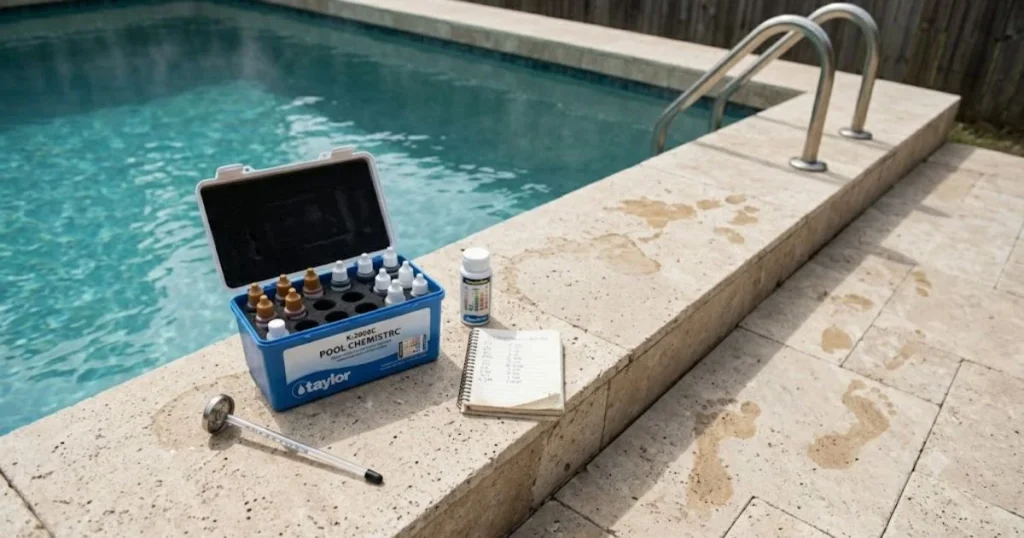
I’ve seen this framed as a strict either-or choice in some articles, and other sources argue liquid kits should replace strips entirely. My take, after going through the accuracy differences and how real pool owners actually use these tools day to day: neither extreme fits most people.
Keep strips on hand for a fast daily or every-other-day glance. Sanitizer present? Roughly in range? Good, move on. Then run a full liquid test once a week, or any time something looks off, smells off, or a strip gives you a reading you don’t trust. For deeper background on the EPA’s guidance on pool water efficiency and chemical management, their WaterSense program is worth a look, and the CDC’s Healthy Swimming guidance lays out the pH and chlorine ranges that keep water safe in the first place.
This guide covers home pool testing for residential owners. It does not cover commercial pool compliance testing, which typically requires certified lab equipment and different reporting standards.
FAQ: Pool Test Strips vs Liquid Test Kit
What’s the best test kit for a home pool?
The Taylor K-2006 FAS-DPD kit is the most trusted option for accuracy. AquaChek 7-Way strips work well for quick daily checks.
How do I know if my test strips are wrong?
If your pool looks cloudy or algae is forming despite a normal strip reading, run a liquid FAS-DPD test to confirm the real number.
Should I use strips or liquid kits for chlorine?
Use strips for a daily glance. Use a liquid FAS-DPD kit whenever you’re deciding how much chlorine to add.
Why does CYA read so poorly on strips?
CYA relies on a turbidity reaction that’s genuinely hard to judge by color pad alone. Liquid kits use a clearer turbidity test that’s easier to read accurately.
When should I call a pool professional instead of testing myself?
If your water stays cloudy, green, or foamy after correcting your readings, a professional test can catch issues like total dissolved solids that DIY kits miss.
Final Take
If you’re only checking whether chlorine is present before a swim, test strips are perfectly acceptable. But when you’re deciding how much chlorine, acid, stabilizer, or calcium increaser to add, guessing can become expensive fast. That’s where a liquid FAS-DPD kit earns its place. The extra five minutes spent testing accurately can save hours of troubleshooting, and a lot of unnecessary chemical costs, later.