
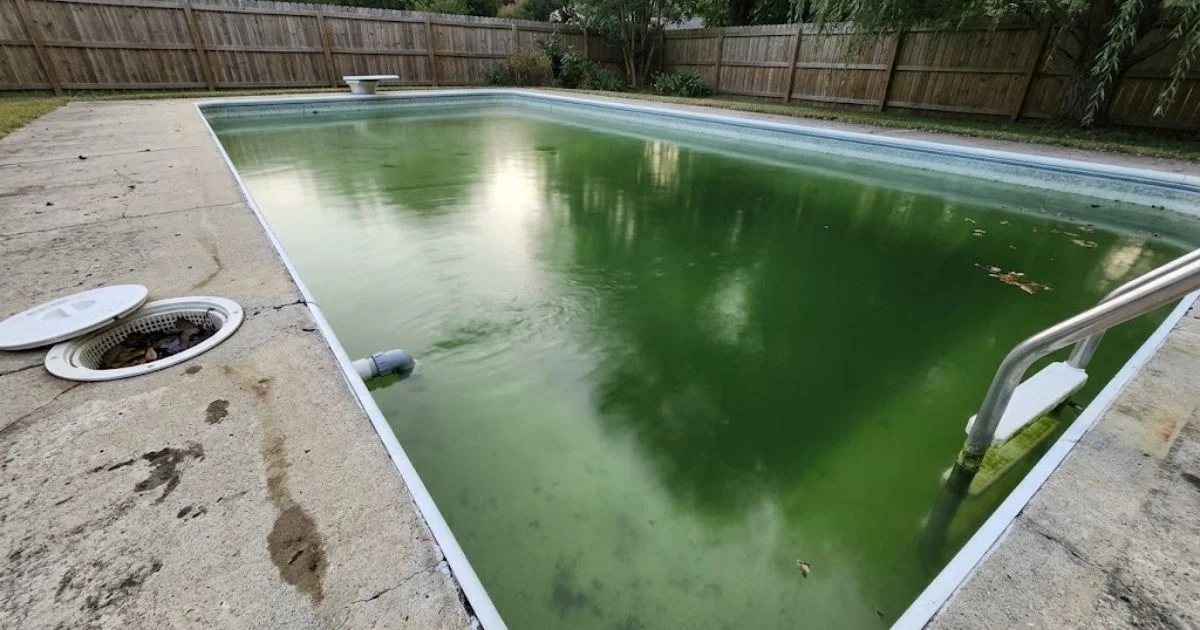
Pool Still Green After Shocking
If your pool is still green after shocking, the problem is almost never that shock “doesn’t work.” More often, the chlorine never had a fair shot. High cyanuric acid, wrong pH, underdosing, a dirty filter, or dead algae still floating through the water, one or more of those is why you’re staring at green water right now.
Quick Answer: If your pool is still green after shocking, the problem is usually not a lack of shock but an underlying issue such as high CYA, incorrect pH, insufficient chlorine, poor filtration, dead algae, or metals in the water. Correct the root cause first, then filter the water continuously to restore a clear, healthy pool.
According to the CDC’s 2024 Model Aquatic Health Code (MAHC), maintaining effective free chlorine levels and the proper pH is essential for preventing algae growth and ensuring chlorine works as intended. Many pool owners overlook this critical relationship, chlorine and pH work together, and when either is out of balance, even repeated shock treatments may fail to clear a green pool.
Why Shock Keeps Failing (And What Most Guides Miss)
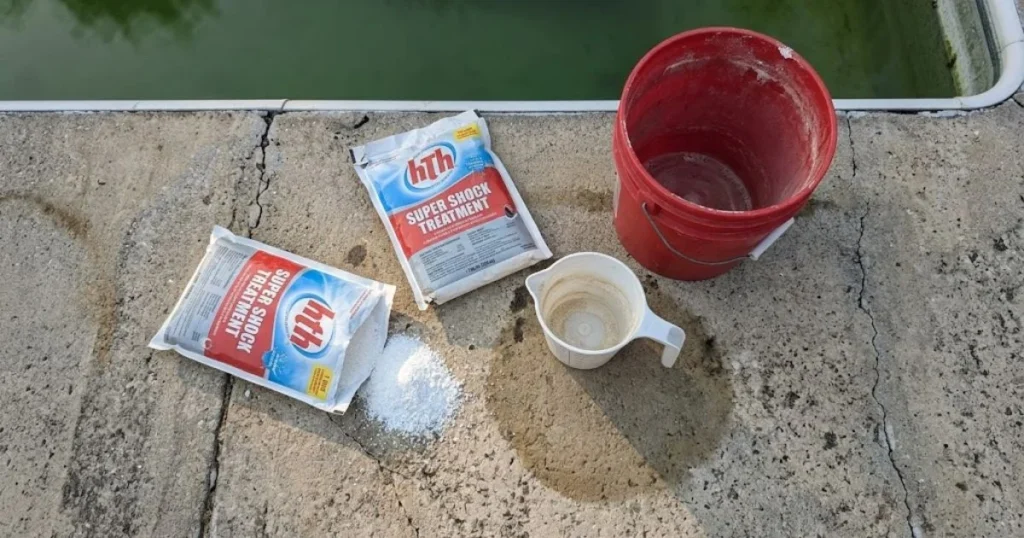
Pool shock is designed to spike free chlorine high enough to kill algae, bacteria, and organic contaminants fast. But it only works when several conditions line up: pH in range, CYA not too high, enough product for the pool volume, and a filter running long enough to remove what chlorine kills.
Here’s the thing: most troubleshooting articles cover one of those factors. They pick pH or they pick CYA, and they stop there. What they skip is the diagnostic order, meaning which problem to test for first so you’re not wasting chemicals on the wrong fix.
Or maybe I should say it this way: shock is the last step, not the first. Test and balance before you dose. That order matters more than the brand of shock you choose.
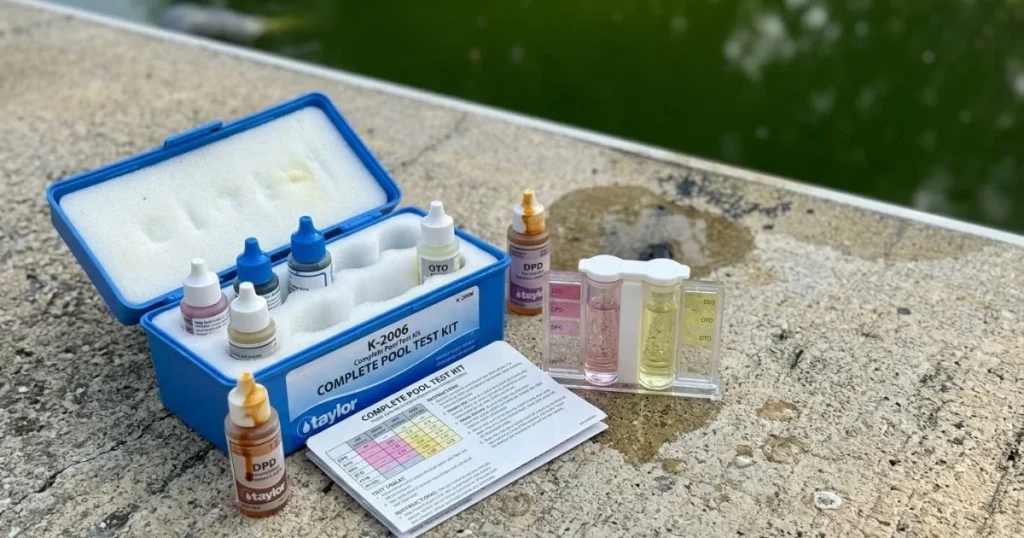
Pool owners who’ve been through this pattern often report the same thing. They shocked twice, maybe three times, saw no improvement, and only found the real answer when they finally ran a full test kit on their water. A solid option for that is the Taylor K-2006 Test Kit, which measures free chlorine, combined chlorine, pH, total alkalinity, calcium hardness, and CYA in one kit.
the right shock process
Reason 1: High Cyanuric Acid Is Blocking Your Chlorine
CYA, or cyanuric acid, is pool stabilizer. It protects chlorine from burning off in sunlight, which is genuinely useful. But when CYA climbs too high, it grabs onto chlorine molecules so tightly that they can’t kill algae. This is commonly called chlorine lock, though the more accurate description is that CYA raises the minimum free chlorine level needed to be effective.
Ideal CYA for a non-saltwater pool sits between 30 and 50 ppm. Saltwater pools can go up to 60 to 80 ppm. Once CYA creeps past 80 to 100 ppm, even a chlorine reading that looks “fine” on a test strip may be doing almost nothing against live algae.
This is the counter-intuitive part most guides bury: your chlorine test can show a normal number and your pool can still be actively growing algae. That’s not a broken test. That’s high CYA making most of that chlorine unavailable. how CYA affects chlorine effectiveness
The only real fix for excessive CYA is partial drain and refill. There’s no chemical that breaks it down fast enough to be practical.
How to Check If CYA Is Your Problem
Test with a liquid kit or take a water sample to a pool store. If CYA is above 80 ppm:
- Drain 30 to 50 percent of the pool water
- Refill with fresh water
- Retest CYA before shocking again
- Target 30 to 50 ppm before proceeding
Reason 2: pH Was Too High Before You Shocked
Chlorine’s effectiveness drops sharply as pH rises. At a pH of 7.2, roughly 65 percent of your chlorine is in an active sanitizing form. At pH 8.0, that drops to around 20 percent. You could be adding the right amount of shock and losing most of its power before it reaches a single algae cell.
The right range is 7.2 to 7.6, with 7.3 to 7.4 being the sweet spot for shocking. If pH was high when you shocked, the chlorine was hamstrung from the start. Lower pH with muriatic acid or dry acid first, then shock. balancing pH before shocking
Quick note: total alkalinity affects how stable your pH is. If alkalinity is low, pH will bounce around and be hard to hold in range. Test both.
Reason 3: You Underdosed for the Size of the Algae Bloom
One bag of shock works fine for a pool with a minor sanitizer dip. A pool that’s gone visibly green is a different situation entirely. The algae bloom has already consumed free available chlorine (FAC) from the water, and the chlorine demand is far higher than a normal maintenance dose can address.
A general starting point for a green pool is 30 ppm of free chlorine as a target, not as an added amount. That means calculating backward from your pool volume to figure out how much product actually gets you there.
Some sources recommend the SLAM Process (Shock, Level, And Maintain) from the TroubleFreePool community, which involves holding free chlorine at a target level based on your CYA, not just dumping in a set number of bags. I’ve seen conflicting advice on exactly how high to push FC for heavy blooms: some sources say 10 times CYA level, others cap it lower for safety. My read is that the 10x CYA ratio is a reasonable upper target for severe green pools when CYA is in a normal range, but it should be paired with a functioning filter running continuously. explains the free chlorine to CYA ratio for algae treatment
Learn our Guide on : free chlorine targets by CYA level
Reason 4: The Filter Wasn’t Running Long Enough
Chlorine kills algae. The filter removes it. These are two different jobs, and skipping the second one is why pools stay cloudy green even after algae is technically dead.
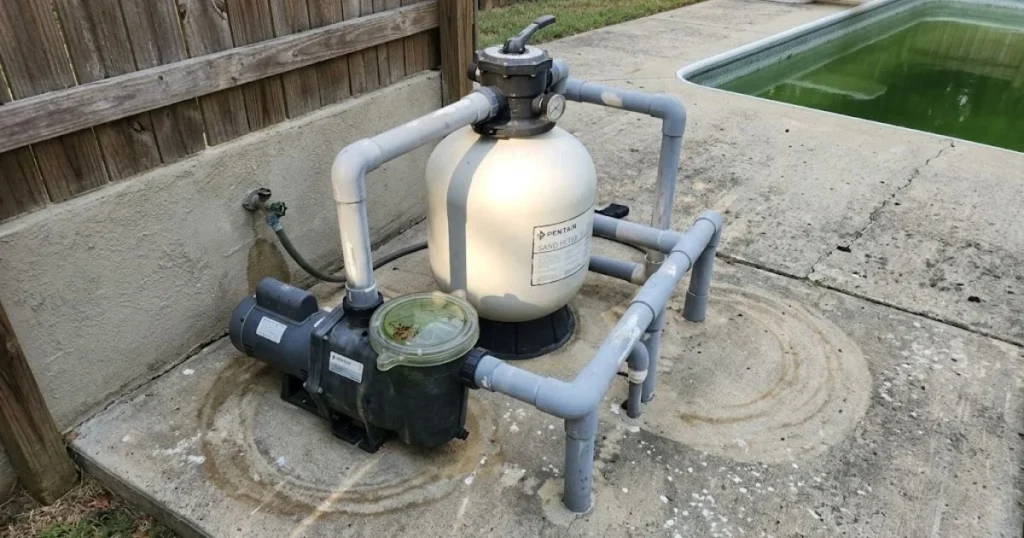
Dead algae particles are small enough to pass through a sand filter’s pores if the filter isn’t running long enough or if the media is overdue for replacement. After a heavy shock treatment, the filter needs to run continuously, ideally 24 to 48 hours without shutting off. Backwash your sand filter every 8 to 12 hours during this process if pressure climbs.
A cartridge filter doing this job needs to be rinsed and inspected mid-treatment. A filter caked with debris can’t capture the particles it’s supposed to be removing.
Pool owners with above ground pools sometimes run into this more because their filtration systems are smaller relative to pool volume. The fix is the same: longer runtime, clean media, consistent circulation. removing dead algae after treatment
Reason 5: What You’re Seeing Is Dead Algae, Not Live Algae
This is the one that frustrates people most. The pool is still green after shocking, the walls don’t feel slimy, chlorine levels are holding, and yet the water stays murky. That’s usually dead algae, not active algae.
When algae dies, it breaks into tiny particles that stay suspended in the water column. The pool looks green or cloudy because those particles scatter light. The filter is working on them, but it takes time, especially with a heavy bloom.
Signs you’re looking at dead algae rather than live algae:
✓ Walls and floor are not slippery or coated
✓ Chlorine holds overnight without dropping fast
✓ Water color is shifting from bright green to gray or cloudy white
✓ Filter pressure is rising (it’s capturing debris)
If this is your situation, a pool clarifier like HTH Super Clarifier helps clump dead particles so the filter can grab them. Flocculant works faster but requires vacuuming to waste afterward, meaning the water goes out of the pool rather than back through the filter.
Look: if you’re in this situation, the answer isn’t more shock. It’s patience, continuous filtration, and brushing the floor daily to keep settled particles back in suspension where the filter can catch them.
Reason 6: Phosphates Are Feeding Algae Faster Than Chlorine Kills It
Phosphates are algae food. They enter pools from leaves, grass clippings, fertilizer runoff, bird droppings, and even some pool chemicals. In a high-phosphate environment, algae can regrow quickly even as chlorine is trying to knock it back.
Most pool owners never test phosphates. That’s understandable, since standard test kits don’t include them. But if a pool keeps going green repeatedly, especially after confirmed correct chemistry, phosphates deserve a look.
Phosphate remover (lanthanum chloride based products) drops phosphate levels quickly and is compatible with normal pool chemistry. Use it after getting chlorine and pH in range, not as a first step.
Some experts argue phosphate removal is unnecessary if chlorine is maintained properly, and that’s a fair point for a stable, well-managed pool. But if you’re troubleshooting a stubborn green pool that keeps coming back, knocking down phosphates removes one more variable. pool water chemistry recommendations for sanitizer effectiveness
Reason 7: The Wrong Shock Product for Your Situation
Not every shock works the same way, and not every situation calls for calcium hypochlorite.
✓ Calcium hypochlorite (cal hypo): Fast-acting, high chlorine content (65 to 78 percent available chlorine). Best for heavy green pools and SLAM treatments. Does not add CYA.
✓ Sodium dichloro (dichlor): Contains stabilizer. Good for routine maintenance shocking. Avoid repeated use if CYA is already elevated.
✓ Potassium monopersulfate (non-chlorine shock): Oxidizes organics but does not kill algae effectively. Not the right product for a green pool.
If your pool is still green after shock and algaecide, the algaecide is likely not the problem. Algaecide helps prevent algae growth but can’t compensate for wrong pH, high CYA, or a dirty filter. Fix the chemistry first. Algaecide is a maintenance tool, not a rescue product.
Step-by-Step Fix: The Correct Order
To fix a pool still green after shocking, follow these steps:
- Run a full water test: free chlorine, combined chlorine, pH, total alkalinity, CYA.
- Adjust pH to 7.2 to 7.6 before adding any chlorine.
- Check CYA. If above 80 ppm, partial drain and refill before proceeding.
- Calculate the correct shock dose for your pool volume and algae severity.
- Brush all pool surfaces thoroughly before and after shocking.
- Add shock in the evening with the pump running.
- Backwash or rinse the filter every 8 to 12 hours as pressure rises.
- Vacuum dead algae that settles to the floor, using waste mode if possible.
- Run the filter continuously for 24 to 48 hours.
- Retest free chlorine, pH, and CYA before stopping treatment.
Troubleshooting at a glance:
| Symptom | Most Likely Cause | Fix |
|---|---|---|
| Pool still green after shock | High CYA or wrong pH | Test and correct chemistry first |
| Green and cloudy after shocking | Dead algae suspended | Run filter continuously, use clarifier |
| Still green after shock and algaecide | Poor water balance | Balance water before retreating |
| Turns green immediately after shock | Metal contamination | Use metal sequestrant, not more shock |
| Still green after shocking twice | Underdose or filtration issue | Calculate correct dose, check filter |
| Salt water pool still green after shock | CYA too high or cell output low | Test CYA, inspect salt chlorinator |
| Above ground pool still green after shock | Poor circulation | Brush frequently, check pump output |
The Overnight Chlorine Loss Test
Before deciding to shock again, run an Overnight Chlorine Loss Test (OCLT). Measure free chlorine at sunset. Measure it again at sunrise before the pump starts. If FC drops more than 1 ppm overnight with no sunlight, live algae or organic demand is still consuming it. If it holds, the algae is dead and you’re waiting on the filter.
This test saves a lot of wasted shock. It’s not widely covered in basic pool guides, which is part of why people end up shocking three or four times without progress.
How Long Until the Pool Clears Up?
| Pool Condition | Expected Clearing Time |
|---|---|
| Light green, good chemistry | 24 hours |
| Moderate green | 24 to 48 hours |
| Dark green, heavy bloom | 2 to 5 days |
| Deep green, pool floor not visible | Up to 1 week |
If the pool is still green 48 hours after shocking with corrected chemistry, don’t immediately add more shock. Retest first. Confirm free chlorine is holding, pH is in range, and the filter is running clean.
The single most common pattern in stubborn green pools is this: homeowners keep adding chemicals without testing first. Spending ten minutes with a quality test kit before each treatment saves hours of work and avoids chasing a problem that already got fixed two steps ago.
Frequently Asked Questions About Pool Still Green After Shocking
Why is my pool still green after shocking it?
The most common causes are high CYA reducing chlorine effectiveness, pH being too high before shocking, underdosing for the bloom size, poor filtration, or dead algae still suspended in the water.
How long after shocking will my pool clear up?
A lightly affected pool can clear in 24 hours. A heavy algae bloom may take 2 to 5 days with continuous filtration and correct water chemistry.
Should I shock my pool again if it’s still green?
Not right away. Test free chlorine, pH, and CYA first. If chlorine is already elevated, the issue is likely filtration or dead algae, not lack of shock.
Why does my pool turn green right after I add shock?
Immediate green color after shocking usually signals metal contamination, especially copper. Use a metal sequestrant and test for dissolved metals before shocking again.
When should I use algaecide if my pool is still green after shocking?
After chlorine and pH are corrected and the algae bloom is treated. Algaecide like Clorox Pool and Spa Algaecide works as a maintenance barrier, not as a primary treatment for active heavy algae.
Conclusion
A pool still green after shocking usually means the root cause hasn’t been addressed. In most cases, the problem is high CYA, incorrect pH, an insufficient shock dose, poor filtration, dead algae, or metal contamination. Test your water, correct the chemistry, run the filter continuously, and address the underlying issue instead of adding more shock. With the right approach, your pool will clear faster and stay clean longer.