
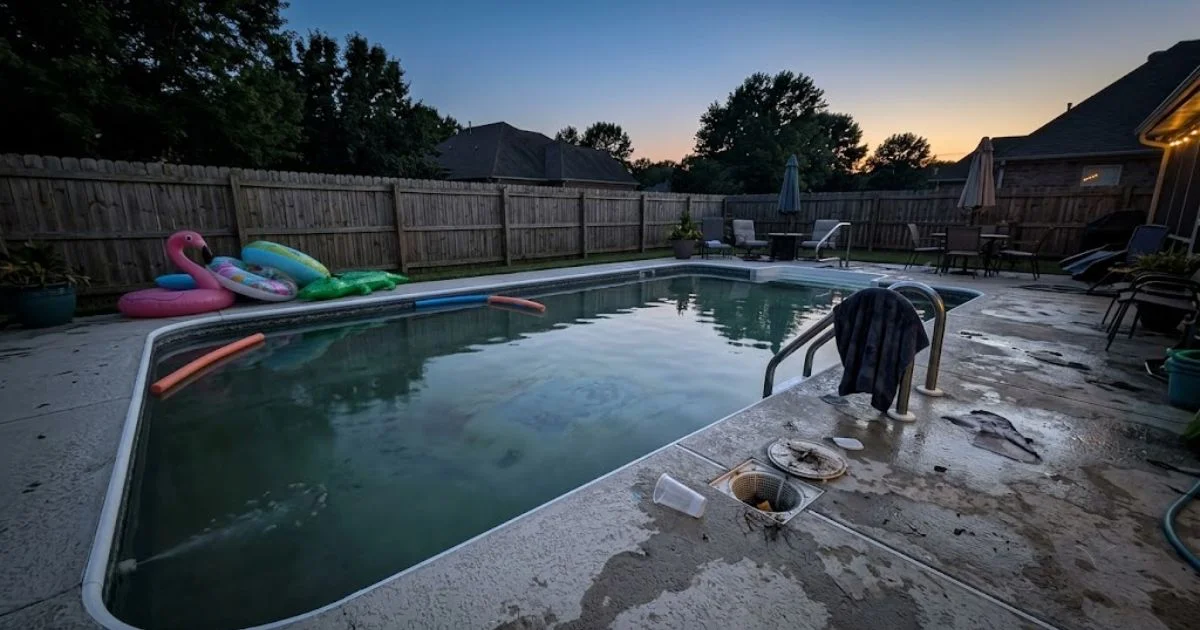
Quick Answer: To fix pool chemistry after a pool party, test free chlorine and pH first, shock with the correct dose for your pool volume and bather load, run the filter continuously overnight, retest in the morning, and confirm free chlorine is between 2 and 4 ppm and pH is between 7.2 and 7.6 before anyone swims. Most pools recover fully within 8 to 12 hours of correct treatment.
how to fix pool chemistry after a pool party
This guide covers what to do the same night the party ends and what to finish in the morning. Both matter.
What Heavy Bather Load Actually Does to Pool Chemistry
Every swimmer who enters a pool introduces sweat, body oils, sunscreen, cosmetics, and organic waste. According to the CDC’s Healthy Swimming Program (2024), these contaminants rapidly consume free chlorine and reduce water quality in ways that routine maintenance doses aren’t designed to handle.
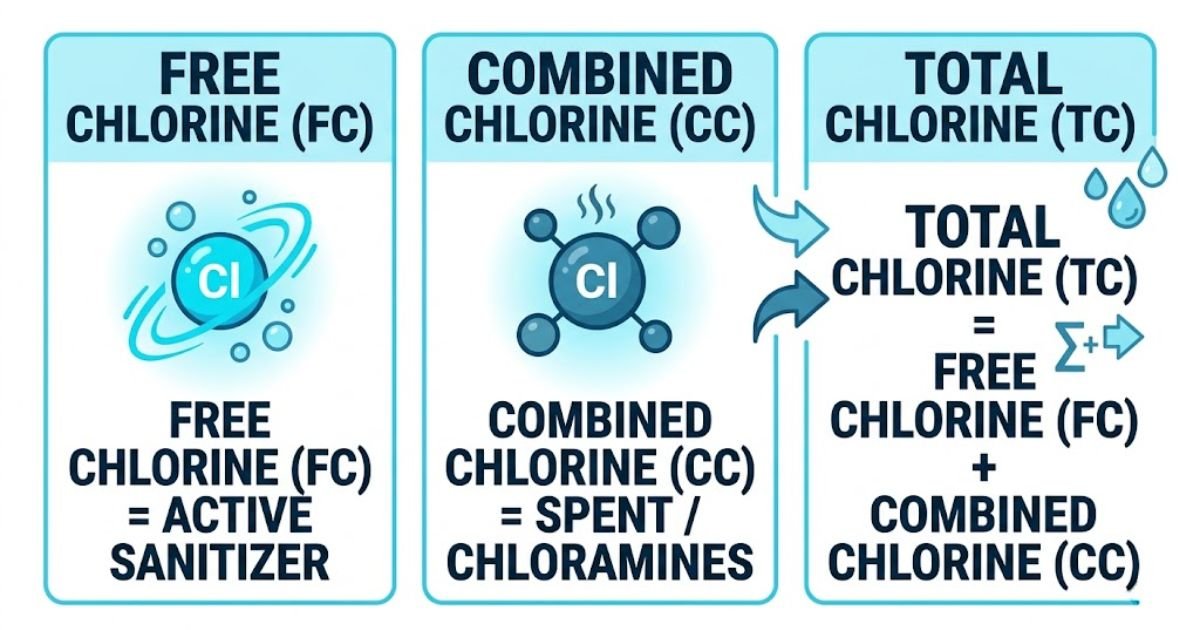
The technical term is chlorine demand, meaning the total amount of chlorine consumed by contaminants before any residual free chlorine remains. After a pool party with 15 or 20 swimmers in a 15,000-gallon pool, the chlorine demand can consume your entire chlorine residual within a few hours, leaving the water with combined chlorine (chloramines) but very little free available chlorine doing actual sanitizing work.
Here’s the thing: your pool can test positive for total chlorine and still be providing almost no real sanitation if most of what’s present is combined chlorine. That’s the situation many pool owners don’t realize they’re in after a heavy swimmer day.
Sunscreen is the biggest single driver of this problem. It’s an oil-based product that coats swimmers’ skin and transfers directly into the water, creating an organic load that chlorine works hard to oxidize before it can sanitize anything else. A party with 15 sunscreen-covered adults swimming for three hours can create a chlorine demand equivalent to twice the party’s bather load in simple body-contact terms.
understanding the difference between free and combined chlorine
Warning Signs to Watch During and Right After the Party
These tell you how hard your chemistry got hit before you even run a test:
✓ Water loses its sparkle mid-party and starts looking flat or slightly hazy
✓ A strong chlorine smell develops (this means chloramines, not excess chlorine)
✓ Eye or skin irritation complaints from swimmers
✓ Foam forming around the return jets or skimmer
✓ Visible film or sheen on the water surface from body oils
That chlorine smell is the counter-intuitive one. Most people assume it means too much chlorine. The data says the opposite: a strong chemical smell near a pool almost always means combined chlorine is high and free chlorine is depleted. what causes the chlorine smell in pools
Same Night Recovery: What to Do Before You Go to Bed
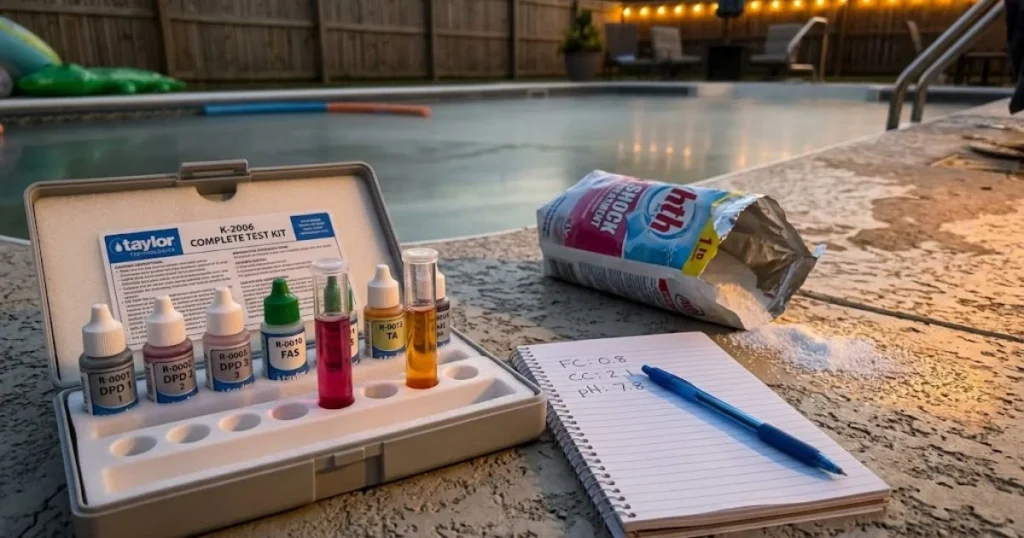
If you notice cloudiness or signs of chemistry stress while the party is still ending, start the recovery the same night. Don’t wait until morning.
To fix pool chemistry the same night after a party:
- Clear the pool of all floats, toys, and debris from the skimmer basket.
- Test free chlorine, combined chlorine, and pH with a reliable liquid test kit.
- Lower pH to 7.2 to 7.4 if it’s above range before adding shock.
- Add the correct shock dose based on pool volume and bather load (see next section).
- Brush pool walls and floor to distribute shock and loosen debris.
- Run the filter and pump continuously through the night.
Do this within two hours of the party ending if possible. The longer combined chlorine and organic waste sit untreated, the harder the morning recovery becomes.
How to Fix Pool Chemistry After a Pool Party
Quick note: always add shock to water, never water to shock. And shock at dusk or after the sun is fully down so UV doesn’t burn off the chlorine before it works.
correct shock procedure and evening application timing
How Much Chlorine Do You Actually Need After a Party
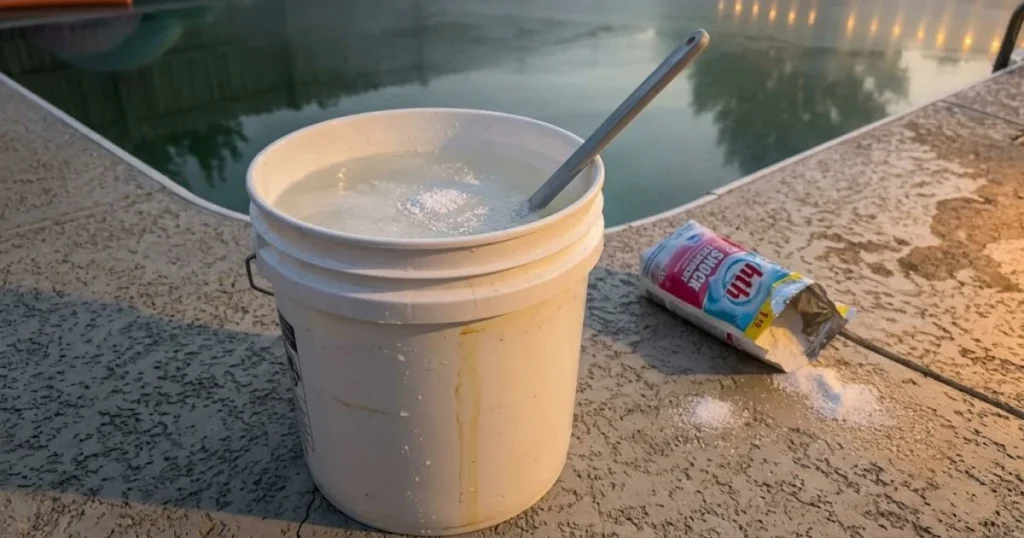
This is where most guides give vague advice like “shock your pool.” That’s not specific enough when you’ve had 20 people swimming for four hours.
A standard maintenance shock dose raises free chlorine by roughly 10 ppm in a 10,000-gallon pool per 1 pound of calcium hypochlorite (cal-hypo at 68 percent available chlorine). After a heavy bather load, you’re not doing maintenance. You’re fighting chlorine demand.
Bather load shock calculator (approximate):
| Swimmers | Pool Size | Shock Dose (Cal-Hypo 68%) |
|---|---|---|
| Up to 10 | 10,000 gallons | 1 to 1.5 lbs |
| Up to 10 | 15,000 gallons | 1.5 to 2 lbs |
| 10 to 20 | 10,000 gallons | 2 to 3 lbs |
| 10 to 20 | 15,000 gallons | 2.5 to 3.5 lbs |
| 20 or more | Any size | Test first, target 10 to 15 ppm FC |
For heavy parties, target 10 ppm free chlorine as your shock goal, not just “add one bag.” Use HTH Super Shock Treatment or an equivalent 68 percent cal-hypo product. Pre-dissolve in a bucket of water before adding to the pool for faster distribution.
I’ve seen some sources recommend non-chlorine shock after parties to avoid cloudiness. That’s a fair approach for light use. My read is that non-chlorine shock oxidizes but doesn’t sanitize, so after a heavy bather load with depleted free chlorine, cal-hypo is the correct product. Save non-chlorine shock for maintenance weeks when chlorine levels are already adequate.
free chlorine targets by pool size and condition
Next Morning Full Recovery Protocol
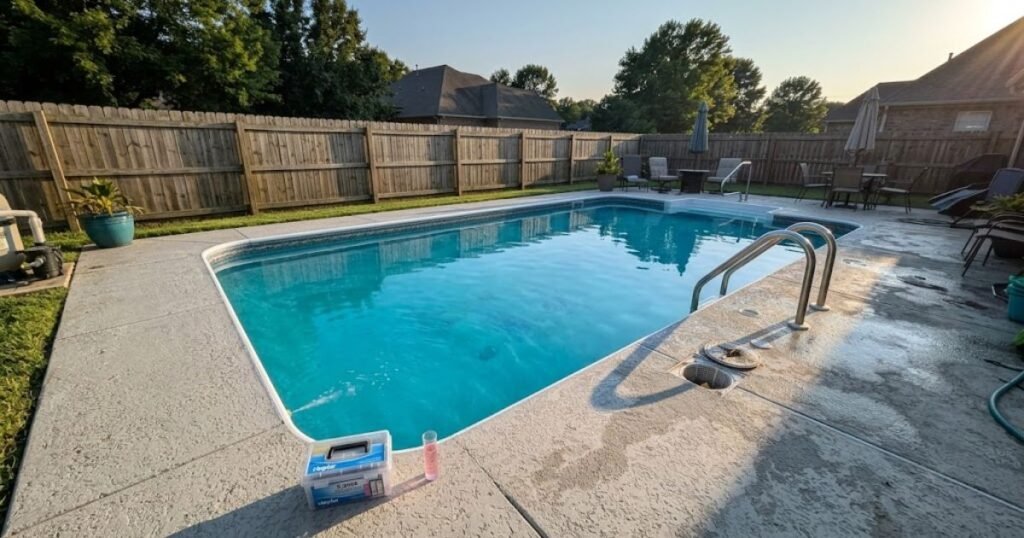
The same-night shock and overnight filtration handle the heavy lifting. The morning is about confirming the work is done and getting the water safe for the next swim.
What to test and in what order:
Test in this sequence. Order matters because pH affects how you read chlorine results.
- pH first target 7.2 to 7.6. If pH is off, your chlorine reading is harder to interpret accurately.
- Free chlorine should be at or above 2 ppm to be safe for swimming, ideally 3 to 4 ppm.
- Combined chlorine if CC is above 0.5 ppm, the water still has chloramine load that needs more time or a small additional shock dose.
- Total alkalinity target 80 to 120 ppm. Heavy bather load and chemical additions can shift alkalinity.
- Calcium hardness check if you added significant amounts of cal-hypo the night before.
The Taylor Technologies K-2006 Test Kit covers all five parameters with liquid reagent accuracy, which matters more after heavy use than a color-matched strip. using a liquid test kit for accurate post-party readings
Or maybe I should say it this way: test strips give you a starting point on a normal maintenance day. After a pool party with 20 swimmers, you need real numbers.
Can Guests Swim Again Tomorrow? The Honest Answer
Most pools treated correctly the same night are safe to swim by mid-morning the next day. The CDC’s 2024 Healthy Swimming guidelines set free chlorine at a minimum of 1 ppm and pH between 7.2 and 7.8 as the baseline for safe swimming water.
The practical threshold for comfort and safety after shock treatment is slightly higher: wait until free chlorine drops back to 4 ppm or below from the shock peak. Shocking raises FC to 10 or 15 ppm temporarily. That level is safe for brief contact but harsh for prolonged swimming.
Safe swim timeline after post-party shock:
✓ Shock the pool 24 hours before the party, not after, so free chlorine has time to return to a safe swimming range
✓ Run the filter for at least 8 hours the day before to start with clean, balanced water
✓ Set a pool capacity limit: a rough guideline is one swimmer per 6,000 to 7,000 gallons of pool volume for manageable chlorine demand
✓ Require a brief shower or rinse before entering, this removes sunscreen and body oils before they enter the pool
✓ Clean the skimmer basket at the mid-point of the party if it runs long
| Treatment Done | FC at Test | pH | Safe to Swim? |
|---|---|---|---|
| Same-night shock, 8 hours of filtration | 2 to 4 ppm | 7.2 to 7.6 | Yes |
| Same-night shock, 8 hours of filtration | Above 5 ppm | Any | Wait 2 to 4 more hours |
| No same-night treatment, morning shock | 2 to 4 ppm | 7.2 to 7.6 | Yes, after 4 hours of filtration |
| Morning shock, water still cloudy | Any | Any | Not until water clears visibly |
Look: if you can’t see the pool floor clearly at the deepest point, don’t let anyone swim regardless of what the test numbers show. Visibility is a basic safety requirement, not an aesthetic preference. safe swimming chemistry and water clarity standards
How to Prevent Chemistry Problems Before the Next Party
Treating the problem after the fact costs more time and chemicals than preventing it. These steps taken before a party significantly reduce post-party recovery time.
The single most effective thing you can do before a big pool party is shock the night before, not the night after. A party that starts with 6 to 8 ppm free chlorine has a chemical buffer. A party that starts at 2 ppm is already borderline before the first swimmer gets in.
when post-party shock treatment fails to clear the water
Frequently Asked Questions About Pool Chemistry After a Pool Party
How do I fix pool chemistry after a pool party?
Test pH and free chlorine first, correct pH to 7.2 to 7.4, shock with the correct dose for your pool volume and bather count, brush the pool, and run the filter overnight.
How much chlorine do I need after a party with 20 swimmers?
For a 15,000-gallon pool, use 2.5 to 3.5 pounds of 68 percent cal-hypo shock and target 10 ppm free chlorine. Test in the morning before adding more.
Why does chlorine disappear so fast after lots of swimmers?
Swimmers introduce sweat, sunscreen, and body oils that create chlorine demand, consuming free chlorine before it can sanitize. Sunscreen is the biggest single driver after heavy bather load.
When should I let guests swim again after fixing pool chemistry?
When free chlorine is between 2 and 4 ppm, pH is between 7.2 and 7.6, and you can clearly see the pool floor at the deep end. Most pools reach this 8 to 12 hours after correct same-night treatment.
Should I shock my pool before or after a pool party?
Both. Shock 24 hours before so chlorine returns to a safe level before the party. Shock again the same night after the party ends to clear the bather load contamination.
Conclusion
Restoring your pool after a party doesn’t have to be difficult. Test the water, balance the chemicals, run the filter, and shock the pool if needed. Once the water is clear and chlorine and pH are within the recommended range, your pool is safe to enjoy again. Making this quick post-party routine a habit will keep your pool clean, healthy, and ready for the next gathering.