
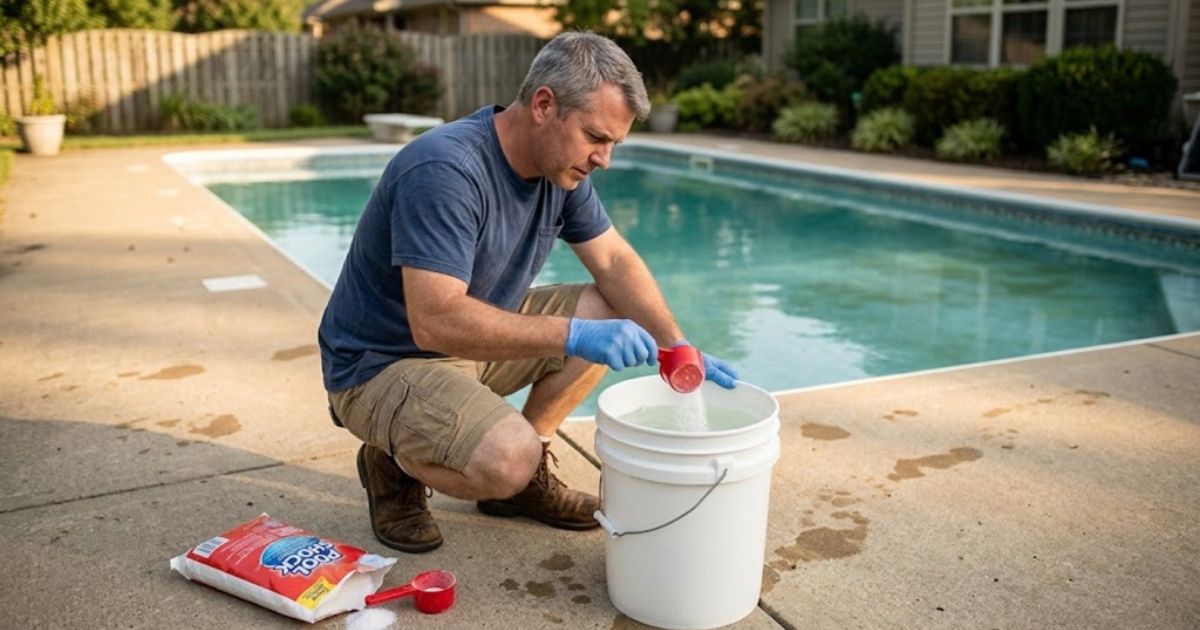

Shocking a pool with powder chlorine means pre-dissolving calcium hypochlorite granules in a bucket, pouring it near the return jet at dusk, and running the pump overnight. Skip the bucket step and those granules sit on your liner, that’s how bleach stains happen. This guide gives you the exact steps, dose, and wait time.
This guide covers standard chlorine and saltwater residential pools. It does NOT address commercial aquatic facilities or pools with cyanuric acid levels above 80 ppm, those require a separate treatment protocol.
How to shock a pool with powder chlorine comes down to one preparation step most homeowners skip, one dosing number you need to know, and one timing rule that determines whether your chlorine actually works. The preparation is pre-dissolving. The number is 1 lb per 10,000 gallons. The timing rule is dusk, never daytime. Skip any one of these and you either end up with bleach-stained liner, a pool that looks clear but still has active bacteria, or chlorine that burns off in direct sunlight before it does anything useful.
How to shock a pool with powder chlorine the right way means understanding that “powder chlorine” is not one thing, it is a category. This guide covers both main types, gives you the exact dosing table, walks you through every step in order, and explains the one mistake that ruins vinyl liners permanently.
What “Powder Chlorine” Actually Means: Cal-Hypo vs Dichlor
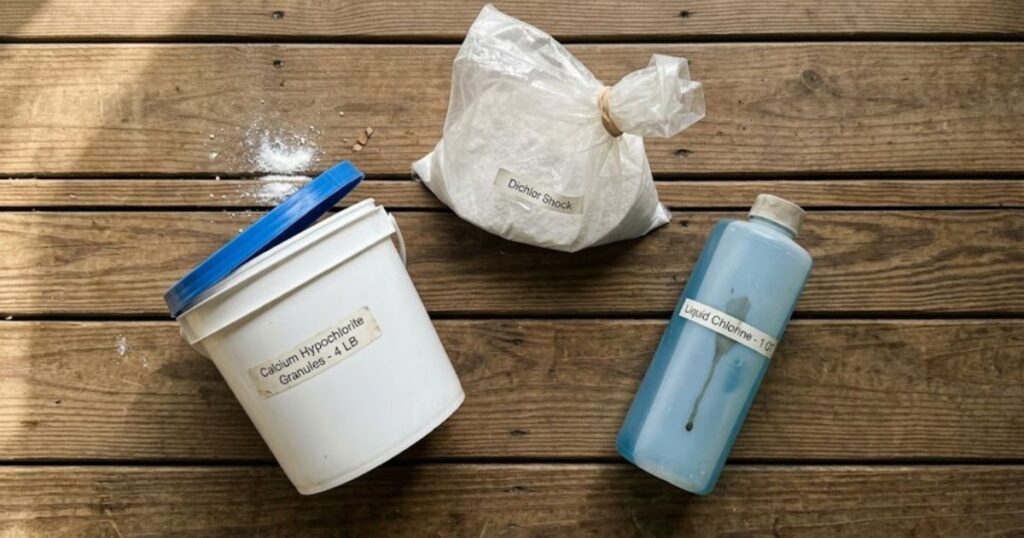
When pool owners search for “powder chlorine shock,” they are usually referring to one of two granular products:
Calcium hypochlorite (cal-hypo) is the stronger option, containing 65–73% available chlorine. It is unstabilized, meaning it contains no cyanuric acid (CYA), and it is the product pool professionals reach for first when dealing with algae, cloudy water, or post-storm contamination. Because it is unstabilized, sunlight burns it off quickly. You add it at night. It also raises calcium hardness slightly with each application, which matters if your fill water is already hard.
Sodium dichlor is stabilized, meaning it contains CYA built in. It dissolves faster than cal-hypo and is gentler on surfaces, which makes it a reasonable choice for fiberglass pools and saltwater pools. The tradeoff is that it adds roughly 9 ppm of CYA per 10,000 gallons every time you shock. If your pool already runs on trichlor tabs, your CYA is likely climbing toward the 70–80 ppm ceiling where chlorine lock becomes a real problem.
| Type | Chlorine % | CYA Added | Best For | Pre-dissolve Required |
|---|---|---|---|---|
| Cal-Hypo (powder) | 65–73% | No | Most pools, algae treatment | Always |
| Dichlor (granular) | 55–62% | Yes (+9 ppm) | Saltwater, fiberglass | Less critical |
| Liquid chlorine | 10–12% | No | Small pools under 10,000 gal | No |
For most residential pools, cal-hypo is the right call. It is stronger, cheaper per effective dose, and does not stack CYA every time you use it.
Before You Add Anything, The Pre-Shock Checklist
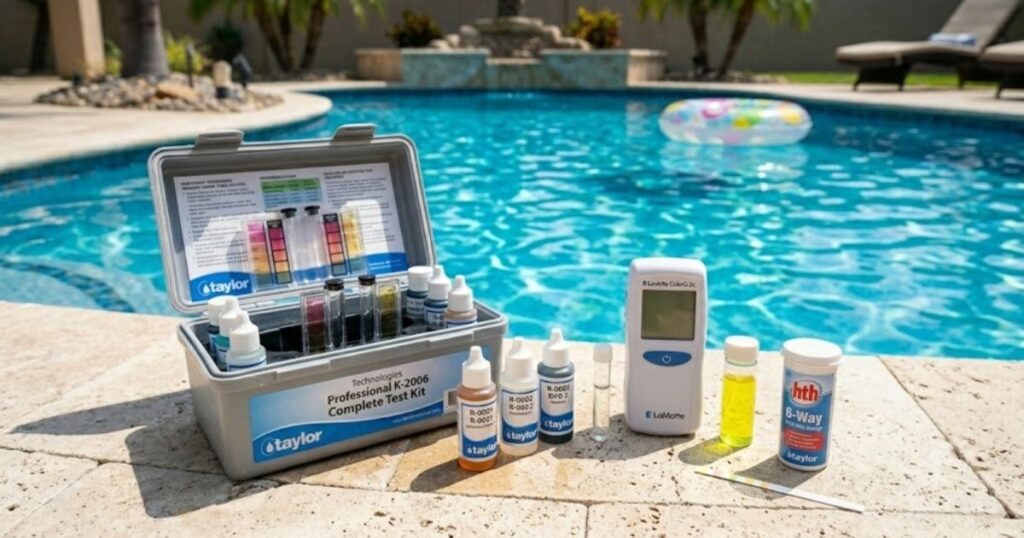
Shocking an unbalanced pool wastes product and can make the problem worse. Run through this checklist first:
✓ Test free chlorine (FC) and combined chlorine (CC) using a drop-test kit. The Taylor K-2006 is the standard for residential pools. You need your CC reading to calculate the right dose.
✓ Adjust pH to 7.2–7.4. Chlorine is roughly 50% more effective at pH 7.2 than at pH 7.8. If your pH is above 7.6, bring it down with muriatic acid or sodium bisulfate before adding any shock. Do not shock a high-pH pool.
✓ Check alkalinity: 80–120 ppm. High alkalinity causes pH to resist adjustment, fix alkalinity first if it is above 120 ppm. For a step-by-step guide, see our article on how to lower alkalinity in a pool.
✓ Brush the walls, floor, and steps. This loosens any algae clinging to surfaces before the shock hits, giving the chlorine direct contact with what it needs to kill.
According to PHTA (Pool & Hot Tub Alliance) water quality standards, pre-shock pH adjustment is the single most impactful variable in shock effectiveness. Get the pH right first, then dose.
How Much Powder Chlorine to Use: Dosing Table
The standard dose for calcium hypochlorite shock is 1 lb per 10,000 gallons for routine maintenance. For more serious conditions, increase the dose:
| Pool Size | Routine Shock | Cloudy / Light Green | Dark Green / Heavy Algae |
|---|---|---|---|
| 10,000 gal | 1 lb | 2 lbs | 3–4 lbs |
| 15,000 gal | 1.5 lbs | 3 lbs | 4.5–6 lbs |
| 20,000 gal | 2 lbs | 4 lbs | 6–8 lbs |
Always verify dosage against your specific product label, available chlorine percentages vary between brands.
If you do not know your pool’s volume, calculate it before shocking. Adding the wrong amount in either direction either fails to fix the problem or creates a new one.
- ✓ For the most effective shock treatment, add powder chlorine after sunset and keep your pool pump running overnight. This helps the chlorine work longer without being broken down by sunlight, resulting in clearer, safer water by morning.
Step-by-Step: How to Shock a Pool with Powder Chlorine
Step 1: Test the water. Confirm your FC, CC, and pH levels. Your pH must be 7.2–7.4 before you add anything.
Step 2: Calculate your dose. Use the table above. For algae problems, start with a double dose (2 lbs per 10,000 gallons) rather than under-dosing and wondering why the problem is still there the next morning.
Step 3: Fill a 5-gallon bucket ¾ full of pool water. This step is not optional. Pre-dissolving is what separates a clean shock treatment from a bleached liner. Use pool water, not tap water, the mineral balance matters.
Step 4: Add the cal-hypo powder to the water in the bucket. Always add chemical to water, never water to chemical. Pour slowly while stirring. This prevents a volatile reaction and ensures even dissolution. Stir for 30–60 seconds until the granules are fully dissolved and the water turns milky white.
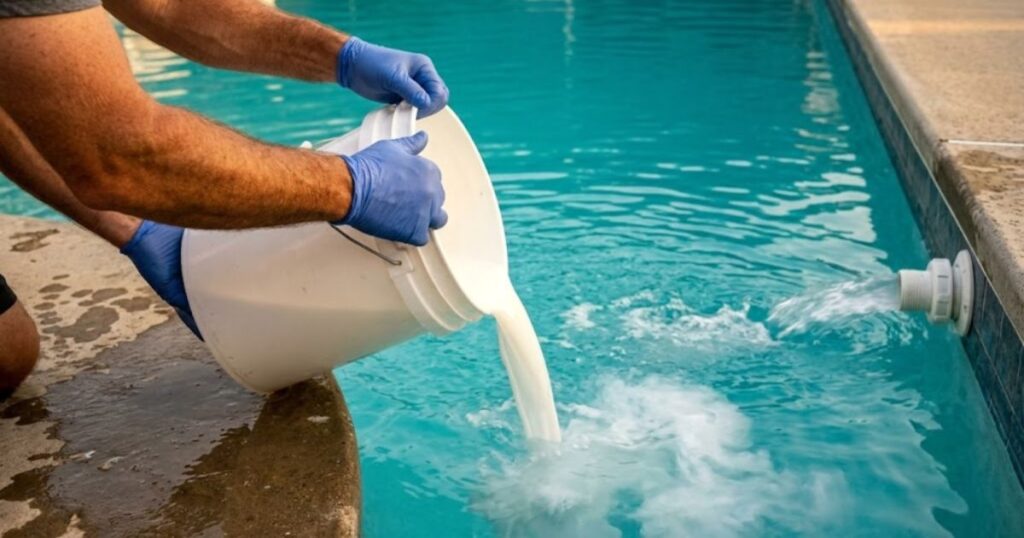
Step 5: Pour the dissolved solution into the pool in front of a return jet. With the pump running, walk slowly around the perimeter and pour the solution in a steady stream. Pouring directly in front of a return jet distributes the chlorine faster throughout the pool.
Step 6: Run the pump for 8–12 hours overnight. Do not turn the pump off after adding shock. Full circulation is what carries the chlorine to every corner of the pool, including dead spots near ladders, steps, and behind skimmer baskets.
Step 7: Retest before anyone swims. Test free chlorine the following morning. The CDC recommends free chlorine between 1–3 ppm for safe recreational water. Do not allow swimming until FC drops below 5 ppm.
⚠️ Vinyl liner owners: Never broadcast dry cal-hypo granules directly onto the liner surface. Undissolved granules settling on vinyl cause permanent white bleach spots within minutes of contact. Always use the bucket pre-dissolve method, every single time.
When to Shock: Timing Matters More Than You Think
Always shock at dusk or after dark. Calcium hypochlorite is unstabilized chlorine, and UV rays from direct sunlight degrade free chlorine at a rate of approximately 1 ppm per hour. Shocking in the middle of a sunny afternoon means a significant portion of your product burns off before it does any useful work.
The pool pump should be running when you add shock and should stay running for the full 8–12 hour overnight window. If you shocked at 9 PM, test at 8–9 AM. Brush the walls and vacuum the floor that morning to clear out any dead algae or debris that the shock stirred up.
One more rule: shock first, then add algaecide, never both on the same day. A superchlorination dose will neutralize algaecide’s active compounds on contact, wasting the product entirely.
Common Questions About Shocking a Pool with Powder Chlorine
Can I add powder chlorine shock directly to my pool without dissolving it first?
No. Cal-hypo granules must be pre-dissolved in a 5-gallon bucket of pool water before adding to the pool. Dry granules that settle on vinyl liners or plaster cause bleaching and surface etching that cannot be reversed.
How long does powder chlorine shock take to work?
Cal-hypo begins working within minutes of circulation. Complete sanitization, including killing active algae, takes 8–12 hours with the pump running. Dark green pool water may require a second treatment 24 hours after the first.
Why is my pool still cloudy after shocking with powder chlorine?
Cloudy water after shocking usually means one of three things: the dose was too low for the level of contamination, pH was above 7.6 before you added shock which cut chlorine’s effectiveness in half, or the filter is dirty and needs backwashing. Run the pump an additional 12 hours and retest FC before adding more product.
How often should I shock my pool with powder chlorine?
Once a week during swimming season as routine maintenance. Add an extra shock after heavy rain, pool parties, extreme heat, or any visible water clarity change. For a full seasonal schedule, see our pool maintenance schedule guide.
Final Thoughts
Knowing how to shock a pool with powder chlorine is an essential skill for every pool owner. By testing your water, using the correct amount of shock, circulating the water properly, and following safety guidelines, you can eliminate bacteria, algae, and contaminants while keeping your pool crystal clear.
Regular pool maintenance combined with proper shocking prevents costly problems and ensures your swimming pool stays safe, clean, and ready for use all season long.