
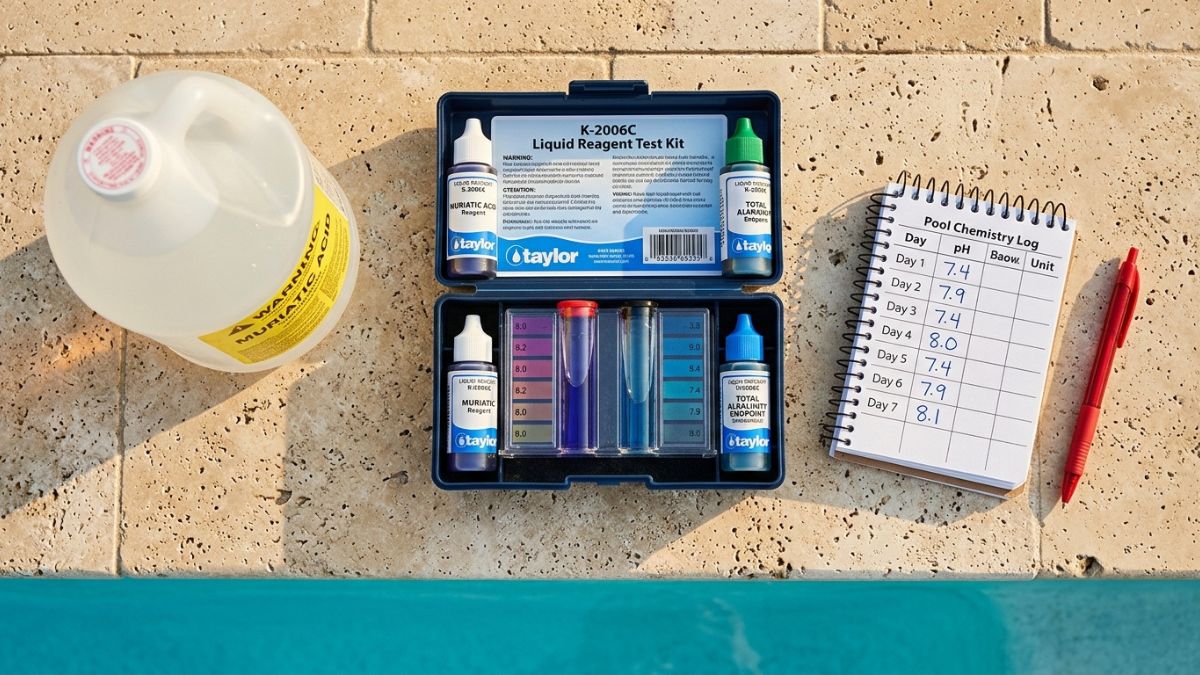

Pool pH bouncing back after adding acid is one of the most frustrating problems in pool ownership. You add muriatic acid, watch pH drop to 7.4, feel good about it, and then test again the next morning to find it sitting at 7.9 or 8.0 again. So you add more acid. Same result the following day.
The acid is not broken. Your testing is probably fine. The problem is that something in your pool is continuously pushing pH upward, and acid only addresses the symptom for a few hours before that underlying force takes over again.
This guide explains exactly why pH bounces back, identifies which specific cause applies to your pool, and gives you the correct fix that stops the cycle rather than just delaying it.
Pool pH bouncing back after adding acid almost always means total alkalinity is too high, creating a CO2 buffer that pushes pH upward as soon as the acid dissipates. The fix is lowering TA to 60 to 80 ppm using the acid-and-aerate method, not adding more acid to chase pH alone.
Key Takeaways
✓ Acid lowers pH temporarily but does not fix what is pushing it back up
✓ High total alkalinity is the root cause in the majority of pH rebound cases
✓ Aeration from returns, spillovers, and features accelerates CO2 loss that raises pH
✓ Salt chlorine generators continuously push pH upward as a byproduct of chlorine production
✓ The correct fix is lowering TA first, then managing pH becomes straightforward
✓ Chasing pH with acid while ignoring TA makes the problem worse over time
Why Acid Only Works Temporarily
Understanding this one thing changes how you approach the entire problem.
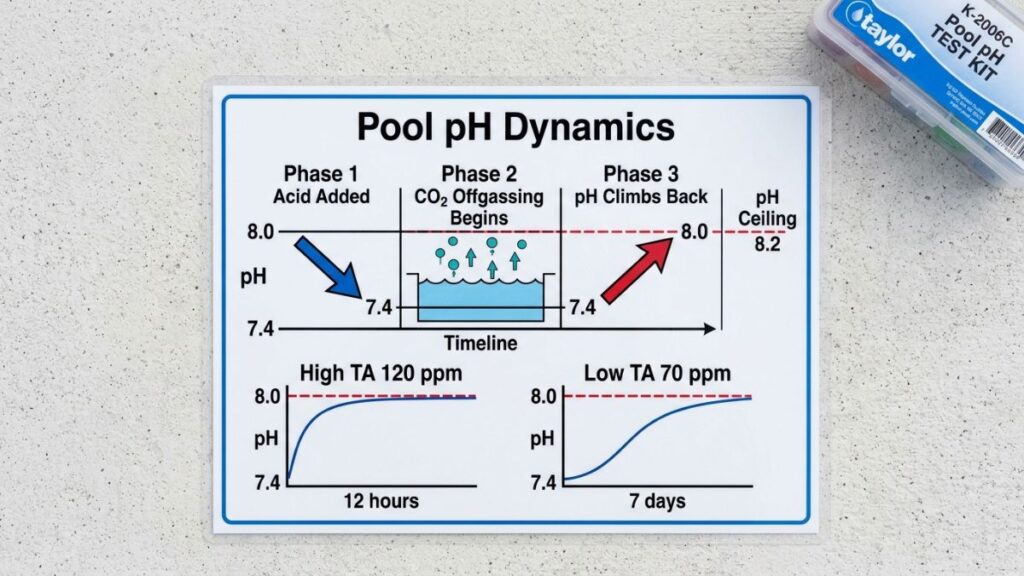
When you add muriatic acid to pool water, it reacts with carbonates and bicarbonates in the water, temporarily lowering pH. But your pool water is in constant contact with the atmosphere. Carbon dioxide continuously escapes from the water surface, and every time CO2 leaves, carbonic acid levels drop and pH rises.
The key word is continuously. This is not a one-time event. Every hour your pool is exposed to air, CO2 is offgassing and pH is climbing toward what pool chemistry experts call the pH ceiling the natural equilibrium point for your water, which sits around 8.0 to 8.2 depending on your alkalinity level.
As one forum member explained after working through this exact problem: “Acid knocks the pH down, but as soon as CO2 starts offgassing again, pH climbs right back up. High alkalinity is the usual driver because it gives the water a bigger CO2 buffer to lose.”
The acid worked perfectly. The problem is what happens the moment it finishes working. Our complete guide on why pool pH keeps rising covers the full chemistry behind this process.
The 7 Real Reasons pH Keeps Bouncing Back After Adding Acid
Reason 1: Total Alkalinity Is Too High
This is the cause in the majority of pH rebound cases. When TA is above 100 to 120 ppm, your water contains more bicarbonate alkalinity than needed. That excess bicarbonate creates a powerful CO2 buffer meaning the water has more dissolved carbon dioxide to release, which means pH rises faster and higher after each acid dose.
Pool owners who lowered TA to 60 to 80 ppm consistently report that acid additions hold for days or weeks instead of hours. Those who only chase pH with acid while TA stays at 120 or above report needing acid every single day.
Check your TA reading against our pool alkalinity levels chart. If TA is above 100 ppm, this is almost certainly your primary cause.
Reason 2: Aeration from Water Features and Return Jets
Every time water splashes, bubbles, or breaks the surface, CO2 escapes faster. Spillover spas, waterfalls, fountains, and return jets pointed upward all accelerate pH rise significantly.
One forum member with a spillover spa described adding acid every three days and achieving temporary drops to 7.4, followed by a return to 7.9 within 48 hours. The advice from experienced pool owners was consistent: shut off waterfalls and bubblers temporarily, lower TA slowly with small acid doses, aim return jets downward, then recheck.
If you have any of these aeration sources running constantly, expect pH to rise faster than a pool without them.
Reason 3: Salt Chlorine Generator
Salt systems produce chlorine through electrolysis, and that process raises pH as a continuous side effect. The electrolysis reaction at the cell produces sodium hypochlorite with a naturally high pH, and the micro-bubbles created at the cell add further aeration.
If you recently switched from trichlor tablets to a salt system and your pH management became dramatically more difficult, this is exactly why. Trichlor tablets are strongly acidic and were chemically counteracting your pH rise. The salt system does the opposite.
Weekly or twice-weekly acid additions are completely normal for salt pool owners. The goal is reducing the frequency, not eliminating it entirely.
Reason 4: New or Recently Resurfaced Plaster
Fresh plaster releases calcium carbonate and other alkaline compounds into pool water for months after installation. This is a normal part of the curing process and contributes directly to pH rising faster than normal.
If your pool is under one year old or was recently replastered, this is likely contributing to your rebound. It does slow down over time but requires patience during the first season.
Reason 5: High-Alkalinity Fill Water
Every time you top up the pool, you are adding water from your tap. If your local water has high pH or high alkalinity, each refill introduces more carbonate buffering capacity into the pool. In hot climates where evaporation causes frequent top-ups, this effect compounds significantly.
Test your tap water’s pH and TA separately before adding it to the pool. If it reads above 7.8 or TA above 120 ppm, that fill water is working against you.
Reason 6: Incorrect Acid Dose
Underdosing is more common than most guides acknowledge. Pool owners often add what feels like a significant amount of acid but calculate it based on the wrong pool volume or an inaccurate TA reading.
If TA is at 120 ppm and you add acid to target pH only without lowering TA, you may need a much larger dose than you expect. Using a pool calculator like PoolMath with accurate pool volume and current TA reading gives you a realistic dose rather than an estimate.
One Reddit user described adding what the PoolMath app recommended as sufficient but watching pH go from 7.6 to 7.8 then back to 8.0 without any movement in TA. The response from experienced users was direct: lower TA more, not just pH.
Reason 7: Inaccurate Testing Equipment
Test strips become unreliable after exposure to humidity, heat, or age. A strip reading of pH 7.4 when the actual reading is 7.8 means you think you fixed the problem when you did not.
A liquid drop test kit like the Taylor K-2006C gives consistent readings that test strips cannot match. If your readings seem inconsistent or you are adding what should be enough acid and seeing no change, verify your test results with a drop kit before adding more chemicals. Our guide on how to test pool water correctly explains exactly why this matters.
Diagnosis: Which Cause Is Yours
Use this table to identify the most likely cause based on what you observe.
| What You See | Most Likely Cause | Check This First |
|---|---|---|
| pH back to 8.0 within 24 hours, no water features | High TA | Test TA, target under 100 ppm |
| pH bounces back faster when waterfall is running | Aeration | Shut off features, retest after 48 hours |
| pH always high since switching to salt system | Salt cell | Normal, reduce TA to slow frequency |
| pH problem started after replastering | New plaster curing | Patience plus reduced acid dose |
| pH reading varies widely day to day | Inaccurate test strips | Switch to Taylor K-2006C drop kit |
| TA will not move despite acid additions | Underdosing, wrong pool volume | Recalculate pool volume, use PoolMath |
| pH bounces back after filling pool | High-alkalinity fill water | Test tap water separately |
The Correct Fix Step by Step
This is the sequence that actually stops the cycle. Not chasing pH, but targeting what drives it.
Step 1: Get accurate readings. Test pH and TA with a liquid drop kit. Write both numbers down. Our guide on how to test pool water correctly shows which kit to use and how to get reliable readings.
Step 2: Calculate your target. If TA is above 100 ppm, the goal is bringing it to 60 to 80 ppm. Use PoolMath with your exact pool volume to calculate how much acid is needed.
Step 3: Add acid in small doses near an active return jet. Pre-dilute acid in a bucket of pool water first. Pour it near a return jet with the pump running. Do not dump it near skimmers or directly onto pool surfaces.
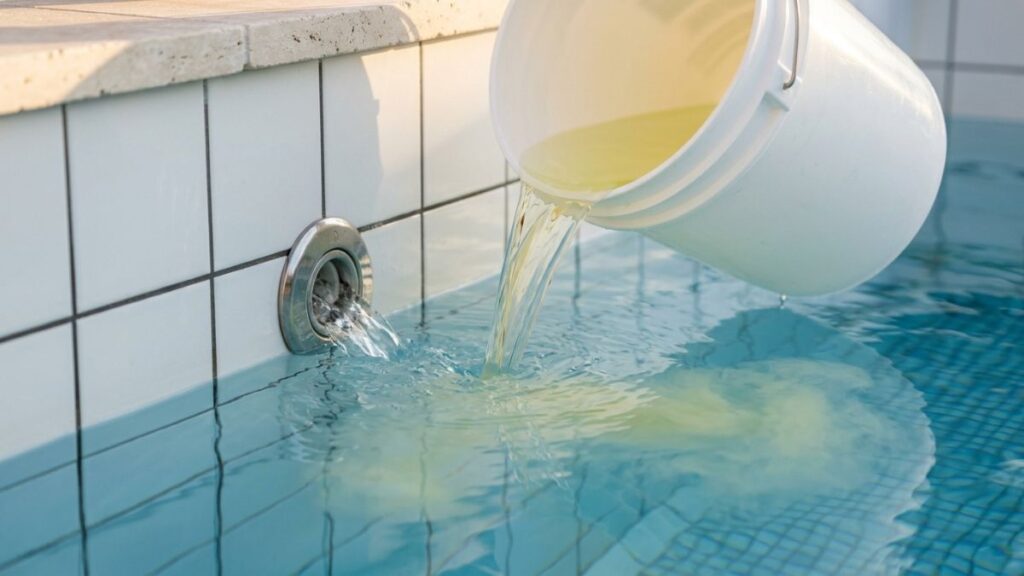
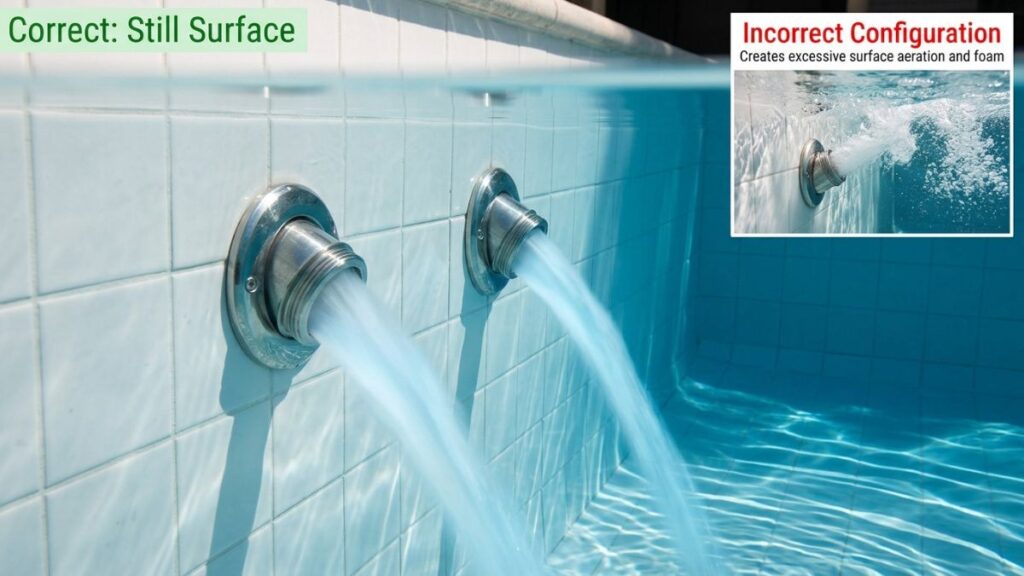
Step 4: Aerate intentionally after adding acid. This is the step most guides skip. Acid lowers both pH and TA. Aeration raises pH back up without touching TA. Point return jets upward, run water features for a few hours, then retest. This raises pH back toward 7.4 to 7.6 while TA stays at its new lower level.
Step 5: Repeat the acid-and-aerate cycle gradually. Each cycle lowers TA by 10 to 20 ppm. When TA reaches 60 to 80 ppm, pH will stop climbing as aggressively. Acid additions will start lasting days instead of hours.
Step 6: Manage ongoing aeration sources. Point return jets slightly downward. Consider reducing water feature run times if pH drift is still faster than desired.
The full acid-and-aerate process is covered in detail in our guide on how to lower pool pH naturally.
The single most important shift in thinking for this problem is this. Stop trying to fix pH and start trying to fix TA. Once TA is at 60 to 80 ppm, pH corrections that used to last 12 hours will start lasting 10 days. The acid did not stop working. The water stopped fighting you.
Common Mistakes That Keep the Cycle Going
| Mistake | Why It Fails | Correct Approach |
|---|---|---|
| Adding more acid without checking TA | pH drops temporarily, TA unchanged, cycle continues | Test TA first, target that number |
| Adding acid in large single doses | pH overshoots, requires correction in opposite direction | Small doses, retest, repeat |
| Retesting pH within 1 hour of adding acid | Water not fully circulated, reading inaccurate | Wait minimum 4 to 6 hours |
| Ignoring aeration sources while treating | Features continuously push pH back up during treatment | Shut off features during active TA correction |
| Using test strips for critical decisions | Strips too inaccurate for precise adjustments | Use Taylor K-2006C drop test kit |
| Raising TA with baking soda mid-treatment | Undoes progress on TA reduction | Do not add baking soda while trying to lower TA |
How Long Until pH Finally Stays Stable
This is the question every frustrated pool owner wants answered. The realistic timeline depends on where TA currently stands.
| Current TA | Sessions to Reach Target | Realistic Timeline |
|---|---|---|
| 100 to 120 ppm | 2 to 3 sessions | 1 to 2 weeks |
| 120 to 150 ppm | 4 to 6 sessions | 2 to 4 weeks |
| Above 150 ppm | 6 to 10 sessions | 4 to 8 weeks |
Each session is one acid-and-aerate cycle. Trying to rush by lowering TA more than 20 ppm per session risks crashing pH too far and creating a new problem in the opposite direction.
Once TA is in the 60 to 80 ppm range, most pool owners find that acid additions hold for 5 to 14 days instead of 12 to 24 hours. For salt pools and pools with significant water features, more frequent additions remain normal but at much longer intervals than before.
According to the CDC’s healthy swimming pool guidelines, maintaining pH between 7.2 and 7.8 is essential for effective disinfection. Stable TA is what makes maintaining that range consistently achievable.
Frequently Asked Questions
Why does my pool pH go back up after adding acid? Acid lowers pH by consuming carbonate alkalinity in the water. As soon as the acid dissipates, CO2 continues escaping from the water surface, which raises pH again. High total alkalinity creates more carbonate buffer to lose, so pH climbs faster and higher. Lowering TA removes most of the driving force behind the rebound.
Should I lower alkalinity or just keep adding acid? Lower alkalinity. Adding acid to chase pH while ignoring TA treats the symptom and not the cause. Each acid addition temporarily lowers pH but also slowly lowers TA if done correctly with the acid-and-aerate method. Targeting TA reduction directly gets to the answer faster.
Why does pool pH bounce back after adding acid? Pool pH bouncing back after adding acid occurs because total alkalinity creates a CO2 buffer in the water. When acid lowers pH, CO2 begins escaping from the water surface again, which raises pH back toward its natural equilibrium ceiling. High TA makes this cycle happen faster. The fix is lowering TA to 60 to 80 ppm, not adding more acid to chase pH repeatedly.
What is the fastest way to stop pool pH from bouncing back? Lower total alkalinity using the acid-and-aerate method. Add small amounts of acid near an active return jet, then run aeration to raise pH back to 7.4 to 7.6 without raising TA. Repeat until TA reaches 60 to 80 ppm. Once TA is in this range, pH stops climbing as rapidly after each acid addition.
Is it normal for pool pH to keep rising after acid? Yes, to a degree. pH naturally rises as CO2 escapes from pool water. However, if pH returns to 7.9 or above within 24 hours of adding acid, that rate of rebound is a sign that TA is too high or that aeration from water features is accelerating CO2 loss faster than normal.
Final Thoughts
Pool pH bouncing back after adding acid is not a sign of bad acid or a broken pool. It is a sign that something is continuously driving pH upward faster than a single acid dose can counteract. In the majority of cases, that something is total alkalinity sitting higher than it needs to be.
The correct response is not more acid. It is identifying which of the seven causes applies to your specific pool, then addressing that cause directly. For most pool owners, that means lowering TA to 60 to 80 ppm using the acid-and-aerate method over two to four weeks. Once TA is in that range, the same acid addition that used to last a day will hold pH stable for a week or more.
If you also need guidance on reading your alkalinity correctly before starting treatment, our pool alkalinity levels chart shows exactly where every TA reading falls and what action it requires.