
pool chlorine smell causes
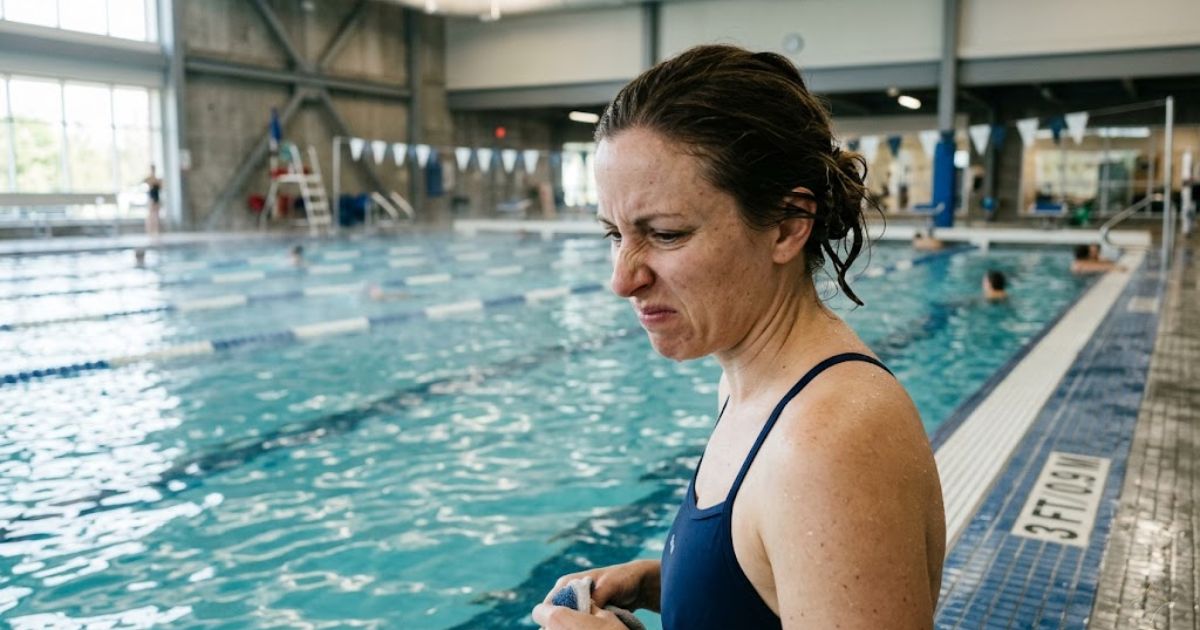
That sharp, eye-watering smell at the pool. Most people assume it means too much chlorine.
It almost always means the opposite.
📌 KEY TAKEAWAYS
✓A strong pool smell signals too little free chlorine, not too much, chloramines are the actual cause
✓Chloramines form when chlorine reacts with sweat, urine, and sunscreen, they don’t sanitize
✓The fix is shocking the pool, not reducing chlorine or adding fresh water
✓A properly chlorinated pool with low combined chlorine has almost no smell at all
Indoor pools smell stronger because trichloramine gas accumulates above the water without ventilation
The Counter-Intuitive Truth About Pool Smell
Strong pool chlorine smell is caused by chloramines, not excess free chlorine. Chloramines form when free chlorine reacts with sweat, urine, and sunscreen, becoming a spent, non-sanitizing byproduct. A well-maintained pool with adequate free chlorine and low combined chlorine has almost no detectable smell. The stronger the odour, the more depleted free chlorine actually is.
Here’s the thing almost nobody believes the first time they hear it: a pool that smells strongly of chlorine usually has too little working chlorine, not too much.
Walk into a public pool that “reeks of chlorine” and your instinct says the water is over-treated. The opposite is true. That smell means free chlorine has already been consumed by contaminants in the water, and what’s left behind is a chemical compound that doesn’t sanitize anything. The pool isn’t over-chlorinated. It’s under-protected and producing a smell as a side effect.
This single fact changes how you should respond to pool odour, permanently.
Free Chlorine vs Chloramines: What’s Actually Happening
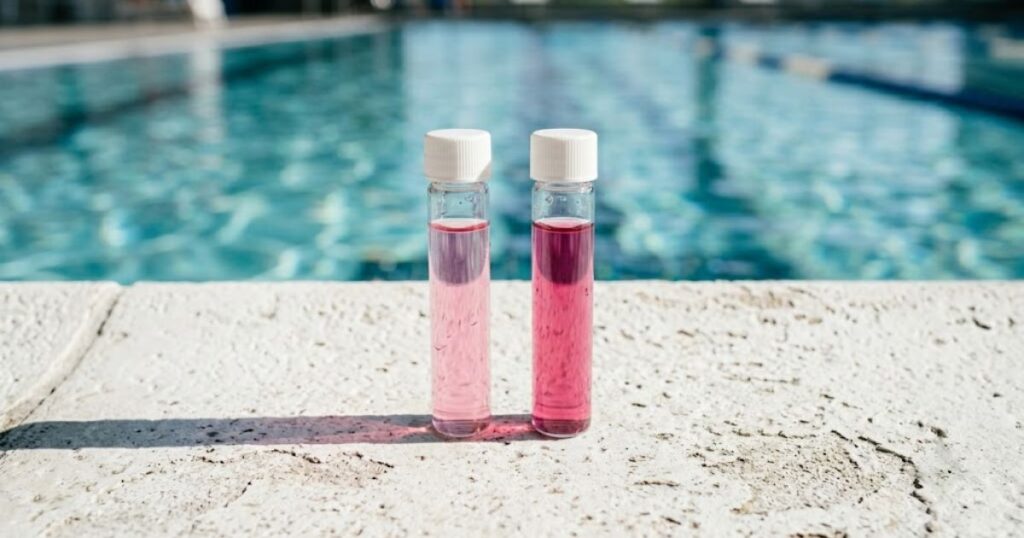
Free chlorine is the active sanitizer that kills bacteria and algae and has minimal odour at proper concentrations. Chloramines (combined chlorine) form when free chlorine reacts with nitrogen compounds from swimmers, sweat, urine, sunscreen, and body oils. According to the CDC, chloramines, particularly trichloramine, are the primary cause of the characteristic pool smell and associated eye and respiratory irritation.
Three types of chloramine form during this reaction:
Monochloramine (NH₂Cl) the mildest, barely noticeable, still mildly disinfecting.
Dichloramine (NHCl₂) more volatile, this is where the smell starts becoming noticeable and eye irritation begins.
Trichloramine (NCl₃) the compound actually responsible for “pool smell.” Highly volatile, it evaporates off the water surface as a gas, which is why you smell it before you even get close to the water, and why indoor pools without adequate ventilation can become genuinely uncomfortable.
Free chlorine, on its own, at the ideal 1–3 ppm range, has very little odour. It’s the chloramines doing all the smelling.
“Read the full breakdown of free chlorine, combined chlorine, and total chlorine,and why the gap between them matters”
- ✓ A strong chlorine smell is usually a warning sign of chloramine buildup not excess chlorine, so fixing water balance is the real solution.
Why Does a Pool Smell Worse After Shocking?
This trips people up constantly.
You shock the pool specifically to destroy chloramines, and for a short window afterward, the smell can actually intensify before it disappears. Here’s why: shocking pushes the reaction through breakpoint chlorination, the chemical threshold where chloramines are broken apart rather than formed. During that process, intermediate compounds and gas off-products are released, producing a temporary, stronger smell that dissipates within a few hours as the pump circulates and the gases escape.
Or maybe I should frame it this way: it’s like cleaning out a clogged drain. The smell often gets worse for a moment right before it gets completely better.
If the smell persists for more than 24 hours after shocking, the treatment likely didn’t reach full breakpoint, usually due to insufficient dose, high pH reducing effectiveness, or daytime application losing potency to UV before it finished the job.
“How to shock a pool step by step, the correct dosing and timing to reach breakpoint chlorination on the first try”
High Chlorine Smell vs Chloramine Smell: How to Tell the Difference
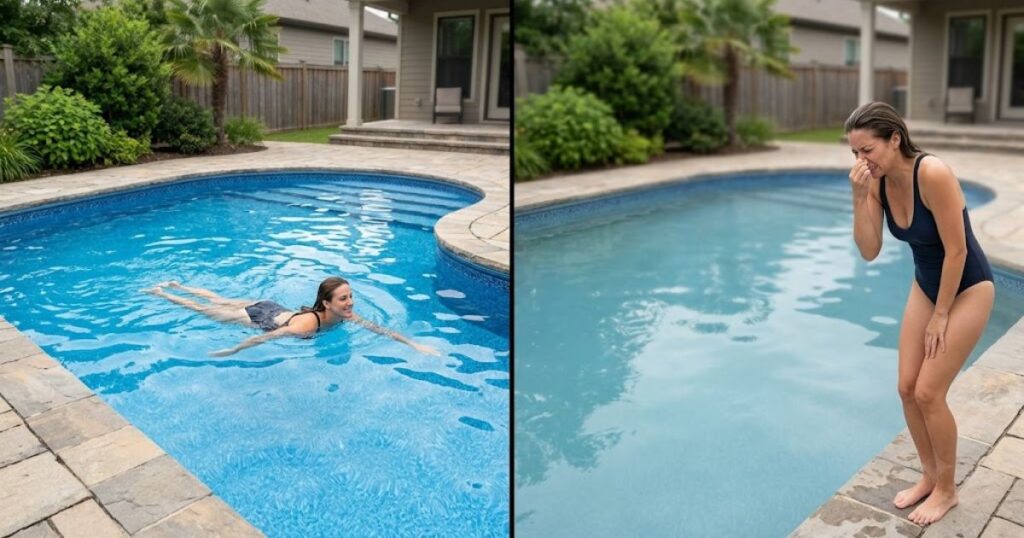
You can’t tell the difference by smell alone, you need a test. But the symptoms point you in the right direction.
| Symptom | High Free Chlorine | High Combined Chlorine (Chloramines) |
|---|---|---|
| Smell intensity | Mild to moderate | Sharp, strong, persistent |
| Eye irritation | Possible at very high levels | Common even at low total readings |
| Skin feel | Dry, tight | Itchy, irritated |
| Swimwear fading | Yes, with prolonged exposure | Minimal |
| DPD test result | Free chlorine reads high (5+ ppm) | Total chlorine higher than free chlorine |
| Correct fix | Lower chlorine, wait, sun exposure, neutralizer | Shock the pool to reach breakpoint |
The diagnostic test: measure free chlorine and total chlorine separately using a DPD kit. If total chlorine is significantly higher than free chlorine, the smell is chloramines, not excess sanitizer. If free chlorine itself reads above 5 ppm and total chlorine is close to free, you genuinely have too much active chlorine.
In the overwhelming majority of “my pool smells terrible” cases, it’s the chloramine scenario.
“If free chlorine itself is genuinely too high, here are 5 methods to lower it fast with exact dosing”
How to Eliminate Pool Smell Fast
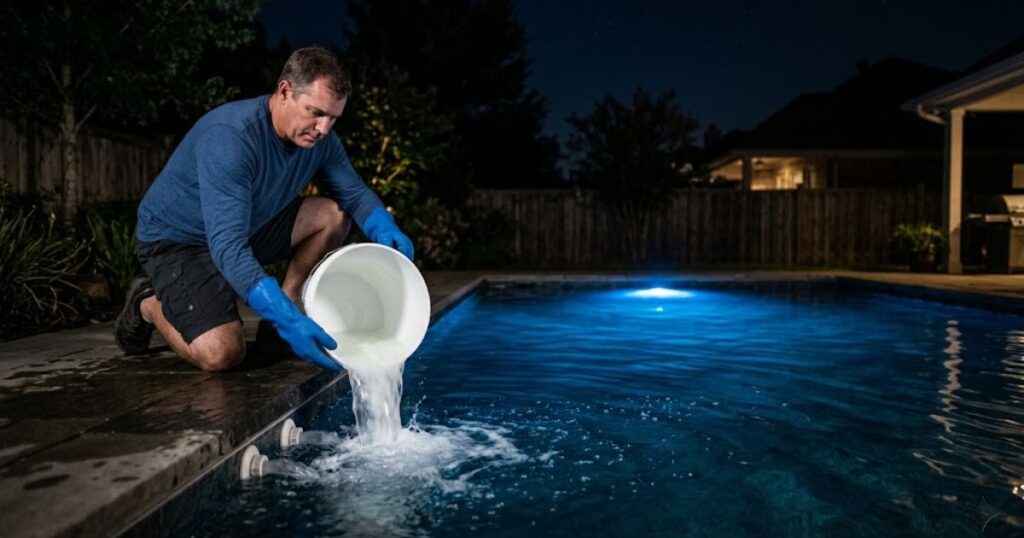
To eliminate pool chlorine smell, shock the pool to breakpoint chlorination, raising free chlorine to approximately 10 times the measured combined chlorine level. Correct pH to 7.2–7.4 first, since high pH reduces shock effectiveness significantly. Add shock after dark to prevent UV degradation, run the pump overnight, and re-test in the morning before swimming.
Steps to eliminate the smell:
- Test free chlorine and total chlorine, calculate combined chlorine (the actual problem)
- Adjust pH to 7.2–7.4 before doing anything else
- Calculate target free chlorine: combined chlorine × 10 = breakpoint target
- Shock with calcium hypochlorite after dark, dosed to your pool volume
- Run the pump continuously overnight at full speed
- Re-test the next morning, confirm combined chlorine is below 0.2 ppm
What doesn’t work: adding fresh water alone (dilutes but doesn’t destroy chloramines fast enough for a same-day fix), adding more regular chlorine without reaching breakpoint (can actually increase chloramine formation temporarily), or air fresheners and pool fragrance products (mask the smell, do nothing to the chemistry causing it).
For indoor pools specifically, improving surface ventilation and air exchange above the water reduces trichloramine accumulation between shock treatments, but it doesn’t replace correcting the water chemistry itself.
Frequently Asked Questions
Why does my pool smell so strongly of chlorine?
A strong pool smell is almost always chloramines, not excess free chlorine. Chloramines form when chlorine reacts with sweat, urine, and sunscreen, and they smell far stronger than properly balanced free chlorine. The fix is shocking the pool, not reducing chlorine.
Does a strong chlorine smell mean too much chlorine?
No, it usually means the opposite. A strong smell signals that free chlorine has been depleted and converted into chloramines, which provide no sanitizing benefit and produce the characteristic odour. Properly chlorinated water with low combined chlorine has very little smell.
Why does my pool smell worse right after I shock it?
Shocking pushes the water through breakpoint chlorination, briefly releasing intermediate compounds as chloramines are destroyed. The smell can intensify for a few hours before disappearing entirely as the pump circulates and gases off-gas from the water surface.
How do I get rid of pool smell fast?
Test free and total chlorine to confirm chloramines are the cause, correct pH to 7.2–7.4, then shock to roughly 10 times your combined chlorine reading. Add shock at night, run the pump overnight, and re-test in the morning before swimming.
The Bottom Line
The next time a pool smells strongly of chlorine, resist the instinct to think there’s too much of it.
There’s too little working chlorine, and too much of the spent, smelly kind. Test free chlorine against total chlorine. If the gap is wide, shock the pool to breakpoint, don’t dilute it, don’t mask it, don’t reduce the chlorine you do have.
Fix the chemistry. The smell disappears because the actual cause does.