
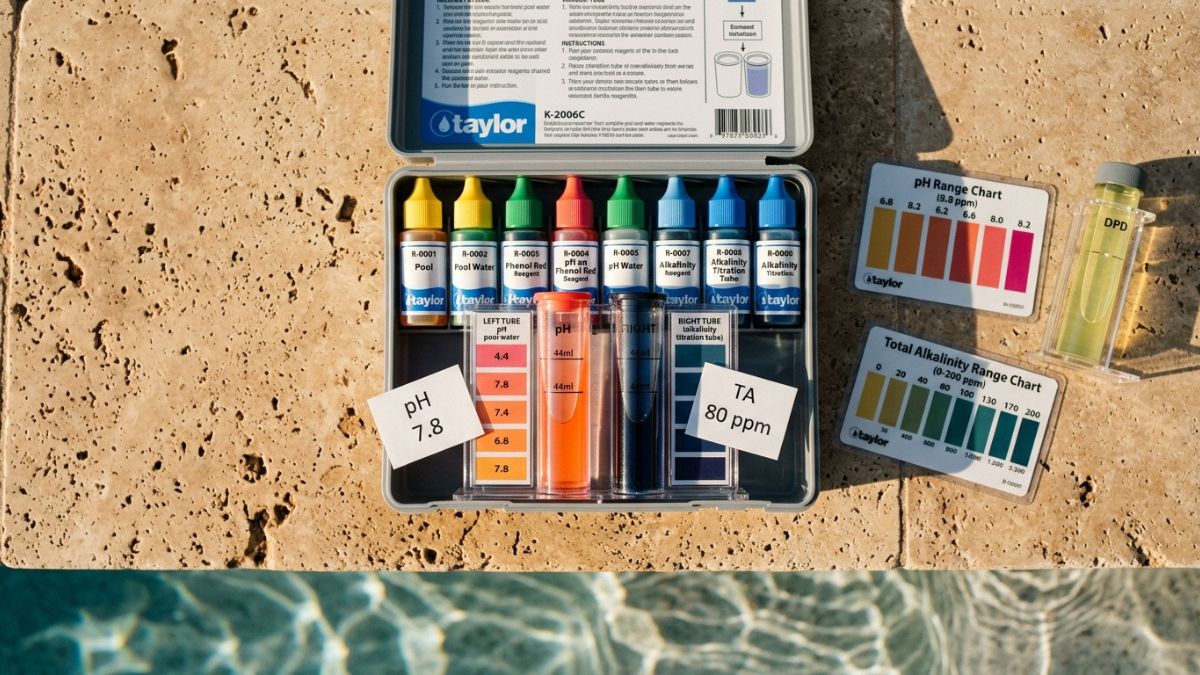

Pool pH vs total alkalinity is the most consistently misunderstood topic in residential pool chemistry. The words sound related. They behave in ways that look connected. And the advice you find online mixes them up constantly, which is why so many pool owners feel like they fix one number only to break the other.
Here is the clearest way to think about them before anything else.
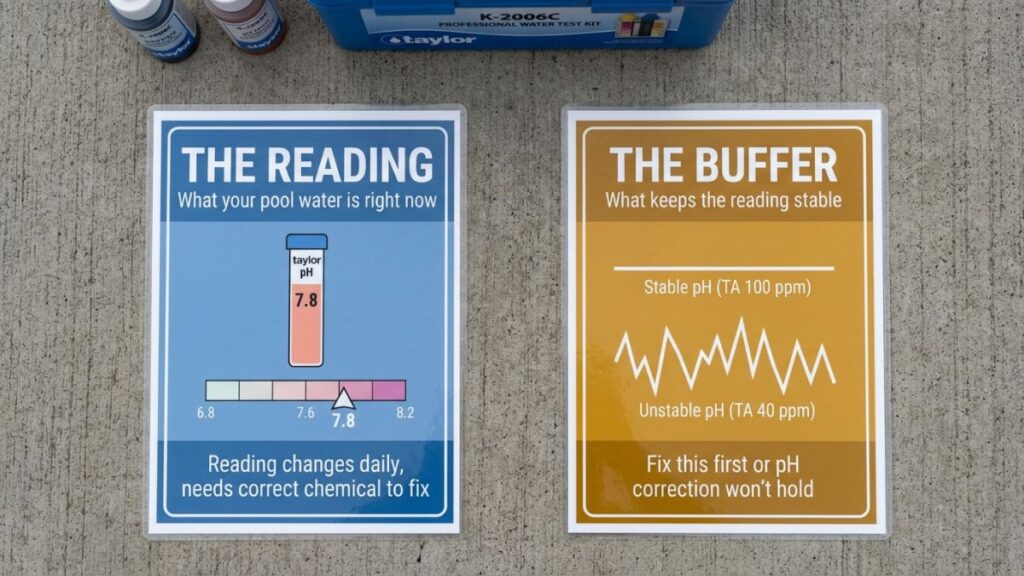
pH tells you where your water is right now. Total alkalinity tells you how stable it will stay there.
One is a reading. The other is a protection system. Confusing them leads to a specific, recognizable problem: you correct pH, it drifts back, you correct it again, it drifts again, and the cycle never ends. That cycle has a name. It is called pH bounce. And it is almost always caused by misunderstanding the relationship between these two numbers.
Quick Answer: pH measures how acidic or basic your pool water is right now. Total alkalinity measures how resistant the water is to pH changes. Always fix alkalinity first. Correcting pH while alkalinity is wrong means the correction will not hold.
Key Takeaways
✓ pH measures current acidity or alkalinity on a scale of 0 to 14
✓ Total alkalinity measures buffering capacity, how resistant water is to pH changes
✓ pH target is 7.2 to 7.8, ideal 7.4 to 7.6
✓ Total alkalinity target is 80 to 120 ppm for most pools
✓ Always correct TA before adjusting pH or adjustments will not hold
✓ Low TA causes wild pH swings from small inputs
✓ High TA causes pH to lock high and resist acid correction
✓ They influence each other but are controlled by different chemicals
Pool pH vs Total Alkalinity
What pH Actually Measures
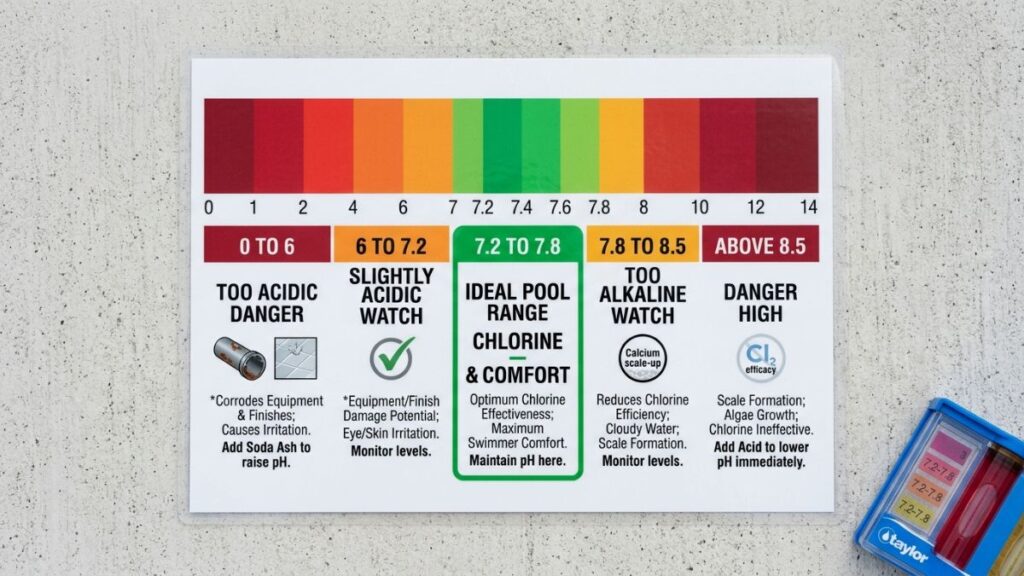
pH stands for potential of hydrogen. It measures the concentration of hydrogen ions in your pool water on a scale from 0 to 14. The lower the number, the more acidic. The higher the number, the more alkaline or basic. The number 7 is neutral.
Your pool needs to stay between 7.2 and 7.8 for three specific reasons.
Chlorine effectiveness. At pH 7.4, roughly 50 to 60 percent of your chlorine exists in the active hypochlorous acid form that kills bacteria and algae. At pH 8.0, that drops below 20 percent. The chlorine is still in the water but mostly in a weaker, less reactive form. You can have correct chlorine levels and still have a pool that is not properly sanitized, purely because pH has drifted too high.
Swimmer comfort. The human eye has a natural pH of around 7.4. Water outside the 7.2 to 7.8 range irritates eyes and mucous membranes. High pH water causes prolonged itchiness. Low pH water causes immediate stinging. When swimmers complain about eye or skin irritation and chlorine looks correct, pH is almost always the first thing to check.
Equipment and surface protection. Water below 7.2 is acidic enough to corrode metal fittings, etch plaster, weaken vinyl liners, and damage heater components. Water above 7.8 deposits calcium scale on tiles, heat exchangers, and return fittings.
According to the CDC’s healthy swimming guidance, maintaining pool water between pH 7.2 and 7.8 is a core safety requirement for effective disinfection.
What Total Alkalinity Actually Measures
Total alkalinity measures the concentration of alkaline substances dissolved in your pool water, primarily bicarbonates, carbonates, and hydroxides. It is measured in parts per million.
Alkalinity tells you how resistant the water is to a reduction in pH. Low alkalinity leads to wild fluctuations in pH. High alkalinity keeps it stable.
Think of it as a chemical shock absorber built into the water itself. When something tries to change the pH, whether that is rain, bathers, a chemical addition, or CO2 from the air, the alkalinity buffer absorbs the input and resists the change. A pool with TA at 100 ppm barely notices when a swimmer gets in. A pool with TA at 30 ppm swings dramatically from the same input.
A simple way to think about alkalinity is that it insulates pH from being reduced too easily. Alkalinity ions do this by either releasing or attracting a Hydrogen ion as needed. So when acid is added, carbonate ions can absorb Hydrogen to create bicarbonate ions.
The target range for total alkalinity is 80 to 120 ppm for most residential pools. This range provides enough buffering to resist normal daily inputs without locking pH at one extreme or the other.
The Key Relationship Most Pool Owners Miss
pH and total alkalinity are related but they are not the same measurement. They influence each other, but you control them with completely different chemicals.
Total alkalinity is to pH what cyanuric acid is to free chlorine. Total alkalinity stabilizes pH levels.
The confusion comes from the word alkalinity. It sounds like it measures the same thing as alkaline pH. It does not. pH tells you the current state of the water. Alkalinity tells you how stable that state will be.
A pool may test at a good pH today, but if alkalinity is too low, that pH may not stay there. Rain, refill water, chemical additions, swimmers, or aeration can quickly move it out of range. So even if pH looks okay for the moment, alkalinity can still be the bigger issue.
This explains the most common pool chemistry frustration. You test pH, it looks correct. You come back two days later and pH has moved significantly. The pH reading was fine when you tested it. Alkalinity was not, so nothing was holding it in place.
Side by Side Comparison
| Feature | pH | Total Alkalinity |
|---|---|---|
| What it measures | Current acidity or alkalinity | Resistance to pH change |
| Scale | 0 to 14 (logarithmic) | Parts per million (linear) |
| Ideal range | 7.2 to 7.8 | 80 to 120 ppm |
| When low | Corrosive, irritating, corrodes equipment | pH bounces wildly from small inputs |
| When high | Chlorine weakens, scale forms, cloudy water | pH locks high, resists acid correction |
| Raises with | Soda ash, borax | Sodium bicarbonate |
| Lowers with | Muriatic acid or dry acid | Muriatic acid plus aeration |
| Affects chlorine | Yes, directly | Indirectly through pH influence |
| Fix order | Second | First |
What Happens When pH Is Wrong
Low pH below 7.2: Acidic water corrodes metal fittings, pump components, and heater elements. Plaster and grout dissolve slowly. Vinyl liners become brittle. Swimmers experience immediate eye burning and skin irritation. Equipment damage is irreversible once started.
High pH above 7.8: Above 7.8, chlorine stops working effectively, scale forms on surfaces, and the water turns cloudy. Calcium falls out of solution creating a milky haze that does not clear from shocking alone. Chlorine readings may look correct while sanitization is actually inadequate.
Our complete guide on pool pH too high or too low covers the symptoms of both directions with step-by-step fixes.
What Happens When Total Alkalinity Is Wrong
Low TA below 80 ppm: A pool with low alkalinity, say 40 ppm, has almost no buffering capacity. pH bounces around constantly. Add a cup of acid and pH crashes. Heavy rain shifts it. Bather load swings it through the day. This is called pH bounce, and it is the single most frustrating water chemistry problem to chase. You cannot fix pH bounce by adjusting pH. The pH chemicals work for an hour. Then the water drifts again because nothing is holding it in place.
High TA above 120 ppm: Alkalinity above 180 ppm locks pH at the high end of the scale, usually 7.8 or above, and resists every attempt to bring it down. You add muriatic acid, pH dips briefly, and within a day, it is right back up. Scale starts forming, chlorine efficiency drops, and your test strips look perpetually wrong.
High TA is the most common cause of the recurring “pool pH bouncing back after acid” problem. Our dedicated guide on pool pH bouncing back after adding acid explains this in full detail.
Check your current TA reading against our pool alkalinity levels chart to understand exactly where your number falls and what it requires.
Why You Always Fix Alkalinity Before pH
Alkalinity buffers pH, meaning it controls how much pH moves when you add chemicals, so adjusting pH while alkalinity is out of range is like trying to steer a car with loose lug nuts. You will get somewhere, but not where you intended, and you will be back at it tomorrow.
The sequence matters because of how these two numbers interact.
If you correct pH while TA is too low, the water has no buffer. Any small input, the next rainstorm, a few swimmers, CO2 from overnight air exchange, moves pH away from where you just set it. You are correcting a number in sand.
If you correct pH while TA is too high, the correction barely moves the pH and will not hold. The high TA buffer keeps pushing pH back toward the high end within hours.
The correct sequence every time:
- Test both pH and total alkalinity
- Correct total alkalinity if it is outside 80 to 120 ppm
- Wait for the alkalinity adjustment to circulate and stabilize
- Retest pH
- Correct pH only after TA is confirmed in range
- Verify both numbers 24 hours later
You raise alkalinity into range first, the water gains buffering capacity, and pH stops wandering. Then you adjust pH if it still needs adjusting, and often it does not, because alkalinity adjustments nudge pH along with them.
The Exact Chemicals for Each
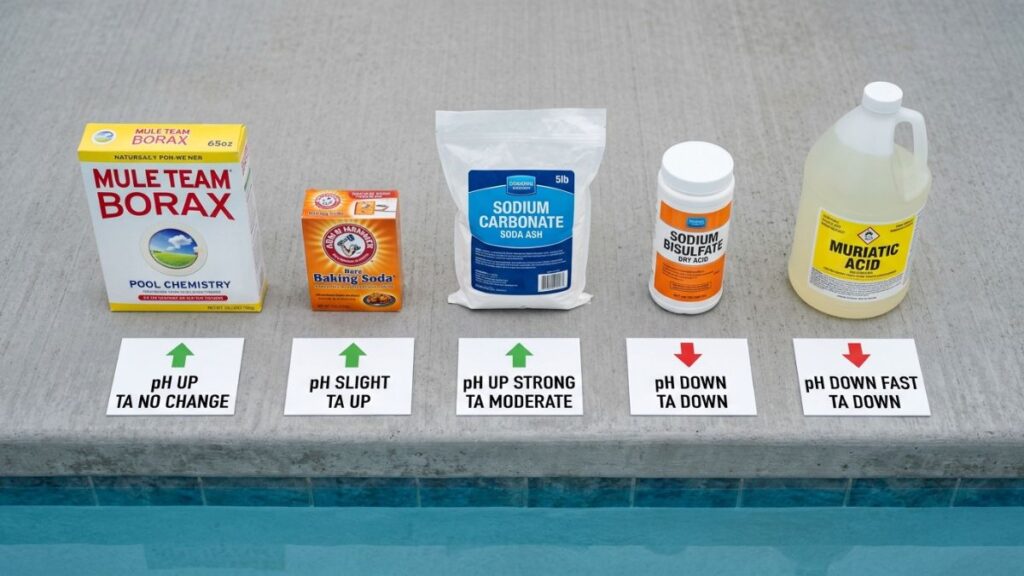
Knowing which chemical controls which number prevents the most common overcorrection mistakes.
| Goal | Chemical | Effect on pH | Effect on TA |
|---|---|---|---|
| Raise TA | Sodium bicarbonate (baking soda) | Minor rise | Significant rise |
| Lower TA | Muriatic acid plus aeration | Lower then recover | Lowered |
| Raise pH only | Borax (sodium tetraborate) | Significant rise | Minimal change |
| Raise pH and TA | Soda ash (sodium carbonate) | Strong rise | Moderate rise |
| Lower pH and TA | Muriatic acid or dry acid | Lower | Lower |
The most important line in this table: sodium bicarbonate raises TA primarily and pH minimally. Soda ash raises both. Borax raises pH with minimal TA impact. Using the wrong chemical for your specific situation is the most common source of pool chemistry going backward after a treatment.
When your alkalinity is in range but pH is too low, use borax. Not baking soda, which will push TA too high. Our guide on how to raise pool pH without raising alkalinity explains exactly when to use which chemical.
When both are low, use soda ash to handle both together. When you need to lower high TA, use acid then aerate to recover pH. Our guide on how to lower pool pH naturally covers the acid-and-aerate method in full detail.
How They Affect Each Other When You Adjust
This is what causes the most confusion in pool chemistry. pH and TA influence each other every time you touch either one.
In fact, any changes to pH or alkalinity will always influence the other in the same direction, even if the knock-on effect can sometimes be slow. When pH rises, it converts carbonic acid into bicarbonate, which increases total alkalinity. When pH falls, bicarbonate converts back into carbonic acid, reducing total alkalinity.
The practical result:
✓ Adding acid to lower pH also lowers TA a small amount
✓ Adding soda ash to raise pH also raises TA a moderate amount
✓ Adding sodium bicarbonate to raise TA also nudges pH upward slightly
✓ Aeration raises pH without affecting TA at all, which is why it is used after acid treatment to recover pH while keeping TA at its new lower level
This interconnection is exactly why the acid-and-aerate method works so well for lowering high TA. The acid drops both pH and TA. The subsequent aeration raises pH back to target without raising TA, leaving alkalinity permanently lower.
Adjust your alkalinity to establish a pH ceiling you can manage. Then adjust calcium hardness high enough that at your new alkalinity target, your LSI remains balanced.
If your pH feels impossible to manage and keeps moving back after every correction, stop adjusting pH and test total alkalinity first. In almost every case of chronic pH instability, the root cause is alkalinity that is either too low (causing pH bounce) or too high (causing pH to lock at 7.8 or above). Fix the alkalinity and pH management becomes straightforward.
Decision Tree: Which Do You Fix First
Use this to identify your situation and the correct first step.
| Your Situation | First Action | Second Action |
|---|---|---|
| pH off, TA in range | Adjust pH directly with appropriate chemical | Retest after 6 hours |
| pH off, TA low | Raise TA with sodium bicarbonate first | Then adjust pH |
| pH off, TA high | Lower TA with acid-and-aerate method first | Then recheck pH |
| pH fine, TA low | Raise TA only | pH may self-correct, retest |
| pH fine, TA high | Lower TA with acid-and-aerate | Aerate to recover pH |
| Both off in same direction | Address TA first | pH often corrects partially |
| pH bouncing despite corrections | Almost certainly a TA problem | Test and correct TA |
From the Author
The most common frustration I hear from pool owners is some version of “I keep fixing it and it keeps going wrong.” Almost every time, the real issue is that they are adjusting pH without first confirming alkalinity is stable. A pool that has TA at 40 ppm looks like it has a pH problem. Every small input, a handful of swimmers, afternoon sunlight, a light rain, moves pH dramatically. The actual problem is the absence of a buffer. Once TA reaches 90 ppm, those same inputs cause a pH movement of 0.1 or 0.2 units instead of 0.6 or 0.8. The pool suddenly becomes manageable, not because the pH adjustments started working better, but because the foundation was finally correct.
Frequently Asked Questions
What is the difference between pool pH and total alkalinity? pH measures how acidic or basic your pool water is right now on a scale of 0 to 14. Total alkalinity measures how resistant the water is to pH changes, expressed in parts per million. pH is the current reading. Alkalinity is the stability system that determines how long that reading holds.
Should I adjust pH or alkalinity first? Always adjust total alkalinity first. If TA is out of range, any pH correction will not hold because the buffering capacity is wrong. Fix the foundation (TA), then fine-tune the reading (pH).
Can pool pH be correct while alkalinity is wrong? Yes. A pool can test at 7.4 pH while TA is at 40 ppm. But that 7.4 will drift quickly because there is no buffer holding it there. This is one of the most common causes of recurring pH problems.
Does raising alkalinity raise pH? Slightly. Sodium bicarbonate raises TA significantly and nudges pH upward a small amount. Soda ash raises both pH and TA more significantly. Borax raises pH with minimal effect on TA.
Why does my pH keep bouncing back after fixing it? Almost always because total alkalinity is too high or too low. High TA continuously pushes pH back up after each acid addition. Low TA means pH swings dramatically from small inputs. Our guide on pool pH bouncing back after adding acid covers this in detail.
What happens if I fix pH before alkalinity? The pH adjustment will not hold. The water lacks the buffering capacity to maintain the corrected reading, so any small input moves pH away from the target again quickly.
Does total alkalinity affect chlorine? Indirectly. TA does not directly interact with chlorine, but by controlling pH stability, it controls how effective chlorine is. A pool with bouncing pH from low TA will frequently have pH above 7.8 where chlorine is significantly weakened. Our pool chlorine levels chart shows how pH directly impacts chlorine effectiveness.
How often should I test both pH and alkalinity? Test pH two to three times per week during swimming season. Test total alkalinity once per week. After any significant event (heavy rain, heavy swimmer use, chemical addition), test both the following morning. Our guide on how to test pool water correctly explains which testing method gives the most reliable results for both parameters.
Final Thoughts
Pool pH and total alkalinity work together but they are fundamentally different measurements that require different chemicals and different treatment sequences. pH is what you read. Alkalinity is what makes that reading stay stable.
The reason this distinction matters in practice is that alkalinity problems disguise themselves as pH problems. A pool with low TA looks like it has unstable pH. A pool with high TA looks like it has persistent high pH that resists acid. Both are actually alkalinity problems wearing a pH mask.
Test both every time. Fix alkalinity first. Adjust pH only after TA is confirmed in range. That single change in approach eliminates most of the recurring chemistry problems that frustrate pool owners through the entire swimming season.