
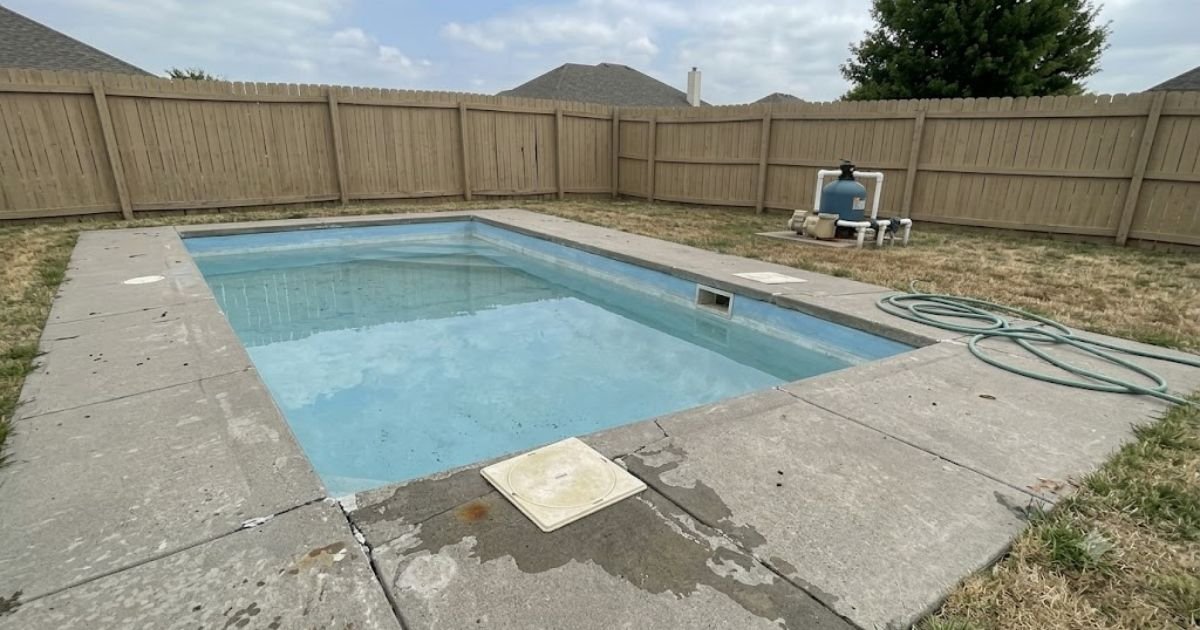

Quick Answer: Most pools lose 1/4–1/2 inch of water per day through normal evaporation. If your pool loses more than 1/2 inch daily, especially overnight or during mild weather, perform a 24-hour bucket test. If the pool loses more water than the bucket, you likely have a leak.
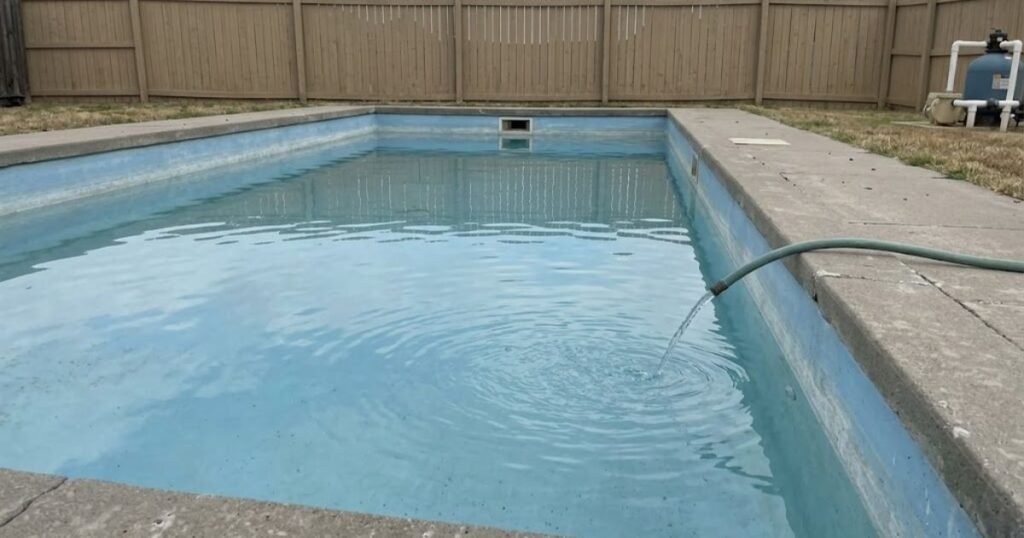
You refilled the pool last week. Yesterday the water line is visibly lower again. Is this normal, or is something leaking?
This is the most common anxiety question in pool ownership. It has a clear answer, you just need one test.
Pool water level dropping is any measurable water depth decline not explained by splash-out or backwashing. The cause is either natural evaporation or a structural and plumbing leak. Distinguishing the two requires a 24-hour bucket test.
How Much Water Loss Is Actually Normal?
Most residential pools lose 1/4 to 1/2 inch of water per day under normal summer conditions. That is 1 to 2 inches per week, or 25 to 50 gallons daily for a standard 15,000-gallon pool.
The actual rate depends on air temperature, water temperature, wind speed, and humidity. According to the Pool and Hot Tub Alliance, pools in arid or high-wind climates can lose up to 1 inch per day from evaporation alone without any leak present.
Here’s the thing: most pool owners panic when they see 1 inch of water loss over three days. In a dry, windy climate, that is completely normal. What is not normal is losing that same amount overnight or in mild weather.
Evaporation rate by climate zone (approximate):
| Climate Zone | Normal Daily Loss | When to Suspect a Leak |
|---|---|---|
| Desert Southwest (AZ, NV) | 1/4 to 1 inch | Over 1.25 inches/day |
| Hot and Humid (FL, TX Gulf) | 1/4 to 1/2 inch | Over 3/4 inch/day |
| Moderate (CA, Pacific NW) | 1/8 to 1/4 inch | Over 1/2 inch/day |
| Northeastern US | 1/8 to 3/8 inch | Over 1/2 inch/day |
If your loss exceeds the right column consistently, run the bucket test before calling anyone.
The Bucket Test: Step-by-Step (Exact Method)
The bucket test separates evaporation from a leak without any equipment. It creates an identical evaporation environment inside a bucket sitting in your pool water. Both lose water at the same rate from evaporation. Any extra loss in the pool comes from a leak.
To perform the pool bucket test, follow these steps:
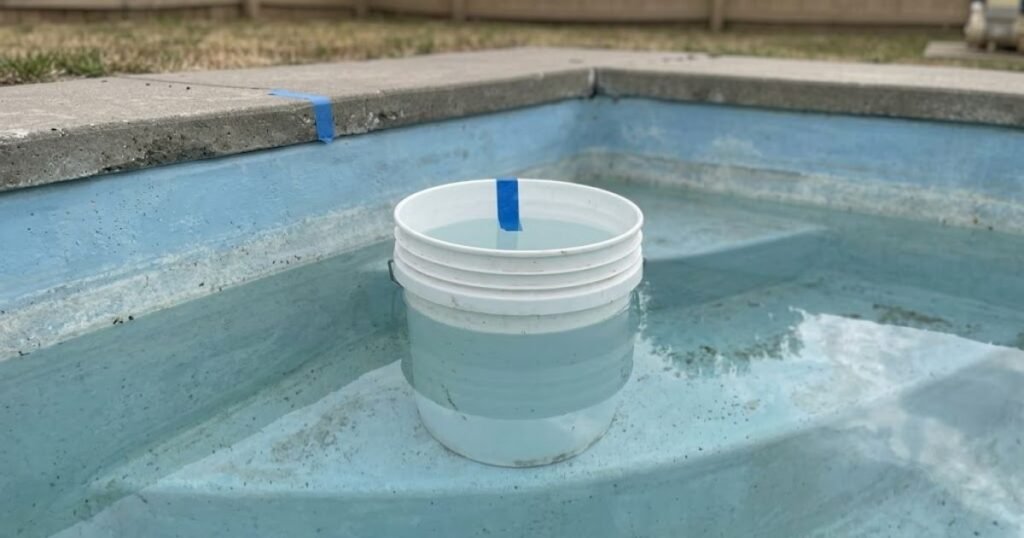
- Fill a 5-gallon plastic bucket with pool water to about 1 inch from the top.
- Place the bucket on the second pool step so it sits in the water up to the same level as the pool surface. Do not let it float.
- Mark the water level inside the bucket with a piece of waterproof tape or a permanent marker.
- Mark the pool water level on the pool wall or skimmer at the same time.
- Run the pool pump on its normal schedule for exactly 24 hours.
- After 24 hours, measure how much each level dropped.
Do not run the test during rain. Do not use the pool during the test. Make sure the auto-fill valve is turned off before you start or it will refill the pool and ruin the measurement.
Reading Your Bucket Test Results
Pool dropped same as bucket: Normal evaporation. No leak.
Pool dropped more than bucket: You have a leak. The difference between the two measurements is your actual daily leak rate. A 1/2 inch gap is a meaningful leak. A 1 inch gap is serious.
Bucket dropped more than pool: Almost never happens naturally. Check that the bucket was not in shade while the pool sat in full sun. Redo the test.
Or maybe I should say it this way: the bucket is not measuring how much water you lost. It is measuring how much the weather alone would take. The pool’s job is to match it exactly. If the pool loses more, something else is taking the water.
Signs It Is Definitely a Leak
Some situations skip the bucket test. If you see any of these, call a specialist directly.
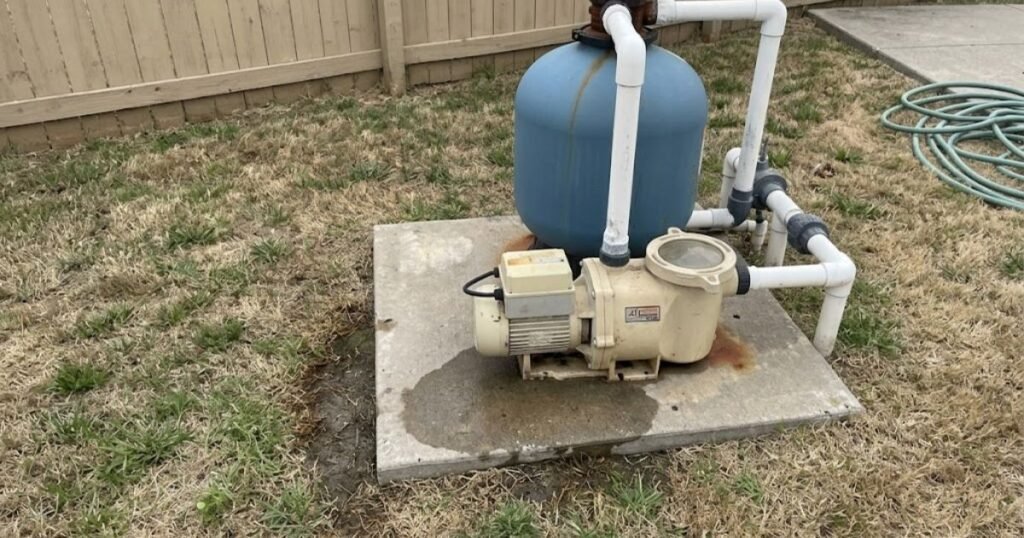
Wet or spongy ground near the equipment pad, pool shell, or buried plumbing lines is a direct sign. Not a puddle — soil that stays wet when it has not rained.
A pool that drops more than 1 inch overnight with the pump off is almost never evaporation. As Aquaman Leak Detection explains, evaporation nearly stops at night when temperatures drop and wind calms. Overnight loss is a red flag.
Visible cracks in the shell, skimmer box, or coping, and on vinyl liner pools, wrinkles or seam separations near steps and fittings.
Pool chemistry constantly drifting low despite regular treatment is indirect evidence of leak-driven dilution. Every fresh water top-off resets your numbers. Read our guide on how to test pool water accurately to understand this pattern.
Where Pool Leaks Usually Happen
Knowing where to look saves time and money before you call a professional.
Skimmer: The most common leak point in concrete pools. The skimmer throat bonds to the pool shell and can develop separation cracks over time. Run your finger around the skimmer where it meets the pool wall. Any gap or soft spot is suspect.
Return line fittings: Return jet wall fittings develop slow leaks when gaskets fail. A calcium or stain ring around a fitting is a common early sign.
Main drain: Rarely leaks, but concrete pools with hydrostatic pressure issues are the exception. This is a professional diagnosis.
Equipment pad: The pump, filter, and valve connections are common drip points. Look for wet ground, rust staining, or salt deposits around the equipment. Pulliam Pools notes that equipment pad leaks are often slow and cumulative, adding up to significant water loss over weeks.
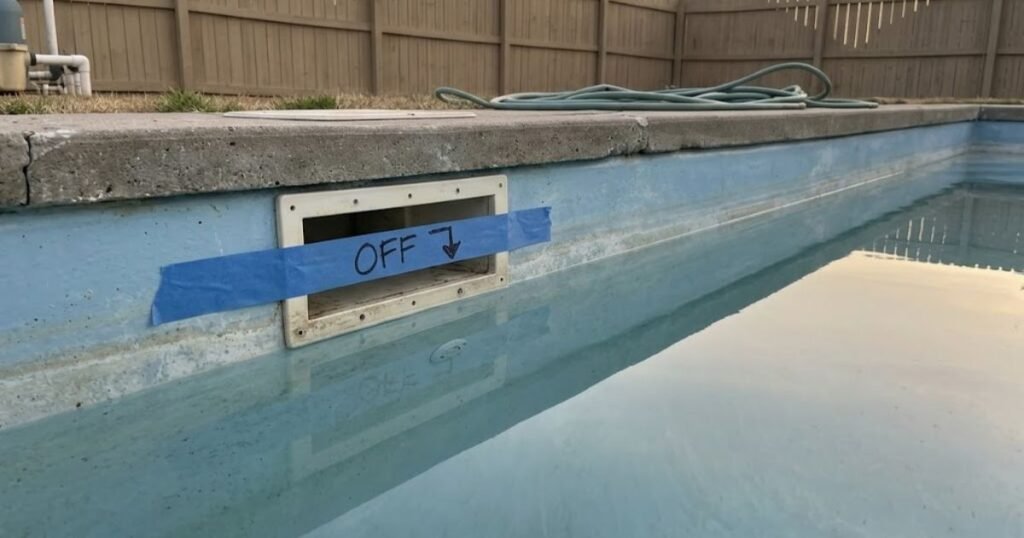
Autofill valve: A faulty autofill valve can top off the pool while a real leak goes undetected. Turn it off 48 hours before running the bucket test.
The Pump On vs Pump Off Overnight Test
Run this test only after the bucket test confirms a leak. It tells you where in the system the leak sits.
Turn off the pump completely. Mark the water level. Check after 8 hours. Then run the pump normally and mark the level again after another 8 hours.
More loss with pump ON: Pressure-side leak — return lines or equipment connections. The pump forces water out through the leak point.
More loss with pump OFF: Suction-side leak — main drain or the pool shell draining passively.
Same loss either way: Shell, skimmer throat, or waterline crack operating independently of pump status.
This narrows the search area before a professional arrives. LeakTronics acoustic equipment then pinpoints the exact location without pressure testing every line.
What Happens to Pool Chemistry When Water Level Drops
Every time you top off with fresh water, you dilute existing chemistry and introduce whatever pH and minerals the source water carries. Total alkalinity drops fastest with repeated refills. Check our pool alkalinity levels chart to see how far your numbers drift, and use the pool water testing guide to track changes accurately. If your pH keeps bouncing up after each refill, read our guide on why pool pH rises back after adding acid — high-pH municipal fill water is usually the cause.
DIY Fix vs Call a Professional
Quick note: not every pool leak requires a $400 service call.
Fix yourself if:
- The leak is at a visible equipment connection (tighten fittings, replace a union O-ring)
- A vinyl liner has a small pinhole away from seams (underwater patch kits work well)
- The skimmer shows a hairline surface crack you can access (two-part epoxy putty on a dry surface)
Call a professional if:
- Bucket test confirmed a leak but you cannot find it visually
- Pump on vs pump off test points to underground plumbing
- Water loss exceeds 1 inch per day consistently
- The pool shell shows structural cracking
Professional acoustic leak detection typically runs $150 to $400 for a diagnostic visit. Anderson Leak Detection and similar certified services use LeakTronics equipment to listen for water movement through cracked pipes without excavation.
Frequently Asked Questions
Why is my pool water level dropping faster than usual this week? Hot weather, wind, and low humidity spike evaporation. A heat wave can push loss past 1 inch in 3 days with no leak. Run the bucket test before assuming anything.
How do I know if my pool is leaking or just evaporating? Do the 24-hour bucket test. Mark a bucket on a pool step, run the pump normally for 24 hours. If the pool drops more than the bucket, you have a leak. If they match, it is evaporation.
Should I keep refilling my pool while looking for a leak? Yes. Track how much water you add and how often. Do not let the level drop below the skimmer mouth or you risk running the pump dry.
Why does my pool lose more water when the pump is running? Pressure-side leak. The pump forces water through return lines and fittings at pressure, which pushes more water out through the leak point.
PoolProGuide Tip: What We See Most Often
After covering hundreds of pool diagnostic situations at poolproguide.com, one pattern repeats: pool owners run the bucket test wrong and get a false result.
Two mistakes cause this almost every time. Leaving the autofill valve on, which tops off the pool but not the bucket and makes the pool appear fine when it isn’t. And placing the bucket on the deck instead of a step, so the bucket evaporates faster than the pool surface and skews the result.
Turn off the autofill. Put the bucket on a step in the water. Those two fixes alone give you a clean reading.
Some sources say 12 hours, others 48. Our read is 24 hours on the pump’s normal schedule.
Conclusion
A dropping pool water level is either normal evaporation or a leak. The 24-hour bucket test tells you which one within a day. Most summer water loss is evaporation. Loss overnight, in mild weather, or beyond 1/2 inch per day points to a leak.
If the bucket test confirms a leak, run the pump on vs pump off test to narrow the location before spending money on detection. Fix visible equipment leaks yourself. Call a certified specialist when the source is underground or structural.
Every refill drifts your chemistry. Fix the loss at the source rather than chasing pH and alkalinity corrections indefinitely. For more pool troubleshooting guides, visit poolproguide.com.