
Open your pool when water temperature consistently reaches 60°F. Inspect equipment first, fill to the correct level, run the filter, then add chemicals in the right order — alkalinity first, pH second, shock last. Most pools are swim-ready within 3 to 7 days.
Opening a pool for the first time each season is where most maintenance mistakes happen. Pool owners pull off the cover, add whatever chemicals are in the garage, and wonder why the water is still green three days later.
The problem is almost always the order, wrong chemical sequence, skipped equipment check, or shock added before pH is balanced. This guide fixes all of that.
How to open a pool for the season means more than removing a cover. It is a chronological process: inspect the equipment, fill the water, run the filter, balance chemistry in the correct order, and shock only after the other parameters are correct. Skip a step or reverse the sequence and you waste chemicals and time.
How to Open a Pool for the Season
Before You Start: Equipment Inspection Checklist
Work through this list before you touch the cover or add a single chemical:
- Pump: Inspect the lid O-ring, replace it if stiff, cracked, or flat. A bad O-ring causes air leaks that prevent priming.
- Filter: For sand filters, check the multiport valve gasket. For cartridge filters, inspect for tears or collapsed pleats and replace if needed. For DE filters, check the grids.
- Heater: Check the combustion chamber for animal nesting, which is common after winter. Inspect burner tray connections before firing it up.
- Skimmer: Check the skimmer body for cracks. Inspect the weir door, a stuck weir is one of the most overlooked causes of poor circulation.
- Returns, plumbing, and valves: Inspect eyeball fittings for cracks. Check PVC union connections for freeze damage. Turn each valve through its full range, any valve grinding needs attention before the pump starts.
Replace any O-rings you are unsure about. A full O-ring kit costs $10 to $25 and prevents a pump air leak that ruins your first week.
Step 1: Remove and Clean the Winter Cover
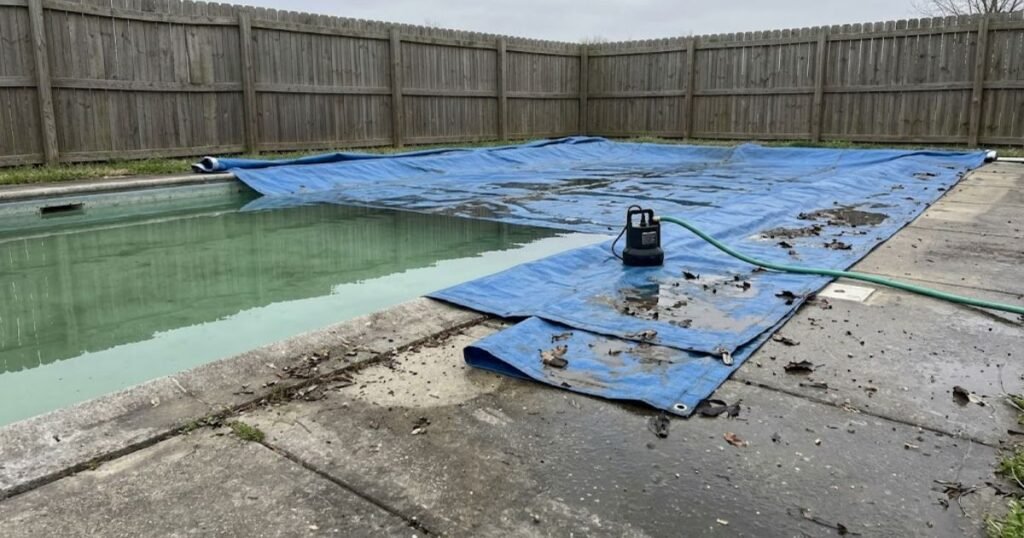
Pump off standing water from the top of the cover before removing it. Water on top of a pool cover weighs hundreds of pounds and will dump directly into the pool when you pull the cover, dragging debris and bacteria in with it.
Use a submersible pump or a cover pump to remove standing water first. Then remove any water bags or cover anchors. Slide the cover off to one side with at least one other person, a wet pool cover is heavier than it looks and tears easily when dragged alone.
Lay the cover flat, rinse with a garden hose, let it dry fully, then fold and store it. A clean dry cover lasts 8 to 12 years. A cover folded wet develops mildew within 2 to 3 seasons.
Remove any ice compensators, air pillows, or expansion plugs from returns and skimmers before moving on.
Step 2: Reinstall Equipment
Reconnect all equipment removed for winter: unions on pump and filter, drain plugs in pump, filter and heater, return jet eyeballs, skimmer baskets, and any timer wiring.
For above-ground pools, also reinstall ladders, steps, and hoses connecting the pump and filter.
Do not start the pump yet. Fill to the correct level first or you risk running the pump dry.
Step 3: Fill Water to the Correct Level
The correct level for most pools is the middle of the skimmer opening. Below that, the pump draws air. Above it, the skimmer loses suction.
If you are adding more than 6 inches of water, test the source water for pH and calcium hardness first, municipal water varies significantly by city. Loss of more than 4 inches in a covered pool may indicate a leak. Read our guide on pool water level dropping if the level is significantly low.
Step 4: Run the Filter and Check for Problems
Prime the pump if needed, then start the system. Watch for the first 30 minutes:
- Air bubbles from return jets for more than 5 minutes (suction-side air leak)
- Water dripping from any union or fitting
- Unusual pump noise, cavitation, grinding, or whining
- Multiport valve leaking from the backwash port on filter setting
If the pump loses prime within 2 minutes, check the lid O-ring, unions, and skimmer basket first.
Backwash sand or DE filters before opening. Cartridge filters should be cleaned or replaced. Run the filter 6 to 8 hours before testing chemistry.
Step 5: Test Water Chemistry In This Exact Order
Test before you add anything. Never add chemicals to untested water.
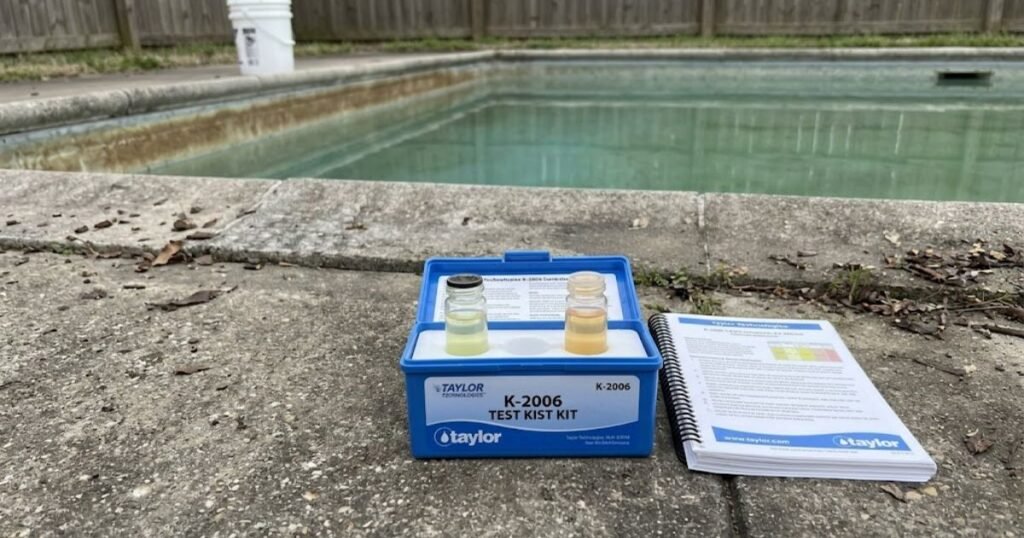
Use the Taylor Technologies K-2006 test kit. Test strips are not accurate enough for opening chemistry where parameters can be far off after months of sitting.
Test in this order:
- Total alkalinity (TA) target 80 to 120 ppm
- pH target 7.2 to 7.8
- Calcium hardness (CH) target 200 to 400 ppm
- Free chlorine likely near zero at opening
- Cyanuric acid (CYA) target 30 to 50 ppm for outdoor pools
According to the Pool and Hot Tub Alliance, all five parameters should be in range before you add shock. Shocking an unbalanced pool is the primary reason opening shock does not work.
Read our guide on how to test pool water accurately if you have not used a reagent kit before.
Step 6: Add Opening Chemicals in the Right Order
Here’s the thing: the order matters more than the products. Adding shock before pH is balanced reduces chlorine effectiveness by up to 90 percent at high pH. Adding calcium hardness after shocking can cause cloudiness. Sequence determines results.
Chemical addition order at pool opening:
| Step | Chemical | Target | Why This Order |
|---|---|---|---|
| 1 | Total alkalinity increaser (sodium bicarbonate) | 80 to 120 ppm | TA buffers pH — fix it first |
| 2 | pH adjustment (muriatic acid or sodium carbonate) | 7.2 to 7.8 | pH controls chlorine effectiveness |
| 3 | Calcium hardness increaser (calcium chloride) | 200 to 400 ppm | CH affects water balance and equipment |
| 4 | Cyanuric acid / stabilizer | 30 to 50 ppm | Protects chlorine from UV degradation |
| 5 | Pool shock (calcium hypochlorite) | 10 ppm at opening | Shock last, after all other parameters are correct |
| 6 | Algaecide (optional) | Per label dose | Add after shock fully disperses (24 hours later) |
Wait at least 4 to 6 hours between adding alkalinity increaser and testing pH. Both affect each other, and testing immediately after adding TA gives a false pH reading.
For exact dosing by pool volume, use our pool alkalinity levels chart and muriatic acid calculator. If pH is high at opening, read our guide on pool pH too high or too low. For CYA basics, see our explainer on what cyanuric acid does in a pool.
Step 7: Shock the Pool
Shock at opening is not optional. Free chlorine has been near zero for months and organic contamination from winter debris and algae spores needs a high-dose treatment to clear.
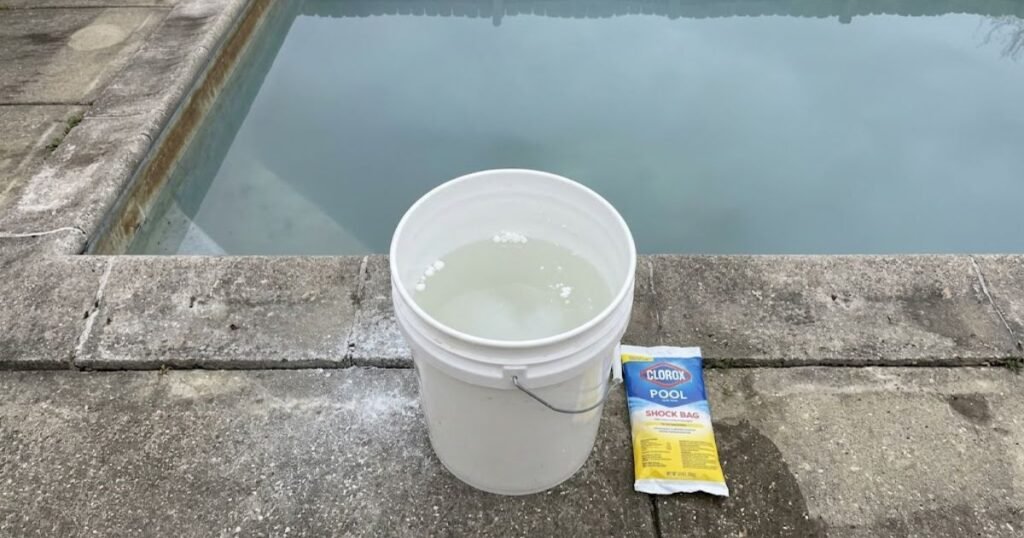
Shock to 10 ppm at opening, not the standard maintenance dose of 3 to 5 ppm. This is called superchlorination, it kills spores that aren’t yet visible and gives the pool a clean chemical baseline.
To shock a pool at opening:
- Balance alkalinity and pH first.
- Calculate the shock dose for your pool volume from the label.
- Pre-dissolve calcium hypochlorite in a bucket of pool water before adding, never add granular shock directly.
- Add the solution around the pool perimeter with the pump running.
- Run the filter for 24 hours.
- Test free chlorine before swimming, must be below 3 ppm.
For the full process, read our guide on how to shock a pool correctly. Clorox Pool and Spa Shock XtraBlue is a reliable product at the correct concentration for opening superchlorination.
According to the Pool and Hot Tub Alliance, algae growth accelerates above 60°F, so opening before sustained warm weather gives shock a better chance of holding. See our pool chlorine levels chart for target ranges at each stage.
Step 8: Run Filter 24 Hours Then Retest
Run the filter continuously for 24 hours after shocking. Do not test chlorine immediately, the reading will be artificially high.
After 24 hours, retest all five parameters. Chlorine should be dropping toward 3 to 5 ppm. pH often rises after shock, correct it again if it climbs above 7.8.
Slight cloudiness at 24 hours is normal. Run the filter another 24 to 48 hours. If still cloudy at 72 hours, a polymeric flocculant helps compact fine particles for the filter to catch.
What If Pool Is Green at Opening?
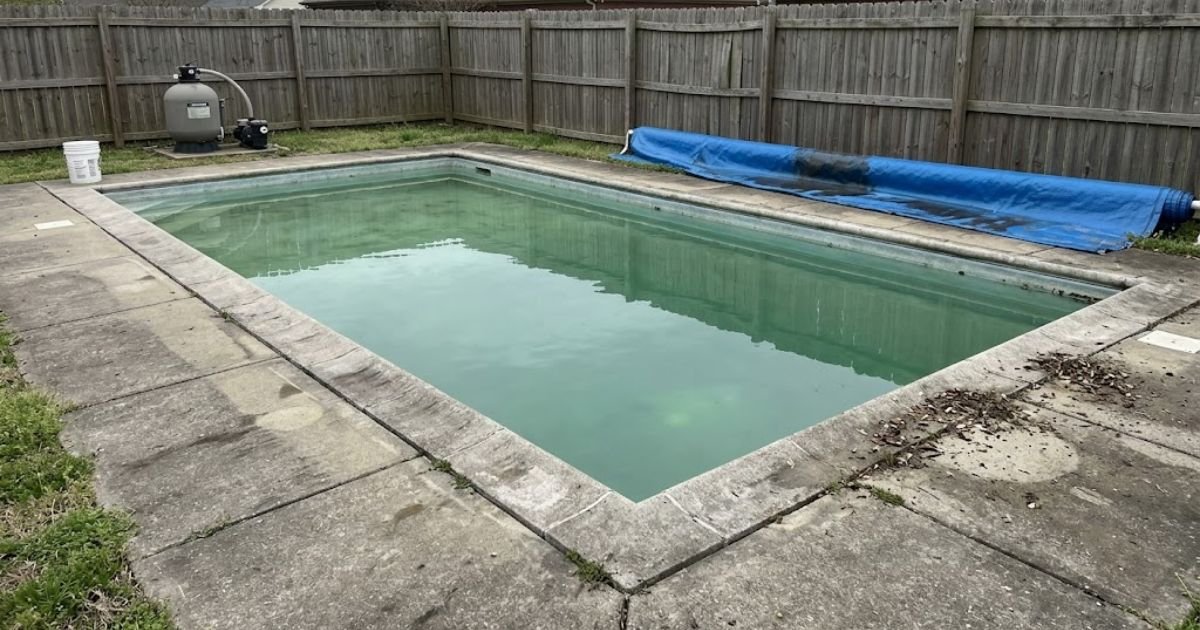
A green pool at opening means algae established during winter. Clear cover or cover that shifted, warmer fall temperatures, or insufficient pre-closing treatment are the most common causes. This is a different process from normal opening.
Look: if you lift the cover and the water is green, here’s what actually works:
- Test first. Do not shock yet. Green water usually has severely unbalanced chemistry that neutralizes shock before it can kill anything.
- Adjust alkalinity and pH to target range first.
- Shock to 20 ppm, double the standard opening dose.
- Run the filter continuously. Backwash or clean it every 6 to 8 hours as dead algae clogs media fast.
- Brush walls and floor every 12 hours to break up algae colonies.
- Retest at 48 hours. Water shifting from green to cloudy grey means the algae is dead. Continue filtering.
- Use a Dolphin Robotic Pool Cleaner or flocculant to remove dead algae from the floor.
Hometown Pools notes that black algae on concrete pools needs a steel brush and localized algaecide treatment at each spot, not just broadcast shock. Perkinson Homes highlights that opening timing before warm weather is the most effective prevention of all.
Or maybe I should say it this way: a green pool is not a failure. It’s the conditions that were right for algae before you got there. Follow the order above and it clears.
Day-by-Day Opening Timeline
| Day | Task |
|---|---|
| Day 1 AM | Remove cover, clean and store. Inspect equipment. Reinstall plugs and hardware. Fill to mid-skimmer. |
| Day 1 PM | Start pump and filter. Run 6 to 8 hours. Watch for leaks and air. |
| Day 2 AM | Test all chemistry. Adjust TA to 80 to 120 ppm. Wait 4 hours. |
| Day 2 PM | Retest pH. Adjust if needed. Add calcium hardness increaser if CH is low. |
| Day 3 AM | Add CYA if below 30 ppm. Run filter continuously. |
| Day 3 PM | Shock to 10 ppm. Pre-dissolve in bucket. Add at perimeter with pump on. |
| Day 4 | Run filter 24 hours. Do not test chlorine yet. Brush walls and floor. |
| Day 5 | Retest all five parameters. Correct pH if above 7.8. Add algaecide 24 hours after shock if desired. |
| Day 6 | Retest chlorine. If below 3 ppm, pool is approaching swim-ready. |
| Day 7 | Final test. Chlorine 1 to 3 ppm and pH 7.2 to 7.8 means the pool is safe to swim. |
When Is It Safe to Swim After Opening?
Two conditions must both be true before anyone enters the water.
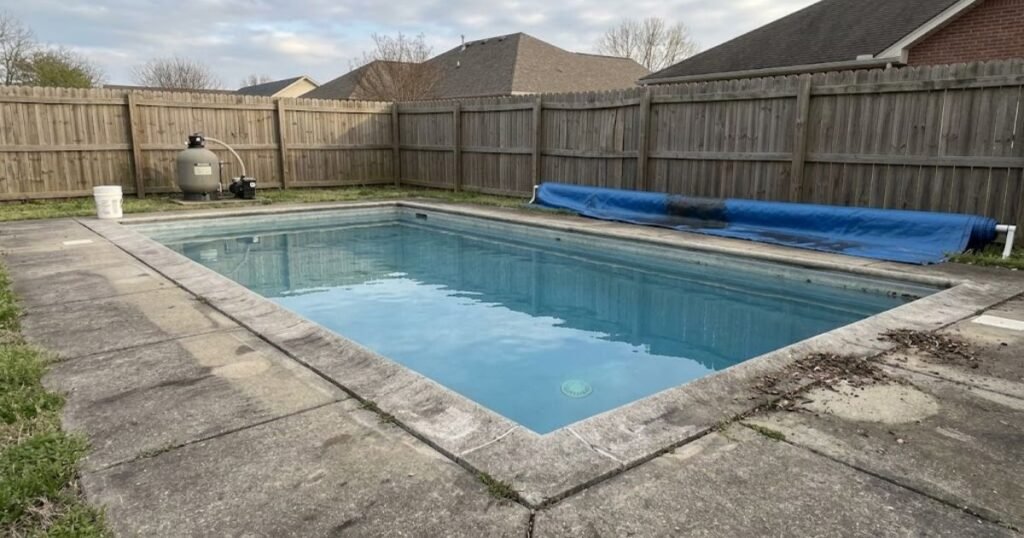
Free chlorine must be at or below 3 ppm. Above 3 ppm causes eye and skin irritation. Above 10 ppm, right after shocking, the water should not be swum in.
pH must be between 7.2 and 7.8. Outside that range, chlorine loses effectiveness and water becomes uncomfortable.
Quick note: some pools with clear, balanced water are swim-ready by Day 4 or 5. The 7-day timeline is the safe standard, not a hard rule. Bookmark our pool chlorine levels chart for ongoing targets.
Frequently Asked Questions
When should I open my pool for the season?
Open when water temperature consistently stays above 60°F, typically late March to early May. Opening before temperatures hit 60°F limits algae growth before you even add chemicals.
How long after opening a pool can you swim?
Most pools are swim-ready in 3 to 7 days. The requirement is free chlorine at 1 to 3 ppm and pH between 7.2 and 7.8. Test before swimming, not by the calendar.
What order should I add pool opening chemicals?
Alkalinity first, then pH, then calcium hardness, then cyanuric acid, then shock last. Adding shock before correcting pH reduces its effectiveness by up to 90 percent at pH above 7.8.
Why is my pool green after opening?
Algae grew during winter, usually from a shifted cover, warm late-fall water, or weak pre-closing treatment. Double-dose shock to 20 ppm, run the filter continuously, and brush every 12 hours.
Do I need to add stabilizer when opening a pool?
Yes, if CYA is below 30 ppm. Outdoor pools without stabilizer lose chlorine to UV within hours on a sunny day. Test at opening and add cyanuric acid to reach 30 to 50 ppm.
PoolProGuide Tip: The Mistake That Costs the Most Time
After covering hundreds of pool opening situations at poolproguide.com, one mistake causes more wasted days than anything else: pool owners add shock on Day 1 without testing chemistry first.
The shock dissipates within hours. pH was 8.2, alkalinity was 30 ppm. The pool looks exactly the same on Day 2. More shock. Same result.
I’ve seen conflicting advice on this, some sources say shock immediately, others say test first. Our read: test first, every time. A pool with pH at 7.4 and TA at 100 ppm holds a 10 ppm shock dose for 12 to 18 hours and actually clears the organic load. A pool with pH at 8.2 burns through that same dose in 2 to 3 hours with minimal impact.
The chemistry has to be right for the shock to work. That is the single most important point in this entire guide.
Visit poolproguide.com for more pool chemistry guides and seasonal maintenance walkthroughs.